Friends of Order and Friends of Liberty
A Letter from Minister Gallatin to his Friend in America, Mrs. Ackerson
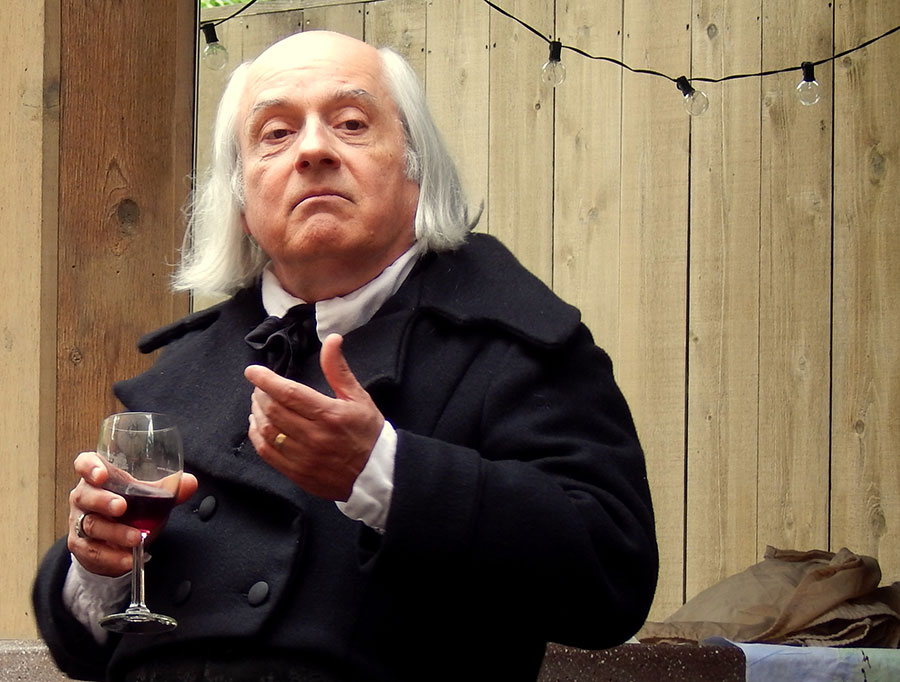
by Albert Gallatin, Minister Plenipotentiary to France (in the 21st century, Ron Duquette) on February 11, 1817, at 1:53 p.m.
My dear friend, Mrs. Ackerson, has asked me my views on the question of Order versus Liberty, and with this missive, I undertake to address her concerns and questions.
In my study of government, finances, and other matters, I have determined that, irrespective of the issue - economical, social, political - the question ultimately is addressed by this: Are you a Friend of Order, or a Friend of Liberty? This question is at the root of all our action in the public (and some would say, even in the private) arena.
Revolutions have been brought about by the conflict of these two Principles. Our own late Revolution began but has not ended this discourse. Every day we are confronted by the playing out of the debate between the two.
An examination of the two Principles is here in order. The Principle of Order (or some would say Power) is that in order for Society to be able to function properly, all must understand their place, all must understand their function, and all must be ordered so that all will function to the greater good of a political (and economical and social) Community. In order for the proper and quiet functioning of Society to occur, Order must be the essential, if not the only, Principle.
The Principle of Liberty, on the other hand, argues that no advances in Society are possible unless the Individual is allowed the freedom to act as he will; that, unless the creative Effort is permitted its fullest range, Society would otherwise stagnate, corrupt, and die. In order for the greatest creative allowance to be possible, the greatest Liberty must occur. Without Liberty, Life is worth nothing.
My good friend Mr. Jefferson in his great statement of the political Philosophy of our nation, stated that there were certain inalienable Rights, amongst which were Life, Liberty, and the Pursuit of Happiness. On the other hand, Mr. Locke's three main Principles were Life, Liberty, and Property. In these two statements we see expressed the debate between Liberty and Order. How so? Because in order to pursue Happiness, as in Mr. Jefferson's formulation, one must be at liberty to do so - constraint of any sort would seem to impinge severely on its exercise. In Mr. Locke's formulation, however, it is necessary for Order to prevail so that the individual may more safely accumulate Property and enjoy its results.
Nonetheless, I personally reject the absolute Nature of the dichotomy as it is expressed. And why? Because it is my observation that Order without Liberty tends to Tyranny; Liberty without Order tends to Anarchy. Neither of these end States is a fit government for any person. Let me elaborate.
Order (or Power) without Liberty tends to be frightened of innovation, of experimentation, of creative effort which may or may not lead to a firm and clear result. It does not suffer challenge; it does not permit expansion beyond the stated bounds set by the present Order. We saw this when the Roman Church attempted to impose a universal Order upon the religious Beliefs of men; but Martin Luther and others "protested" against this imposed Order, which had become grossly disordered and violated the essential Principles of the Beliefs of that Church. When Order (the Church) was challenged, and attempted to re-impose Order by accusations of Heresy and Disorder and the Penalties of Execution, it led to the fracturing of the Church - but the Liberty needed to challenge the Church's position was at the bottom essential to the addressing of the serious issues present.
To the credit of the Roman Church, the effort to clarify its beliefs in what has been termed the "Counter-Reformation" occurred only when an open debate was permitted - that is, when a degree of Liberty was introduced into their discussions. But it is safe to argue that such a degree of imposed Order by the Church was destructive of the beliefs of the individual in face of his God.
Conversely, Liberty without Order tends to be frightened of restraint, whether imposed from without or from within, as being destructive of its creativity. All is permitted, and Chaos is the consequence. We saw this in the Revolution in France.
When M. de La Fayette and his colleagues began their challenge of the established Order, their intent (and I have spoken with him on this very matter since my arrival in France as our Minister) was not to overthrow completely the Order present at that time, but to modify it, to moderate it, to create a constitutional Monarchy. They did not anticipate the destruction of the Order present at that time; they wished merely to allow more Liberty in the exercise of political matters, and in so doing, to release a degree of creativity to relieve the Burdens on the Third Estate.
However, as we have seen, revolutionaries are rarely satisfied with the present state of Revolution; someone always wishes to be more "revolutionary" than the prior revolutionary. Therefore, more Liberty must be exercised, and more Order must disappear in order to "move forward" towards yet greater Liberty - which encourages those unsatisfied by the present state of affairs (the current Order) to demand yet greater Liberty - and so it continues. The consequent result? Bloodshed; utter Disorder; no one knew what was and what was not permitted; there was no structure necessary to the ordered functioning of Society.
So in my first example of the Roman Church, Tyranny was the ultimate Result; in the case of the French Revolution, Anarchy. But in the first instance, an exercise of Liberty within its own walls has permitted the Roman Church, if not to recover its former Prominence, at least to become a more respected Institution of Belief - and far less likely to exercise a tyrannical Power. In the second, the imposition of Order, though taken rather too far in the case of Napoleon and his Empire, has finally readjusted itself to the present Order of a constitutional Monarchy under Louis XVIII Bourbon. In the latter, a measure of Liberty is now permitted, though it would not satisfy most Americans.
In the end, my argument is that the question "Are you a Friend of Order or a Friend of Liberty?" misses the essential point, which is that in human society there must be a fine balance between Order and Liberty. Go too far in the one direction, and a tyrannical Power will be exercised; go too far in the other, and a chaotic and ungovernable Society will result.
I hope this discussion provides some occasion for thought and discussion. I would urge you to send this privately to those parties which you feel would be most attentive to this discussion.
I am, my dear lady,
Your most humble, obedient servant,
Gallatin
(Ron Duquette)
Please note, the phrasing, punctuation and spellings in the body of the above article are consistent with English usage in 1817 rather than 2018.