
| INTRODUCTION | 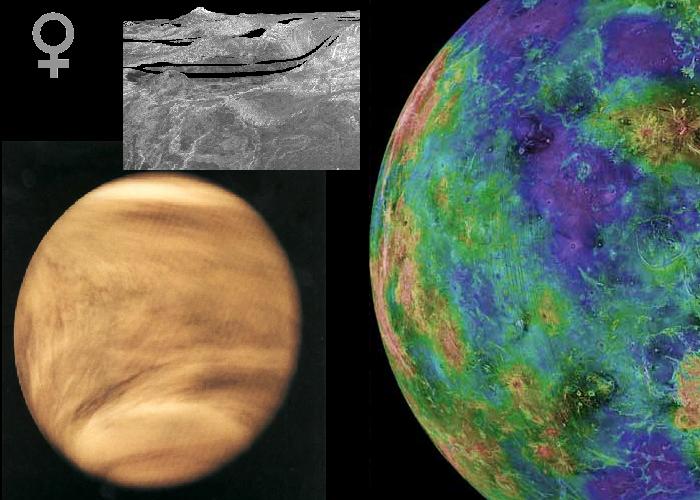 |
| MERCURY | |
| VENUS | |
| EARTH | |
| MARS | |
| JUPITER | |
| SATURN | |
| URANUS | |
| NEPTUNE | |
| PLUTO | |
| SUN |
| VENUS | |
|
Name:Venus, Aphrodite, Ishtar Position:Second Diameter:12103.6 KM Mass:4.869*1024 KG Temp. range: No. of moons: ZERO Distance from sun: 10.82*107 KM Distance from earth: 4.1*107 KM Time to rotate on axis: 8 mon. 3 days Time to orbit the sun: 7 mon. 14 days 12 hrs. 53 min. Comments: hottest planet in the solar system |
The brightest object in the sky after sun and moon, Venus, is usually visible by the naked eye. It is nearly the same size and mass of the earth. However, its day is very long that it is even longer than its year. Mariner 2 was the first spacecraft to visit venus in 1962 but then came many others like Pioneer Venus, Venera 9, Venera 7 and Magellan.
No magnetic fields exists on Venus surface due to its slow motion.
Venus structure is unique. Its atmospheric pressure is equal to 90 atmospheres. Thick carbondioxide and sulphuric acid clouds in the atmosphere traps sun heat which make it the hottest planet in the solar system that is able enough to melt lead on its surface. The surface temperature is about 467 oC. It consists of gently rolling plains with little relief covered by lava flows. The core is made of iron and is 3000 KM in radius.
With few exceptions, the surface features on Venus are named for female figures such as a crater named Cleopatra, a canyon named Diana and a plane named Guinevere.
Earth's sister, Venus, probably once had large amounts of water like earth but it all boiled away. It is now quite dry.
| HOME | FAQ | CONTACT ME | WEBMASTER | GALLERY |