
| INTRODUCTION | 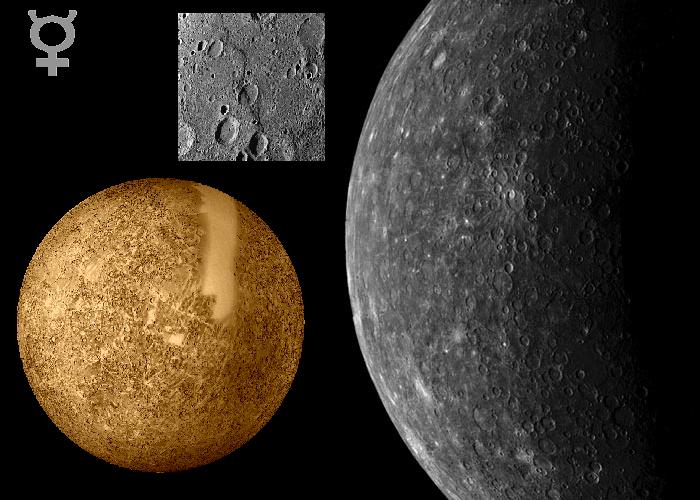 |
| MERCURY | |
| VENUS | |
| EARTH | |
| MARS | |
| JUPITER | |
| SATURN | |
| URANUS | |
| NEPTUNE | |
| PLUTO | |
| SUN |
| MERCURY | |
|
Name:Mercury, Apollo, Hermes Position:First Diameter:4880 KM Mass:3.30*1023 KG Temp. range:( -184 oC -> 427 oC ) No. of moons: ZERO Distance from sun: 5.791*107 KM Distance from earth: 9.11*107 KM Time to rotate on axis: 1 mon. 28 days 15 hrs. 24 min. Time to orbit the sun: 2 mon. 27 days 23 hrs. 7 min. Comments: second densest body in the solar system |
Mercury is the closest planet to the sun, where the sun appears on its surface twice as large as it does from earth. Its day is very long compared to our day where it takes 1 month, 28 days, 15 hours and 24 minutes to complete one rotation on its axis. Mercury is the eight's largest planet in the solar system. Mariner 10 is the first spacecraft that visited Mercury in 1974 and 1975 when 45% of its surface was mapped. However, the planet has been known a long time ago at the time of Sumerians.
Mercury has a very small magnetic field strength which is about 1% of earth's. The planet can be divided into three parts: the atmosphere, the crust and the core.
Mercury's atmosphere is very thin. It contains sodium vapour and helium. The crust is also thin and ranges from 500 to 600 kms but is made from silicate. The crust (surface) mainly consists of craters formed by the bombardement of meteors and comets, and consists of mountain ridges, which are a result of shockwaves and slow cooling of the planet. On the other hand, the thick core is mainly iron and ranges from 1800 to 1900 kms thick.
Caloris basin is one of the main features of mercury's surface. Its diameter is 1300 km and was formed due to a large impact.
Astonishing radar observations of mercury's north poles showed evidence of water ice in the protected shadows of some craters.
| HOME | FAQ | CONTACT ME | WEBMASTER | GALLERY |