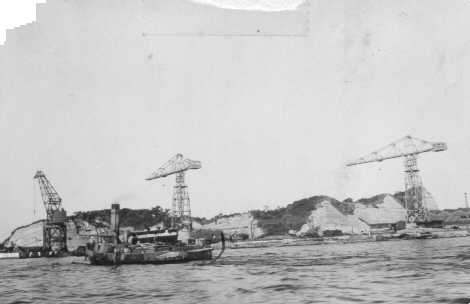
Yokosuka Navy Yard, September 1945
The following story was written by either Alexander Costa or Robert Sutton while serving on board USS LERAY WILSON during World War II. There are statements, which today would be considered prejudiced, that I have not changed. Remember, this was written during wartime by a man who had seen the death of his shipmates. Since I have already attributed the entire document to the author, I have dispensed with quotations. All spelling errors are mine. This story was graciously provided me by George and Shirley Chaisson.
Yokosuka Navy Yard,
September 1945
4 September 1945
This morning we came into Tokyo Bay. There was not much to see because the morning was dark, gray, and dreary. A gray mist or fog covered the bay obliterating just about everything except the outline of the shore and the outline of the rock hills which seem to crowd around the bay. Truly, I guess this is the end of the trail.
There were two forts passed on the way in. They have no names as far as I know but got by number. The two I saw from the bridge were numbers two and three. Number one was missed in the fog. The forts were constructed on rock formations that just protruded above the water. On the port side was fort no. 2. It was shaped like a football and was about a block long and a block wide. This is my own calculation and it may have been larger. Fort no. 2 had taken a beating. It was nothing but big chunks of concrete; fray [ed: I think that is supposed to be gray] and massive like the walls around the old Joliet, Illinois. In its better days the fort had undoubtedly looked like one of our better prisons, back in the states. The walls were reenforced concrete about 10 feet thick. The bombs seemed to have cracked the walls and thus weakened parts of the wall fell under their own weight. Other parts of the wall still stood erect. One end of the ruins seemed to be more intact than the other giving the appearance that the fort actually had been sunk by the bombings and only a part of it left above water. A Jap freighter that was tied up to a dock alongside of the fort had been sunk and only her stern was sticking out of the water.
Fort Number three was on the starboard side. This fort was shaped like the back of a turtle and had the same appearance due to the thick concrete shell that completely covered everything on this island fort. From the looks of the fort, I believe that it was an anti-aircraft battery. There were anti-aircraft guns with sand bags piled around them, and there were also several extra large search lights. There were a few buildings built into the side of the turtle back and there were a couple of big guns housed in this shell also. This fort might have been hit, but it was not messed up to any extent. If my suspicion is correct, the B-29's probably avoided this spot because of the heavy anti-aircraft batteries and it was of little military importance.
Over on a stretch of sand about 3 miles distance from Fort No. 3, rested a Jap Destroyer. She had been hit a couple of times and was beached to keep her from sinking. Yep, the B-29's had ridden the range around here.
Whether Tokyo Bay is beautiful or ugly I have yet to find out. The water seems to be full of floating debris and seems to be dirty. No Japs in small boats came out to greet us or sell us souvenirs. Too bad, for they would have enjoyed a fine business. There were a number of birds all around the bay.
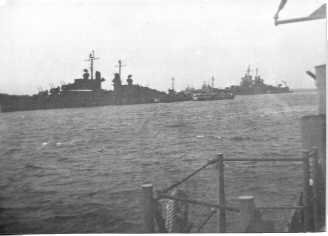
The fleet is in evidence. There are not as many ships around as I expected. I have seen ships in formation as far as the eye could see and had expected to see such a specticle in the bay. I had expected a repeat of the Armada that set out from Manus of the Admiralty Islands when we started on the first and later the second invasion of the Philippine Islands via Leyte and Lingayen Gulf. Perhaps there are a number of ships strung all the way to Tokyo, but the fog and mist is hiding everything. It must have been tough on the B-29's to bomb on a morning like this. We dropped anchor among the big boys of the fleet. The Iowa and Missouri are just off of our fantail. The South Dakota and some Cruisers are close by. A couple of carriers and a few destroyers complete the picture at the present time.
- 1 -
We are supposed to stand by and be ready to get underway in an hours notice. That is bad for it means that if some miserable detail comes up, we can be sure of getting it. So far in this war we always have.
I can't see Mt Fujiyama now, but will see it tonight. Can make out the Yokosuka Navy Yard. Her huge cranes identify her. A Jap battle cruise is tied up there. The wagon is easy to discern because of her pagoda super structure. They say she has been hit topside but is in good shape and the Navy may sail her back to the states and put her on exhibition.
When we got the word to go in, we did not have very far to go. We have been operating in these waters as part of Halsey and his roustabouts. We were with the fleet tankers and the Carriers supplying Halsey's Fleet with beans, bombs, bullets, planes, and petrol. We would rendezvous and slip them the stuff. They would go in along the coast and raise hell and we would lay off and wait for their return. We would rendezvous again in about a week and the fleet would refuel, take on supplies, ammunition, new planes, etc. and go back again. This kept up for weeks, being bold just to convince the Japs that they had better surrender as we could go any place at any time and they were helpless to prevent us from doing just as we pleased. Halsey would tell the Japs his position and tell them just what he was going to do and then do it. All the Japs could do was send out their Kamikaze squadrons. We kept on the lookout for them. They carry a 500 pound bomb and they sure can raise hell when they hit.
All this business was getting old to us and we were willing to bet our all that we could not get the Japs to surrender and we would therefore, have to storm the beaches of Japan and go all through that again. This would cost a lot of lives. Death on invasion beaches is death in the raw and death in the raw is seldom mild. Big stuff is thrown at you at close range. Mortars, bombs, rockets, grenades, land bombs, mines, etc., it blows you wide open and then ties your guts up in bloody knots; arms and legs leave the body and die all alone where they fall. Yes, the war news is good today, but a lot of fellows had to get blown to hell to make it that way.
When the first atomic bomb was dropped we began to wonder but still would have bet that the Japs would not say "uncle." It was hard to believe that we had such a weapon. We thought it was pure propaganda. The idea of splitting the atom and getting atomic power was not new but if we had such a weapon, what were we waiting for??? Why drop just one, why not five or six??? The Jap Kamikaze squadrons were still out after us. They did hit one of our destroyers and the radio said they sunk a couple of light units at Okinawa. The result of the first bomb was hard to believe. We all waited for the second and wished they would make with "bombs away" on a dozen choice spots. The second bomb got the Japs peace minded and they offered to call it quits upon the stipulation that they be allowed to keep the Emperor. To us not actually in on the "know" we were wondering who was making terms to whom. Opinion as to whether to give into the Japs on this point was divided at first; then it swayed back and forth with the line of propaganda we received on the ship's radio. We heard that the Japs got to keep their Emperor and that ended all arguments. But if you think that ended all arguments with the Japs, you're mistaken. Jap planes were still out trying to snoop us and the Kamikazes were still suiciding. We had no encounters. We stayed on war cruising and it was still "Darken Ship, all lights out below decks, the smoking lamp is out topside" when the sun began to sink and nature began to paint its daily picture of beauty -- Sunset at Sea.
Halsey had not been told to stop firing and so he was getting in a few socks at the Jap homeland. On the morning of 10 August one of our groups underwent an air attack. This was the date that the Japs were supposed to really call it quits or else. We took no chances and our planes got into the air. It was War as before, but we did not have an engagement. This was the reason that I mentioned in my correspondence that I could not see any difference between the war and the peace out here.
- 2-
Riding at anchor in Tokyo Bay with Yokohama just four foggy miles across the water, I am beginning to believe that the war is over, but we still have our gun crews standing dawn and dusk alerts.
You might think we have been lucky, and so we have. We did not go through the whole business without a scratch. The battle of Samar Sea saw the Japs chasing our little group of CVE's and DE's, but our aircraft and the fear of being trapped caused the Japs to give up and run. We chased them then but made sure that we did not catch up. Our big boys came to the rescue and spanked the Japs and sank them. We laughed about that but not for long. The other half of our group had bumped into the superior Jap forces, they gave them hell while it lasted but it did not last too long. This was the action in which the DE's made the torpedo runs on the Jap Cruisers and got blown out of the water -- no survivors. On 10 January 1945 we got our scratch. A Jap Betty two motored bomber put the suicide to us crashing midships, wiping out the four gun crews. Killed 12 men some burned to death. What a mess. That was Lingayen Gulf. We rode Suicide Lane at Okinawa for 50 straight days and the Japs couldn't hit us. They tried, day and night; other ships, as you know, were not so lucky.
There will be other days and other trails for us, I hope the trails are not as rough but I hope they all have the same Happy Ending as this one.
- 3 -
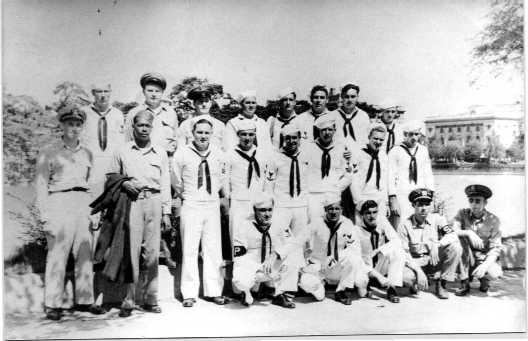
Front
row (squatting): Rdm2 Jenable, SoM2 Potter, George Chaisson,
LT(jg) Walker, LT(jg) Sutton
Second Row: LT Comdr Englander--CO, OC2c Clemmons, RM2
Montgomery, MM2 Murray, FC3 Alfonse, MM1 Burris, FC2 Schmidt,
SoM3 Walker
Back Row: MM3 Garmon, CWT Johnson, CCS Jeter, S1c Culler, PhM3
Morton, WT1 Colose, SF2 Gordon, TM2 Raiburn
On liberty, Tokyo, Japan, September/October 1945. The moat of the
Japanese Imperial Palace is on the left. General MacArthur's
headquarters building is on the right. This building is used by
Daiichi Seimei (First Insurance). They have maintained General
MacArthur's office suite as if he never left.


© 1999-2003 CigarSquid
This page hosted
by  Get your
own Free Home
Page
Get your
own Free Home
Page
Background courtesy of Oscars
Background & Texture Archive

 Sign Guestbook
 View Guestbook