Introduction
Reputed to her well-developed financial system and the
practice of free trade, Hong Kong as a metropolis in the world is a desirable place for
commercial activities. Owing to this factor, a large proportion of the population in Hong
Kong is devoted to the sector of "Financing, insurance, real estate and
business". The proportion of employment in this sector varies from one district to
another; comparisons of such difference in employment rates are significant to the further
understanding of its situation in Hong Kong.
The overall distribution
The distribution of "Financing,
insurance, real estate and business" sector in Hong Kong is concentrated on the both
sides of the Victoria Habour. Central and Western, Wai Chai, Eastern and Yau Tsim Mong
have the most people employed in this sector. Also, some districts have relatively higher
figures than that in their nearby districts.
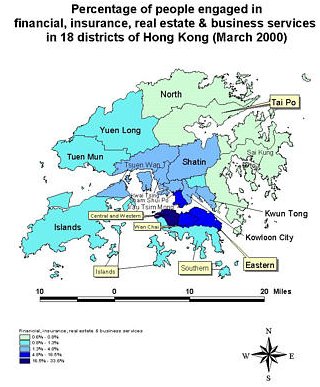
Yau Tsim Mong (49715 people employed) has more people engage in the financing sector,
while the average number of people engage is about 19768. The
other districts in Kowloon are Sham Shui Po, Kowloon City, Wong Tai Sin and Kwun Tong, the
average number of people engage in this sector is about 12199
(excluding Yau Tsim Mong), then in these 4 districts, Kwun Tong (17856 people
employed) gets a relative higher figure.
The figures show that there are more people engage in Kwai Tsing (11127
people employed), Sha Tin (10499 people employed) and Tsuen Wan (10477 people employed)
while the average number of people engage is about 5982. For
the other 6 districts, the range of the figures is between 2318 (Sai Kung) and 4863 (Yuen
Long), the small figures show that the districts do not focus on this commercial industry
as well as that in the urban areas (Kowloon and Hong Kong Island).
Central and Western (145904 people employed), Wan Chai (67630 people
employed) and Eastern (44084 people employed) have the larger proportions of employment in
this sector, and the average number of people engage is about 65609.
Although the average figure is larger than that in Eastern, however, Southern has a
relative very low figure (only 4817 people employed); it reflects the concentracted
employment of this sector in Central and Western, Wan Chai and Eastern.
[TABLE
& GRAPH][MAP]
Explanation
The main reason of the distribution of the
commercial industry in Hong Kong is the mobility of the
people.
Usually, the Hong Kong people will stay in
some particular districts (including culture value, habitual actions and inertia) for many
different purposes, including living, having meals, shopping, working and studying.
Because these districts are the transport foci of the main transportation routes, the high accessibility would boost the commercial industry.
Therefore, the people engage in this sector even the land rent is much more higher.
Yau Tsim
Mong and Central
are the CBDs in Hong Kong, shops, plazas, companies, offices, head offices and regional
head quarters can be found, it is normal for them to have a high figures in commercial
industry because the commercial and financial activities in these districts are extremely
active. Kwun Tong, Wan Chai and Eastern
are the early-developed areas in Hong Kong since few decades before; while Sha Tin and Tsuen Wan
are the earliest "New Towns" developed by the Hong Kong government since 1970s.
Therefore, there are many people living in these districts and create the high population and the high density, the limited
spaces (especially in Causeway Bay in the district Wai Chai) in the
districts therefore boost the value of real estates, business activities are also
increased.
The significance of the employment statistics
"Statistical significance" refers to the
confidence one can have that statistics computed from a random sample accurately describe
the population from which that sample was drawn. The statistics in this webpage are based
on the employment population of the particular sector, not a random sample. Consequently,
the statistics reported here directly describe the characteristics of that population, and
thereby avoid the additional uncertainty of making inferences to a larger population based
on data from a randomly drawn sample.
Useful Links
1. The Securities and Futures Commission of Hong Kong
2. Hong Kong SAR Government offical website
3. Hong Kong industry Internet
4. ESD Services Limited
5. tdctrade.com