

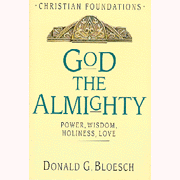
by Donald Bloesch



Bloesch starts out by sketching some of the major alternatives for understanding God present in theology today, briefly outlining and rejecting pantheism, panentheism, deism, agnosticism, classical theism and dualism. As very quickly becomes apparent in his writing, Bloesch very deliberately strives to undertake his theological endeavors in conversation with the theological tradition. Through this dialogue, he accepts what is insightful and biblical, and rejects what is not.
As Bloesch�s understanding of God develops, we see that he views God as a living God, meaning that God is �in movement but not in development.� He rejects traditional understandings of God as static or immobile, even as he rejects pictures of God that imply becoming or developing. With regard to God�s attributes, Bloesch sees them as manifestations of God�s essence which reflect that essence. Thus, much of his constructive work is in exploring the attributes of God.
One of the important themes that develops is that of God�s freedom. With regard to necessity, this means that God does nothing out of necessity, except what is necessitated by God�s love. God freely decides to create, and maintains freedom with regard to that creation. God is genuinely moved by creatures, but this is only as he is moved by his �free power.� Thus, Bloesch puts forth a corrective of the classical notion of impassibility, but does so with a strong emphasis on God�s sovereignty, an emphasis that pervades much of his work. This creates a tension or mystery that reappears frequently throughout the book, for Bloesch simultaneously includes God�s sovereignty, and genuine human agency. God is not seen as the direct cause of all things, even though all things are under His sovereign will. This mystery is seen, for instance, with regard to grace and freedom, where Bloesch asserts, �The mystery of Christian salvation is that God does all�but in and through human effort. �The paradox is that God does all and we do all, but our efforts are entirely dependent on God working in and through us (Phil. 2:12-13).�
Bloesch looks at the problem of evil, as one that confronts theology, and his answers are informative as to his understandings of God and theology. After looking at the historically prominent answers to the existence of evil, Bloesch asserts that the Bible contains a moral but not metaphysical dualism. In looking at God�s relation to this evil that is present, he asserts, �God allows evil to happen for purposes that elude human comprehension, but he does not create moral evil.� Bloesch relates his own theodicy most closely to that of Luther, which centers around the rebellion of the devil. �The devil is always God�s devil in Luther�s theology while at the same time being God�s foremost adversary.� Humans, of course, are caught up in this as well, for we have become willing accomplices in evil. Thus, just as in the rest of his theology, Bloesch affirms both the sovereignty of God and the genuine freedom of humans (and angels) again in his theodicy. He concludes, finally, with the assertion that although we do not have a satisfying explanation for the problem of evil, theology does �point to a spiritual solution,� Jesus Christ.
Holiness and love constitute what Bloesch considers the �two sides of God.� They are God�s inner nature, and exist both in unity, and in tension. God is both loving in his holiness and holy in his love. Neither exists of itself. Bloesch also works to define these two terms, contrasting divine love with human love, and noting the difference between agape and eros, as well as critiquing the equating of love with compassion. He likewise concentrates on the holiness of God, discussing its relation to justice. He draws a parallel between holiness/justice and law/gospel, asserting that they contain similar polarities of relationship. Bloesch then gives attention to the �mystery of the Trinity.� He lays out the biblical foundation for the doctrine, noting with Barth that although the doctrine is not explicitly found in the Bible, it is �the immediate implication of the fact, form and content� of the Bible. He also carries out a sustained dialogue with traditional understandings of the Trinity, looking both at historical and contemporary models. In his own restatement, he asserts that God is one supreme being in a �composite unity,� who can be understood as being one God in three persons, or one person in three modes of being, depending on the definition of the term �person.� He rightly acknowledges that �person� carries with it a very independent connotation in today�s language, which can prove problematic in Trinitarian formulations. Bloesch affirms a Trinity of ontological equality between persons, and a relation of interdependence, while acknowledging the �existential priority� of the father and the voluntary subordination of Son and Spirit in God�s relation to the world.
The final two chapters in God the Almighty deal with what Bloesch terms the biblical-classical synthesis and the biblical-modern synthesis. He first analyzes the influence that Hellenistic philosophy and culture came to have over theology, contrasting understandings of being, reality, truth and God. Although Hellenistic categories did provide helpful tools for probing the nature of God, Bloesch asserts that uncritical acceptance of Hellenistic understandings of God and the world caused a static understanding of God and a �fate�-ful understanding of human existence to emerge. He likewise critiques the biblical-modern synthesis, focusing especially on process theology, as the embodiment of theology which embraces modern re-understandings of the world and of God. Whereas classically God was understood in static terms, now �becoming� has emerged as a key category, replacing static with dynamic. This new synthesis focuses on God as learning, changing, suffering, developing and emerging. While Bloesch recognizes the value of many of these understandings, he advocates a careful and critical appropriation of them. An illustration of this is his understanding of �open-view theism.�
Bloesch dedicates an appendix to an appraisal and critique of open-view theism, as a form of the biblical-modern synthesis undertaken by evangelical theologians. He very forthrightly agrees with many of their critiques of classical theism, but also undercuts a number of their own conclusions as well. He asserts that in their emphasis on prayer, they are also careful to preserve human freedom, and in Bloesch�s view, they do this at the cost of divine sovereignty. God is reduced to one who assists and guides. Bloesch also asserts that in reacting against classical theism�s understanding of God who allows no human freedom but works everything through divine causation, open-view theists make the opposite error of elevating freedom above God�s power. He instead advocates a paradoxical understanding of human freedom and divine sovereignty that does not alleviate the tension between the two. He asserts, �God rules not by deterministic decree but by working in, through and some times over and against human decisions to bring about a world in keeping with his purposes.�
Bloesch�s presentation of the doctrine of God truly is a force to be reckoned with. His writing is extremely clear, and he interacts very deliberately with the major voices throughout history. He also interacts in a very intimate fashion with the Bible, as the authoritative norm for theology. I have found his analysis to be very insightful, and his presentation of God to be balanced, and very biblical.
Bloesch very deliberately seeks to be a theologian who maintains tension and paradox in his understandings of God. He rejects both synergistic and monergistic understandings of God�s interaction with humans, also rejecting determinism and indeterminism. Instead, he affirms both divine sovereignty and human freedom and responsibility. I believe that this approach to understanding God is in fact a necessary one, because I believe it mirrors the way God is portrayed in the Biblical witness. This paradox is seen with regard to freedom and grace, as well as in relation to the existence of sin in the world.
Bloesch is always careful to maintain the freedom and sovereignty of God. This provides a major theme in his theology. It is reflected in his critique of open-view theism, as he asserts that even as God has made himself �open� to the world, he does so by choice, and he is free not to be open as well.
One criticism I have of Bloesch�s theology is with regard to gender. Over all, his statements on gender prove to be very helpful, as he asserts the personal nature of God, who does not have gender, but at the same time encompasses gender. Bloesch acknowledges the validity of both masculine and feminine metaphors for God, but then makes a problematic statement, saying, �the masculine is always dominant.� I agree completely that God as �Father� is an essential controlling metaphor, and cannot be simply replaced with �Mother� because it suits our fancy. There is at least some sense in which this particular metaphor, which holds masculine connotations, is central. Yet, I do not believe we can fairly say that masculine is always dominant, unless we want to say that God has masc uline characteristics, which are higher and better than the weaker and less important feminine characteristics.
One of the characteristics which sets Bloesch�s God the Almighty apart from most other theology books I have picked up is the deep and vibrant devotion which permeates its pages. In his discussion of Trinity, for example, Bloesch relates this at times seemingly abstract doctrine to spirituality, fleshing out the profound implications of understanding God as Trinity for Christian life, worship and prayer. Throughout this book, it is clear that Bloesch understands theology as more than an academic discipline, but as something that is of the utmost importance, with deep implications for life, and for our relationship with God. He concentrates on a number of occasions on prayer, and how we understand God as a God who invites prayer, and he deepens the readers understanding of prayer through his theology, as he notes the place of silence, as well as the place of worship and petition in relation to a holy, loving and eminently personal God. Bloesch�s passion for God is clearly reflected in his writing, and even as his theology inspires understanding, his passion serves to enliven that understanding with relationship to God.

Boyd, Greg and Paul Eddy Across the Spectrum
Grenz, Stanley Renewing the Center
Kaufman, Gordon In the beginning . . . Creativity
Kierkegaard, Soren For Self-Examination
Kierkegaard, Soren Practice in Christianity
McGrath, Alister Scientific Theology, vol. 1, Nature
McGrath, Alister Scientific Theology, vol. 2, Reality
McGrath, Alister Scientific Theology, vol. 3, Theory
Padgett, Alan Science and the Study of God
Pinnock, Clark Most Moved Mover & The Openness of God
Vanhoozer, Kevin First Theology
Science & Theology
Soren Kierkegaard