


By using Eq. (3.12), we can, in principle, evaluate the scattered intensities by measuring the field on a given plane. The above described microscopy techniques allow the determination of some functions of the electric field. Now, we assume that the scattered electric field is generated by a thin sample. From Eq. (3.19), we derive a property of the electric field:
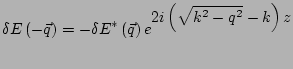 |
(3.43) |
For shadowgraph, we use Eq. (3.22),
in order to evaluate the power spectrum  of
of
 :
:
![$\displaystyle S_i\left(\vec{q}\right) =\frac{4}{I_0} \sin^2\left[\left(k-\sqrt{k^2-q^2}\right)z\right] S_E\left(\vec{q}\right)$](img169.png) |
(3.44) |
 : the oscillations
of the transfer function are smeared, but it could be hard to know
quantitatively how much.
: the oscillations
of the transfer function are smeared, but it could be hard to know
quantitatively how much.
For phase contrast, we use Eq. (3.25),
in order to evaluate the power spectrum of
:
![$\displaystyle S_i\left(\vec{q}\right) =\frac{4}{I_0} \cos^2\left[\left(k-\sqrt{k^2-q^2}\right)z\right] S_E\left(\vec{q}\right)$](img171.png) |
(3.46) |
![$\displaystyle S_i\left(q\right) =\frac{4}{I_0} \cos^2\left[\left(k-\sqrt{k^2-q^2}\right)z\right] I\left(Q\left(q\right)\right)$](img172.png) |
(3.47) |
 : it's an ideal technique for thin samples.
Dark field doesn't allow to recover any information about the phase of the field. It is not suited to make scattered intensity measurements; a statistical approach, described in the following sections, will give interesting results.
We will describe in Section 3.11 the application of Schlieren technique to the measurement of the scattered intensity.
![$\displaystyle S_i\left(q\right) =\frac{4}{I_0} \sin^2\left[\left(k-\sqrt{k^2-q^2}\right)z\right] I\left[Q\left(q\right)\right]$](img170.png)