Let us consider a thin sample, with a non homogeneous refraction
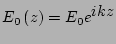
index, and a light plane wave, moving in the direction of the  axis. For
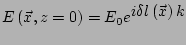
  , at the surface of the sample, the field will be:
 is the difference between the
light path, the integral of the refraction index along , for a
given point
is the difference between the
light path, the integral of the refraction index along , for a
given point  , and its mean value over the whole sample. If
 is small compared to the light wavelength, we can consider
a first order developement:
is small compared to the light wavelength, we can consider
a first order developement:
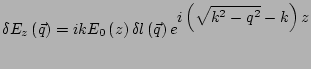
Using Eq. (3.5) we can find the field for
every value of :
 |
(3.20) |
![$\displaystyle E\left(\vec{x},z=0\right) = E_0 \left[ 1 + i \delta l \left(\vec{x}\right) k\right]$](img123.png)