Microscopy, in its basic form, consists in forming an image of a plane on a device which measures light intensity, such as a photographic film or a CCD sensor. Generally it is used to obtain informations about the intensity of the transmitted light, for example, in the case of an organic tissue, treated by some dye.
If a microscope objective forms the image of a plane on the CCD,
the image is given by the interference of the transmitted and
the scattered beams.
For such an image, the signal can be defined as the difference of the
measured intensity
 and the transmitted beam
intensity
and the transmitted beam
intensity  , divided by . We will call this signal
 ,
for reasons that will be clear later.
We consider the case in which the scattered beams are much less intense than
the transmitted one. At the first order in
,
for reasons that will be clear later.
We consider the case in which the scattered beams are much less intense than
the transmitted one. At the first order in  , the signal is:
 has been considered real, so that
 .
.
For  , that is, if the thin sample is in the focal plane,
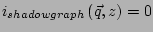 .
The intensity is completely uniform, and bears no informations on the sample.
.
The intensity is completely uniform, and bears no informations on the sample.
Many techniques has been developed in order to make phase modulations
evident: among them, holography and interferometry. A well known way to make
phase modulations evident is
the phase contrast microscopy. Basically, this technique consists in
changing the phase of the transmitted beam by  .
At the first order in :
.
At the first order in :
![$\displaystyle i_{phase\,contrast}\left(\vec{x}\right)=\frac{I\left(\vec{x}\right)-I_0}{I_0}= \frac{2}{I_0}\Im\left[E_0^* \delta E\left(\vec{x}\right)\right]$](img137.png) |
(3.24) |
, that is, with the sample in the focal plane:
 |
(3.27) |
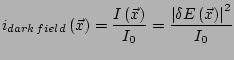
Another way to make phase modulations evident is the so called dark
field technique. It consists in stopping the transmitted
beam. This is accomplished by focusing the transmitted and the scattered beams
by a lens, and by removing the transmitted beam by some kind of reflecting or
absorbing object. This is an homodyne technique; the signal must be defined
as the ratio between the measured intensity
and the intensity of the transmited beam . Since we have only :
, gives:
The Schlieren technique consists in focusing the beams from the sample
by a lens; in the focal plane, a blade stops half of the transmitted beam,
along with the beams scattered in one half plane.
At the first order in , the signal is again, like in shadowgraph:
![$\displaystyle i_{Schlieren}\left(\vec{x}\right)= \frac{I\left(\vec{x}\right)-\t...
...{\tilde{I}_0}\Re\left[\tilde{E}_0 \delta \tilde{E}^*\left(\vec{x}\right)\right]$](img144.png) |
(3.31) |
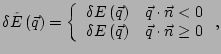
 is the scattered field, without
one half plane in Fourier space:
is the scattered field, without
one half plane in Fourier space:
 is the vector ortogonal to the direction of the blade,
 and
and
 are the intensity and the field of the trasmitted beam, after the
blade.
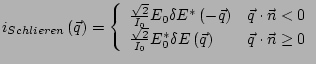
The Fourier transform is:
are the intensity and the field of the trasmitted beam, after the
blade.
The Fourier transform is:
![$\displaystyle i_{Schlieren}\left(\vec{q}\right)= \frac{\sqrt{2}}{I_0}\left[E_0 ...
...e{E}^*\left(-\vec{q}\right)+ E_0^* \delta \tilde{E}\left(\vec{q}\right) \right]$](img150.png) |
(3.33) |
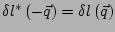
has been considered real, so that
.
For , that is, if the thin sample is in the focal plane:
 |
(3.36) |
 means that all the Fourier components of
 undergo a rotation of : a
sine-like light path modulation gives a cosine-like intensity modulation.
undergo a rotation of : a
sine-like light path modulation gives a cosine-like intensity modulation.
![$\displaystyle i_{shadowgraph}\left(\vec{x}\right)=\frac{I\left(\vec{x}\right)-I_0}{I_0}= \frac{2}{I_0}\Re\left[E_0 \delta E^*\left(\vec{x}\right)\right]$](img131.png)
![$\displaystyle i_{shadowgraph}\left(\vec{q}\right)= \frac{1}{I_0}\left[E_0 \delta E^*\left(-\vec{q}\right)+ E_0^* \delta E\left(\vec{q}\right) \right]$](img132.png)
![$\displaystyle i_{shadowgraph}\left(\vec{q},z\right)= 2k\delta l\left(\vec{q}\right) \sin\left[\left(k-\sqrt{k^2-q^2}\right)z\right]$](img133.png)
![$\displaystyle i_{phase\,contrast}\left(\vec{q}\right)= \frac{i}{I_0}\left[-E_0^* \delta E\left(-\vec{q}\right)+ E_0 \delta E^*\left(\vec{q}\right) \right]$](img138.png)
![$\displaystyle i_{phase\,contrast}\left(\vec{q},z\right)= 2k\delta l\left(\vec{q}\right) \cos\left[\left(k-\sqrt{k^2-q^2}\right)z\right]$](img139.png)