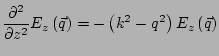
From Maxwell equations, we can derive the wave equation for a transverse component of the electric field in the vacuum [14]:
 is the Laplacian oeprator, with respect to
the horizontal coordinate
is the Laplacian oeprator, with respect to
the horizontal coordinate  . Since we are working with a
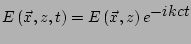
laser, and we consider only elastic scattering, the only temporal
frequency involved is
. Since we are working with a
laser, and we consider only elastic scattering, the only temporal
frequency involved is  :
:
 |
(3.2) |
 is the wave vector. Eq. (3.1) becomes:
 |
(3.3) |
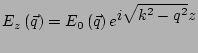
We define
 as the Fourier transform of
 with respect to :
 |
(3.6) |
The quantity
is closely related to the
intensity of the light crossing the plane
 . Each
two-dimensional Fourier mode of amplitude
,
on a given
. Each
two-dimensional Fourier mode of amplitude
,
on a given  , and wavevector
  is generated by a
three-dimensional plane wave of wavevector
is generated by a
three-dimensional plane wave of wavevector
![$ \left[q_x,q_y,k_z\right]$](img94.png) ,
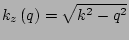
where the only value of
,
where the only value of  is obtained by imposing that the
wavevector of any plane wave has length :
is obtained by imposing that the
wavevector of any plane wave has length :
on a given  , we can evaluate
for each and , by using
Eq. (3.5) and
(3.7). Expressing it by its
three-dimensional Fourier transform:
, we can evaluate
for each and , by using
Eq. (3.5) and
(3.7). Expressing it by its
three-dimensional Fourier transform:
 of the electric field represents a plane
wave travelling in a different direction.
We define
of the electric field represents a plane
wave travelling in a different direction.
We define
 , the two-dimensional power
spectrum of
:
:
, the two-dimensional power
spectrum of
:
:
 has been expressed in terms of the
transferred wavevector
has been expressed in terms of the
transferred wavevector
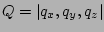
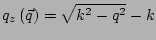
![$ \left[q_x,q_y,q_z\right]=
\left[k_x,k_y,k_z\right] - \left[0,0,k\right]$](img104.png) . From
Eq. (3.7):
. From
Eq. (3.7):
Substituting
of Eq.
(3.8) in
Eq. (3.10),
and comparing the result with Eq. (3.9),
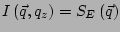
we can relate the scattered intensity
to
the power spectrum of the field
 :
:
From Eq. (3.12) we notice that
 can be measured by evaluating
on any .
can be measured by evaluating
on any .
If the sample is isotropic,
depends only on
 :
:
 and
and  :
:
 ,
Eq. (3.13) can be approximated by
,
Eq. (3.13) can be approximated by
 .
Moreover, if Rayleigh Gans approximation holds,
represents the power spectrum of the refraction index of the sample.
From these two considerations, we obtain the result that, for scattering
on small angles and under Rayleigh Gans condition, the
two dimensional correlation function of the electric field is proportional
to the correlation function of the light path through the sample.
.
Moreover, if Rayleigh Gans approximation holds,
represents the power spectrum of the refraction index of the sample.
From these two considerations, we obtain the result that, for scattering
on small angles and under Rayleigh Gans condition, the
two dimensional correlation function of the electric field is proportional
to the correlation function of the light path through the sample.
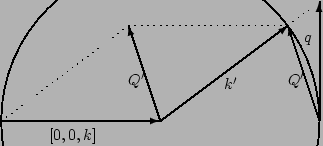 |
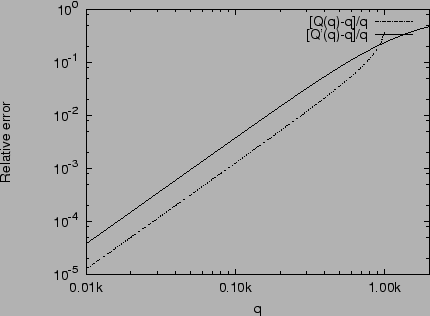
|
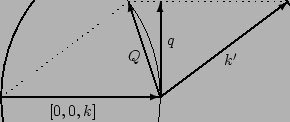
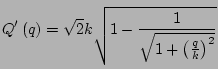
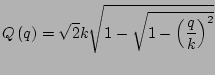
. For small values of the wave
vector, approximates  , the transferred wavevector.
The exact relation is:
, that is
, the transferred wavevector.
The exact relation is:
, that is  ,
the two
equations can be approximated with
,
the two
equations can be approximated with  ; the error
due to this approximation is shown in Fig.
3.3: it's quite small, and
it can often be neglected.
; the error
due to this approximation is shown in Fig.
3.3: it's quite small, and
it can often be neglected.
![$\displaystyle \frac{\partial^2}{\partial t^2} E\left(\vec{x},z,t\right) = c^2 \...
...\left(\vec{x},z,t\right) + \nabla_{\vec{x}}^2 E\left(\vec{x},z,t\right) \right]$](img81.png)
![$\displaystyle E\left(\vec{q},k_z\right)=2\pi E_0\left(\vec{q}\right) \delta \left[ k_z - k_z\left(q\right) \right]$](img98.png)

![$\displaystyle \left< E\left(\vec{q},k_z\right) E^*\left(\vec{q}',k_z'\right) \r...
..._z'\right) \delta \left[k_z-k_z\left(q\right) \right] I\left(\vec{q},q_z\right)$](img102.png)
![$\displaystyle I\left[Q\left(q\right)\right]=S_E\left(q\right)$](img111.png)