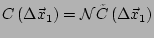
Consider a monodisperse colloid, and the near field scattered light. The
field can be decomposed into the sum of the waves coming from the different
elements of the colloid. Thus at every distance from the colloid, the field
will be given by the sum of many patterns, each randomly placed. An example
of this is given in Fig. 3.4 and
3.5. Figure 3.4 shows the pattern:
the intensity is linearily dependent on the field
 ,
which we can consider given by the wave scattered by a particle of the
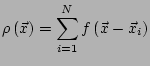
colloid. Figure 3.5 shows the sum of the patterns,
the function
,
which we can consider given by the wave scattered by a particle of the
colloid. Figure 3.5 shows the sum of the patterns,
the function
 :
:
 |
(3.48) |

 are randomly distributed in a surface of measure
  .
.
Now we will evaluate the  -point correlation functions of the sum of many
patterns,
. The results will be obteined, first,
for fixed particle density
-point correlation functions of the sum of many
patterns,
. The results will be obteined, first,
for fixed particle density
 , and
, and
 ; then
we will show that, in a suitable limit, the -point correlation
functions, for
; then
we will show that, in a suitable limit, the -point correlation
functions, for  , can be expressed in terms of two-point correlation
function, corresponding to the Wick formula. In other words, every connected
part of the correlation function developement vanishes: the field becomes
gaussian. As a matter of fact, we will prove an extension of the well known
central limit theorem.
, can be expressed in terms of two-point correlation
function, corresponding to the Wick formula. In other words, every connected
part of the correlation function developement vanishes: the field becomes
gaussian. As a matter of fact, we will prove an extension of the well known
central limit theorem.
In the following,
we will consider only functions with a vanishing average value,
the other cases being easily obtained from this one. This simplifies
the problem, since every odd--point correlation function will vanish.
The -point correlation function of
is:
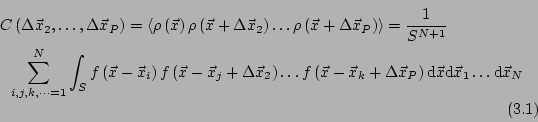
The value of the integral does not depend on all the values of the
indices
 , but only on which of them are equal; the
sum involves
, but only on which of them are equal; the
sum involves  terms, but many of them are equal. For example,
for
terms, but many of them are equal. For example,
for  , the term with
 is equal to
the one with
is equal to
the one with
 , but it is different from
the one with
, but it is different from
the one with
 . The problem is thus to determine
in how many ways we can obtain a given configuration.
. The problem is thus to determine
in how many ways we can obtain a given configuration.
The calculation can be made more easy using graphs. For
evaluating a -point correlation function, we draw
points on a graph, each one corresponding to one of the
points of the correlation function,
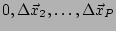 . Then,
we group the points, so that every set
contains an even number of points
3.1.
Each configuration corresponds to
many values of the indices
; the number of them
is the multiplicity of the graph. Every set corresponds
to an operation of integration on a different .
We call
. Then,
we group the points, so that every set
contains an even number of points
3.1.
Each configuration corresponds to
many values of the indices
; the number of them
is the multiplicity of the graph. Every set corresponds
to an operation of integration on a different .
We call  the number of sets; we will have only
integration variables, being the integrand independent on the
other
the number of sets; we will have only
integration variables, being the integrand independent on the
other  variables. The integration on these variables
gives a factor
variables. The integration on these variables
gives a factor  . Moreover, every integration corresponds
to the evaluation of the correlation function
. Moreover, every integration corresponds
to the evaluation of the correlation function
 of the single
pattern
:
of the single
pattern
:
 |
(3.49) |
The multiplicity of the graph depends on ; its value is
 .
For
, we can consider only the leading term
.
For
, we can consider only the leading term  .
.
We can thus describe the rules for evaluating the correlation
functions, as the sum of all the graphs. The value of every graph
is the product of the factors given by each set. The factor is
the product of
 and the correlation function ,
which correlates all the points in the set.
and the correlation function ,
which correlates all the points in the set.
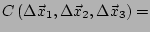
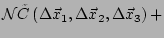
For example, we evaluate the two-point correlation function (Tab.
3.1) and the four-point correlation function
(Tab. 3.2).
For
 , the leading term in the developement of the
correlation function is the one with the higher power of
, the leading term in the developement of the
correlation function is the one with the higher power of
 : it is the one with the higher number of sets.
Since sets with an odd number of elements have a vanishing
contribution, the greatest number of sets can be obtained
only by making sets of two points. This means that only two point
correlation functions of the single pattern
: it is the one with the higher number of sets.
Since sets with an odd number of elements have a vanishing
contribution, the greatest number of sets can be obtained
only by making sets of two points. This means that only two point
correlation functions of the single pattern
 contribute to any
correlation function
contribute to any
correlation function
 of the sum.
Since
is dimensional, it is not possible to state
if it is small or great. This means that we cannot define, in
general, a value of
so great that the field becomes
gaussian. The following heuristic considerations will show that
the field is gaussian if
 , where
  is the
area of one pattern, at least if we can define it in some ways.
Consider a pattern
is the
area of one pattern, at least if we can define it in some ways.
Consider a pattern
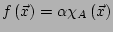 . The P-point correlation function
of the pattern
, evaluated in
. The P-point correlation function
of the pattern
, evaluated in
 , has the value
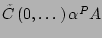 . Every graph will have
a factor
. Every graph will have
a factor  and a factor
  , where is the number
of sets in the graph. So the factor
alwais appears
multiplied by . By imposing
, we obtain that
the only contributions to the correlation function of the sum
of patterns comes from the two point correlation function
of the single pattern: all the Wick formulas are valid.
In order that
, the mean number of scattering particles
inside each area must be large: many pattern must overlap,
in each point.
, where is the number
of sets in the graph. So the factor
alwais appears
multiplied by . By imposing
, we obtain that
the only contributions to the correlation function of the sum
of patterns comes from the two point correlation function
of the single pattern: all the Wick formulas are valid.
In order that
, the mean number of scattering particles
inside each area must be large: many pattern must overlap,
in each point.
![\includegraphics[scale=0.4]{teoria_pattern.ps}](img178.png)
![\includegraphics[scale=0.4]{teoria_somma_pattern.ps}](img179.png)