


We developed this technique very recently; the device has been patented [3,4]. The setup for hEterodyne Near Field Speckles measurement is identical to ONFS one, but the beam stop is missing. The transmitted beam is not removed, and the image is due to the interference of the light scattered from the sample with the transmitted beam.
Two parameters of the system must be selected: the
distance  from the sample to the focal plane of the objective,
or from the CCD, if the objective is missing and the diameter
from the sample to the focal plane of the objective,
or from the CCD, if the objective is missing and the diameter  of the sample and of the incident beam. In ENFS,
the superficial particle density of the sample plays no role.
The parameters must be selected on the basis of the required
wavevector range
of the sample and of the incident beam. In ENFS,
the superficial particle density of the sample plays no role.
The parameters must be selected on the basis of the required
wavevector range
![$ \left[q_{min},q_{max}\right]$](img271.png) . The
ratio
. The
ratio
 cannot exceed two decades, due to the
finite size and discretization introduced by the CCD sensor.
The range
is generally selected in
order to cover interesting wavelenghts of the sample: for example,
from one tenth to ten diameters of the particles, in the case of
a monodisperse colloid. Two conditions must be fulfilled.
cannot exceed two decades, due to the
finite size and discretization introduced by the CCD sensor.
The range
is generally selected in
order to cover interesting wavelenghts of the sample: for example,
from one tenth to ten diameters of the particles, in the case of
a monodisperse colloid. Two conditions must be fulfilled.
must be selected to meet Eq.
(3.62),
in order that the correlations
 vanish. This condition is stronger than
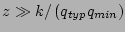 , where
 is the typical diameter of the particles.
Since
is the typical diameter of the particles.
Since
 is the side
  of the images we take,
Eq. (3.62)
implies that
of the images we take,
Eq. (3.62)
implies that
 : the diffraction pattern of
each particle covers a surface much bigger than the observed
one, as required in order that the Fourier transform of the
field can be considered gaussian.
: the diffraction pattern of
each particle covers a surface much bigger than the observed
one, as required in order that the Fourier transform of the
field can be considered gaussian.
 ; in order that
the sensor collect light scattered by that wavevector,
coming from any area of the sample, its diameter must satisfy
Eq. (3.64).
This condition ensures that the sensor cannot see the sample
boundaries: the cample can be considered as infinite. If the diameter
is much less than the one imposed by Eq.
(3.64), the speckles
are governed by the classical, Van Cittert and Zernike
theorem.
; in order that
the sensor collect light scattered by that wavevector,
coming from any area of the sample, its diameter must satisfy
Eq. (3.64).
This condition ensures that the sensor cannot see the sample
boundaries: the cample can be considered as infinite. If the diameter
is much less than the one imposed by Eq.
(3.64), the speckles
are governed by the classical, Van Cittert and Zernike
theorem.
We can notice that the conditions expressed by Eq. (3.62) and (3.64) must hold for both ONFS and ENFS. On the contrary, in ENFS no condition is imposed on the particle density, in analogy with (3.63), since the field does not need to be gaussian.
In general, Eq. (3.63) is fulfilled by the sample; in that case, the field is gaussian, and the ENFS image represents the interference of a gaussian field with a plane wave. The particle density can be so small that the field is not gaussian; this does not mean that the speckles we see represent real objects in the sample. Each speckle is due to the interference between light scattered by many different particles.
Care must be taken in order to avoid multiple scattering.
Since we want avoid
multiple scattering, the scattered intensity is small compared
to the transmitted beam intensity: the second order effects
in
 can be neglected, and Eq.
3.21 holds.
can be neglected, and Eq.
3.21 holds.
![$\displaystyle C_i\left(\Delta \vec{x}\right) = +\frac{2}{I_0} \Re C_{\delta E}\...
...left(\vec{x}\right) \delta E\left(\vec{x} + \Delta \vec{x}\right)\right>\right]$](img295.png) |
(3.68) |
correlations vanish:
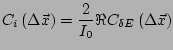 |
(3.69) |
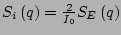 . The measurement of the intensity
allows to recover the field power spectrum.
. The measurement of the intensity
allows to recover the field power spectrum.
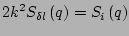
Using Eq. (3.19), we obtain, for a thin sample:
 |
(3.70) |
Under (3.64), Eq. (3.14) holds. We obtain the scattered intensity:
The results do not depend on . The misfocusing
must be sufficent, in order that the correlations
vanish, but
its value does not affect the results.
The considerations about the diameter of the sample
hold also for ENFS: Eq.
(3.62) and
(3.64) give
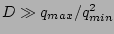 .
This problem has been discussed in Section
3.9. The result is that, in
some cases, the sample and the laser beam have to be extremely
large. In that cases, SNFS can be used instead of ENFS:
that technique will be described in Section 3.11.
.
This problem has been discussed in Section
3.9. The result is that, in
some cases, the sample and the laser beam have to be extremely
large. In that cases, SNFS can be used instead of ENFS:
that technique will be described in Section 3.11.
Equation (3.72)
must be compared with Eq.
(3.45), that
holds for values of much less than those imposed by Eq.
(3.62). The oscillations in the
sensibility of shadowgraph technique come from the non vanishing of
correlations, essentially due to the phase relation
of the beams scattered at symmetric angles by a thin sample. For
example, the zeroes of the transfer function are due to the
distructive interference of the symmetrically scattered beams. In
ENFS, the phase relation is destroied, because the light that hit the
sensor at symmetric angles comes from different regions.
![$\displaystyle I\left[Q\left(q\right)\right] = \frac{1}{2}I_0 S_i\left(q\right)$](img299.png)