


This technique has been presented very recently [1,2]. The device for the measurement of the Near Field Speckles is, basically, a misfocused dark field microscope. The transmitted beam is removed, and the image is due only to the light scattered from the sample.
Some of the parameters of the system must be selected: the
distance  from the sample to the focal plane of the objective,
or from the CCD, if the objective is missing; the diameter
from the sample to the focal plane of the objective,
or from the CCD, if the objective is missing; the diameter  of the sample and of the incident beam;
the superficial particle density of the sample.
The parameters must be selected on the basis of the required
wavevector range
of the sample and of the incident beam;
the superficial particle density of the sample.
The parameters must be selected on the basis of the required
wavevector range
![$ \left[q_{min},q_{max}\right]$](img271.png) . The
ratio
. The
ratio
 cannot exceed two decades, due to the
finite size and discretization introduced by the CCD sensor.
The range
is generally selected in
order to cover interesting wavelenghts of the sample: for example,
from one tenth to ten diameters of the particles, in the case of
the scattering from a monodisperse colloid. Three conditions must be
fulfilled.
cannot exceed two decades, due to the
finite size and discretization introduced by the CCD sensor.
The range
is generally selected in
order to cover interesting wavelenghts of the sample: for example,
from one tenth to ten diameters of the particles, in the case of
the scattering from a monodisperse colloid. Three conditions must be
fulfilled.
must be selected in order to meet the condition
expressed by Eq. (3.60),
with
 ,
in order that the correlations
,
in order that the correlations
 vanish:
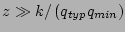 , where
 is the typical diameter of the particles.
Since
is the typical diameter of the particles.
Since
 is the side
  of the images we take,
Eq. (3.62)
implies that
of the images we take,
Eq. (3.62)
implies that
 : the diffraction pattern of
each particle covers a surface much bigger than the observed
one, as required in order that the Fourier transform of the
field can be considered gaussian.
: the diffraction pattern of
each particle covers a surface much bigger than the observed
one, as required in order that the Fourier transform of the
field can be considered gaussian.
 covered by an image:
 ; in order that
the sensor collect light scattered by that wavevector,
coming from any area of the sample, its diameter must satisfy:
; in order that
the sensor collect light scattered by that wavevector,
coming from any area of the sample, its diameter must satisfy:
Under Eq. (3.62), (3.63) and (3.64), Siegert relation holds:
 is the mean over
  and
and
 is the field correlation
function.
The intensity we measure in a point is not directly connected with any
physical part of the sample: each speckle is generate by the
superposition of many diffraction patterns.
is the field correlation
function.
The intensity we measure in a point is not directly connected with any
physical part of the sample: each speckle is generate by the
superposition of many diffraction patterns.
The measurement of the intensity
allows to recover the modulus of the field correlation function
through Eq. (3.65).
Since
is the Fourier transform of
the power spectrum, which is symmetric and real,
is also real.
Moreover, if we think
is alwais
positive, we can calculate it by extracting a square root.
Then,
we Fourier transform
,
thus obtaining
 :
:
![$\displaystyle S_E\left(q\right) = \mathcal{F}\left[ \sqrt{C_I\left(\vec{x}\right)-\left<I\right>^2} \right]\left(q\right)$](img286.png) |
(3.65) |
Using Eq. (3.19), we obtain, for a thin sample:
![$\displaystyle k^2S_{\delta l}\left(q\right) = \frac{1}{\left<I\right>} \mathcal{F}\left[ \sqrt{C_I\left(\vec{x}\right)-\left<I\right>^2} \right]\left(q\right)$](img287.png) |
(3.66) |
Using Eq. (3.14), we obtain the scattered intensity:
![$\displaystyle I\left[Q\left(q\right)\right] = \mathcal{F}\left[ \sqrt{C_I\left(\vec{x}\right)-\left<I\right>^2} \right]\left(q\right)$](img288.png) |
(3.67) |
The results do not depend on . The misfocusing
must be enough, in order that the field is gaussian, but
its value does not affect the results.
The extraction of the square root of the difference between two experimental data is a dangerous operation, since the difference could be negative. In general, as any other inversion of experimental data, it involves an increase and a distorsion of noise. Chapter 7 provides a detailed description of this problem. This kind of problems are avoided by using ENFS or SNFS, described in Sects. 3.10 and 3.11.
We must notice that Eqs.
(3.62) and
(3.64) give
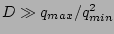 . We can think
as the
wavevector dynamic range we want to measure; hopefully
it can be about one hundred for spatial measurements. On the
other hand,
is of the order of some length
of the particles, for example ten times. For example,
if we consider
. We can think
as the
wavevector dynamic range we want to measure; hopefully
it can be about one hundred for spatial measurements. On the
other hand,
is of the order of some length
of the particles, for example ten times. For example,
if we consider
 colloids, each image must cover
about
colloids, each image must cover
about
 . In order to cover two decades in wavelength,
we need a about one hundred times wider: about
. In order to cover two decades in wavelength,
we need a about one hundred times wider: about
 .
This is not a huge length; moreover,
from the industrial point of view, there's no problem
in making many acquisitions, with different magnifications and
, for every wavevector range, since each acquisition needs
no accurate positioning.
.
This is not a huge length; moreover,
from the industrial point of view, there's no problem
in making many acquisitions, with different magnifications and
, for every wavevector range, since each acquisition needs
no accurate positioning.
On the other hand,
in some cases, for scientific purposes, should be too wide.
This is the case of
measurements of non-equilibrium fluctuations, described in
Chapt. 9. In this case,
we want to evaluate power spectra on two decades in spatial frequencies.
The dimension of the largest fluctuations is about
one tenth of millimeter: a good statistical sample is about
a millimeter large, and the whole sample must be two decades
bigger: about
 .
The building of a Soret cell, or a free diffusion
cell, with such an big diameter can be avoided by using SNFS,
which will be described in Section 3.11
.
The building of a Soret cell, or a free diffusion
cell, with such an big diameter can be avoided by using SNFS,
which will be described in Section 3.11


