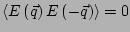
correlations.
In Eq. (3.51) we neglected the
terms like
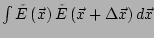 . Such terms should give
contributions like
. Such terms should give
contributions like
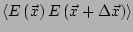 in the Vick formulas; we
neglected them assuming that the phases are random. In this section we
will analyze the conditions under which this happens.
in the Vick formulas; we
neglected them assuming that the phases are random. In this section we
will analyze the conditions under which this happens.
In general,
correlations are not negligible. For example,
we can consider an opaque screen, with a transmission coefficient dependent
on the position, with gaussian distribution. We know that Vick formulas
hold. Now, we send a beam through it, and measure the outgoing intensity
correlation function, immediately after the screen. Since all the points
are in phase, we can assume that the field is real. The Vick formula
for the intensity correlation function states that
 , due to the not
negligible contribution of the term
, which becomes equal
to
, due to the not
negligible contribution of the term
, which becomes equal
to
 . Another example can be found in the theory of
shadowgraph: the term
is responsible for the oscillations
of the transfer function defined in Eq.
(3.37).
. Another example can be found in the theory of
shadowgraph: the term
is responsible for the oscillations
of the transfer function defined in Eq.
(3.37).
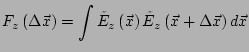
Now we derive the equations giving the evolution of
as
 increases. We define:
 |
(3.55) |
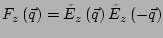
 is:
is:
 |
(3.56) |
 is the power spectrum if
 is the complex conjugate of
 ,
that is if
,
that is if
 is real.
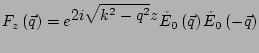
By using Eq. (3.5), we obtain the evolution
of
is real.
By using Eq. (3.5), we obtain the evolution
of
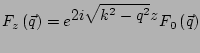
 :
:
 |
(3.57) |
:
evolves like
the electric field
 , but two times
faster than it, as increases.
, but two times
faster than it, as increases.
The root mean square amplitude of
is a conserved quantity; since
 gets
larger and larger as increases, its amplitude must decrease
like
gets
larger and larger as increases, its amplitude must decrease
like  . We can thus define a condition which is enough to ensure that
the terms
are negligible: the diffraction pattern
must be much larger than the correlation lenght. This is implied by
Eq. (3.55).
The gaussianity condition expressed by Eq.
(3.55) is met if many diffraction patterns
overlap in every point. This implies that the diffraction
pattern of each object must be much larger than the object itself, and than
its correlation function, at least if the objects themselves do not
overlap.
. We can thus define a condition which is enough to ensure that
the terms
are negligible: the diffraction pattern
must be much larger than the correlation lenght. This is implied by
Eq. (3.55).
The gaussianity condition expressed by Eq.
(3.55) is met if many diffraction patterns
overlap in every point. This implies that the diffraction
pattern of each object must be much larger than the object itself, and than
its correlation function, at least if the objects themselves do not
overlap.
Some difficulties arise when we consider the power spectrum, or the
Fourier transform of
terms. As we already explained,
the root mean square value of
does not depend on .
A Fourier transform, made over a whole plane at a given ,
could be divergent, for some values of  , as increases.
For example, we consider a Fourier transform made
on a given area
, as increases.
For example, we consider a Fourier transform made
on a given area  , and we evaluate its mode with wavelength 0,
that is, the integral of
over .
It is proportional to
, and we evaluate its mode with wavelength 0,
that is, the integral of
over .
It is proportional to  . We can consider a square area , of side
 , where
  is the wavevector of the longest wavelenght
Fourier mode of the square . So
is the wavevector of the longest wavelenght
Fourier mode of the square . So
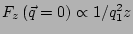 . Once we selected a , the lowest wavevector
we will consider, in order that
is negligible with respect
to a given value, independent on , we must impose a
. Once we selected a , the lowest wavevector
we will consider, in order that
is negligible with respect
to a given value, independent on , we must impose a
 .
.
A more quantitative result can be obtained by considering the
evaluation of the Fourier transform on as the evaluation of
the Fourier transform on the whole plane, followed by the convolution with the
Fourier transform of
 . This is equivalent
to considering the discretization of the allowed wavelengths, due to
a finite area . Near a given value of , the exponential term in Eq.
(3.59) makes an oscillation
in about
. This is equivalent
to considering the discretization of the allowed wavelengths, due to
a finite area . Near a given value of , the exponential term in Eq.
(3.59) makes an oscillation
in about  . The discretized intervals are spaced by :
if
. The discretized intervals are spaced by :
if
 the oscillations are avereged and vanish.
In general, the oscillations will be more visible for small values of .
In order that the oscillations are never visible,
the oscillations are avereged and vanish.
In general, the oscillations will be more visible for small values of .
In order that the oscillations are never visible,
 :
once we have selected , that is the side of , we must
provide that:
:
once we have selected , that is the side of , we must
provide that:
In shadowgraph technique, Eq. (3.60) means that the oscillations of the transfer function are so fast that they cannot be resolved by the sensor, and are thus averaged.
Equation (3.60)
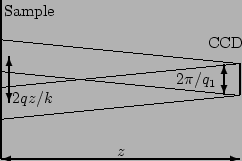
has a geometrical interpretation. The vanishing of
can be expressed in terms of Fourier modes:
, hit
the sensor at an angle  . Every modulation with wavevector
scatters at two simmetric angles; the resulting modulation on the sensor
is thus given by light coming from two different regions, of area ,
whose distance is about
. Every modulation with wavevector
scatters at two simmetric angles; the resulting modulation on the sensor
is thus given by light coming from two different regions, of area ,
whose distance is about  . If the distance is longer than
, the side of , the regions do not overlap: see Fig.
3.6. Equation
(3.60)
states that we must provide that the regions do not overlap. This
means that light collected at symmetric angles is not correlated, as
required by Eq. (3.61).
This condition ensures that the field is gaussian, only if the density of
scatterers
. If the distance is longer than
, the side of , the regions do not overlap: see Fig.
3.6. Equation
(3.60)
states that we must provide that the regions do not overlap. This
means that light collected at symmetric angles is not correlated, as
required by Eq. (3.61).
This condition ensures that the field is gaussian, only if the density of
scatterers
 is so that
 .
.
For the scattering from a thin sample, the intensities of
the beams scattered at two symmetric angles are equal, and the phases
are defined. Since the angles are symmetric, the interference of the
scattered beams with the much intense transmitted beam gives two
interference patterns, sinusoidal modulations, with the same wavevector, and
a given phase. Changing , the two diffraction patterns change their phase;
at some they sums, and at other values they cancel out. This is the origin
of the oscillations in the transfer function of shadowgraph technique,
defined in Eq. (3.37). If
the condition of Eq. (3.60) is met,
the phases of the beams scattered at symmetric directions is random:
on average, the transfer function is constant.
The vanishing of the
terms can be obtained also
by increasing the thickness of the sample. When we pass from the
two dimensional, Raman Nath scattering to the three dimensional,
Bragg scattering, the correlations between the two beams
scattered at the symmetric angles by a given sinusoidal modulation
are not preserved. In shadowgraph language, the transfer function
oscillations are washed out by superposing many layers, at different
. The thickness of the sample  must meet the condition
 .
.