
Rice

Mongo

Peanut

Eggplant

Mango
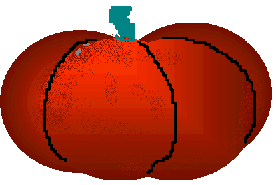
Tomato
Coffee
Banana
(Saba)

Calamansi
(Philippine Lemon)
Papaya

Pineapple

Tobacco
Rice |
Mongo |
Peanut |
Eggplant |
Mango |
Tomato |
Coffee |
Banana (Saba) |
Calamansi (Philippine Lemon) |
Papaya |
Pineapple |
Tobacco |
TOMATO
Technical Description
Tomato (Lycopersicon esculentum Miller) is one of the most important vegetable
crops worldwide. It is grown for both consumption and commercial trade. Apart
from serving as a popular ingredient in a raw green salad for health buffs, it
can be cooked with other vegetable. It is also processed into pickles, catsup,
sauce and paste.
The
tomato plant bears fruits in varied shapes – round, globe, semi-globe or
plum-shaped. The color ranges from orange, deep red, to red orange when mature.
The varieties available in the country are Improved Pope, VC-II-UG, Marikit and
Marilag.
Utilization
Tomato is consumed fresh in salads or as a side dish.
It can be served as baked or stewed, as garnish or flavoring in soups,
and meat or fish dishes. It is
processed into juice, sauce, ketchup, paste, pickles and preserves.
Farm
Practices
Farmers of Western Visayas usually grow the native tomato and Pope variety on a
small farm plot of 0.25 to 0.50 ha. Tomato thrives on a wide range of soil
types. It requires warm weather and plenty of sunshine over a relatively long
season to produce good yields. Farmers usually sow seeds in seedbeds or boxes.
Transplanting, usually 25 to 35 days from sowing follows furrowing. Tomato
farmers also fertilize their crop and spray pesticide to control pest
infestation.
Harvesting
usually occurs 75 to 80 days from transplanting. Tomatoes are harvested 4-6
times over 2½ months, depending on the yield and management. Farmers hire
additional labor during harvest time at P50.00 – P60.00 per day inclusive of
meals.
Specifications
The wholesale buying and selling specifications of tomato are the same. The
varieties available are the native and pope. Native variety also called “pidada”,
“baybay” or Imelda which is squash-like with pronounce ridges, round with
thin and smooth skin and available year-round. Pope variety is elongated ridge
free and thin-skinned.
Both varieties come in assorted sizes and vary by degree of ripeness. Native tomatoes are usually packed in “bacags” of 20 – 25 kg or “kaings” or “crates” of 22 –25 kg. The minimum transaction volume is 1 “bucag”, “kaing” or crate. Retailers sell ripe or semi-ripe tomatoes in assorted sizes by “tumpok” or by kilogram. The minimum retail volume is 1 kilogram.
Seasonality
The native tomato variety is available year-round
reaching peak production from January to April. Lean production is prevalent
from May to December requiring inflows from other areas. The presence of a
sardine processing plant in Bacolod creates a demand for tomatoes. Thus, during
the lean production stocks are sourced from Cagayan de Oro, and occasionally
from Davao City, to augment local tomato supply.
Price
Formation and Differentiation
Price of tomato depends on demand and supply factors. During peak supply months,
tomato prices plunge by as much as P150.00 per “kaing”. However, if supply
is low and demand is high, prices soar to at least P250.00 per “kaing”.
Across varieties, the pope variety commands a higher price of P1.00 –
P2.00 per “kaing”.
Market
Flow
Farmer/ProduceràWholesaler/MiddlemenàRetaileràConsumer
Farmer/ProduceràProcessoràRetaileràConsumer
Farmer/ProduceràRetaileràConsumer
Farmer/ProduceràConsumer
Key
Industry Players
The leading manufacturers of tomato ketchup are Universal Foods Corporation and
Del Monte Philippines, Inc. Manufacturers
of tomato paste and sauces are Northern Foods Corp. (NFC), RAM Food Products,
Inc. and Bukidnon Resources Co. Inc. (BRCI)
Western
Visayas 2002 Tomato
Production
|
Provinces |
Production
(MT) |
| Aklan Antique Capiz Guimaras Iloilo Negros Occ. |
104.34 |
| Total |
7,481.70 |