
Rice

Mongo

Peanut
Eggplant
Mango
Tomato
Coffee
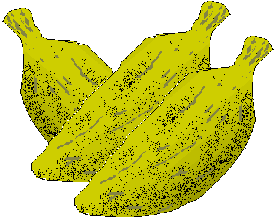
Banana
(Saba)
Calamansi
(Philippine Lemon)
Papaya

Pineapple

Tobacco
Rice |
Mongo |
Peanut |
Eggplant |
Mango |
Tomato |
Coffee |
Banana (Saba) |
Calamansi (Philippine Lemon) |
Papaya |
Pineapple |
Tobacco |
BANANA (Saba)
The saba the is most popular and most widely-eaten variety of banana (Musa spp.) in the country. Its uses are varied – as a popular snack like banana-Q “(fried and/or roasted banana coated with sugar) banana chips, turon” (bananas fried in lumpia wrapper and as feeds. Like other banana varieties, saba contains vitamins, some fat and protein and a high phosphorus content. It is the chief source of banana chips and catsup.
Utilization
Saba can be eaten as processed food like chips, catsup, wine flour, and other food, feed preparations. Its peelings are used as substrate for biogas production; sheets of paper and paper board; banana fibers are manufactured into rope, sack and mat; dried banana blossoms are used in a variety of chinese and filipino dishes.
Most farmers in Western Visayas tend a standing crop. Leaf pruning, propping, and sometimes, bunch spraying, are some maintenance pratices of saba growers.
Saba fruit can be harvest within 150-180 days from shooting. The male bud “puso ng saging” is used as vegetables. Farmers use knives or “bolos” in harvesting.
Saba is one important
raw material; for food processing. Common processed forms are “pinasugbo”
(sweetened banana chip) and banana chips.
Institutional buyers and
processors of catsup prefer to buy big, mature and semi-ripe saba. On the other
hand, banana chips processors prefer to buy green, immature and small to medium
sized bananas. They specify the absence of a hole in the midsection of the saba.
Wholesale buying of
saba involves mature, green fruits classified into the following:
a. Large – more than six inches long with 14-15 fingers
b. Medium – 5 to 6 inches long with 10-13 fingers
c. Small – below 5 inches long with 7-9 fingers
Saba is usually packed in sacks and “kaing”, or simply bundled. A “kaing” approximately contains 40 hands weighing 50 kgs. A bundle of saba usually contains 10 –12 hands, weighing roughly 15 kgs. Procurement is by kilogram. The minimum transaction volume is 1 “kaing”, sack or bundle. Bananas intended for the processor are piled in the truck. There is no quota required. Saba is retailed semi-ripe to ripe. It is classified according to size, as follows:
a.
Large – more than 5.5 inches long
b.
Medium – 4 to 5.5 inches long
c.
Small – 3.5 inches long or less
Saba thrives in Western Visayas. Its is available year-round, particularly during the peak supply months of September to January. Lean supply months last from February to August. Food processors of ‘”bananacue”, a local snack, agree that business is brisk during summer and school holidays. Banana chip processors, on the other hand, consider May and June as peak demand months. Orders from foreign buyers in Europe and Asia come in, since buyers stock up in preparation for winter.
The price of saba is influenced by demand and supply factors. A price difference of P1.00 – P2.00/kg in between classes or sizes is typical. When supply is scarce and demand is high/the price difference reaches P0.20 – P0.30/kg. Wholesalers base their wholesale buying price on the prices quoted by the processors who usually give incentives to the buying stations, depending on the volume purchase.
Farmer/ProduceràWholesaler/MiddlemenàRetailersàConsumers
Farmer/ProduceràProcessoràRetailersàConsumers
Western
Visayas 2002 Banana
Production
|
Provinces |
(MT) |
| Aklan Antique Capiz Guimaras Iloilo Negros Occ. |
34,929.00 |
| Total |
158,207.60 |
Source: Bureau of Agricultural Statistics, Region 6, Iloilo City.