PARATY:
FROM TRADING POST TO NATIONAL MONUMENT... PARATY:
FROM TRADING POST TO NATIONAL MONUMENT...
 Paraty's
foundation date varies from historian to historian. Some say that in
1540/1560 there was already a small settlement devoted to São
Roque at Morro de Vila Velha (today known as Morro do
Forte); some others mention 1597, when Martim Correa de Sá set up
an expedition against the Guaianás Indians in the Paraíba Valley;
others say in 1600 a few paulistas settled in, coming from the
nearby Capitania de São Vicente (the Capitanias were
the first organized administrative land divisions in Brazil, in a
hereditary system devised to start settlements and exploration of the
colony); finally, others insist that 1606 is the year when settlers
from the District of Itanhaém first came. Paraty's
foundation date varies from historian to historian. Some say that in
1540/1560 there was already a small settlement devoted to São
Roque at Morro de Vila Velha (today known as Morro do
Forte); some others mention 1597, when Martim Correa de Sá set up
an expedition against the Guaianás Indians in the Paraíba Valley;
others say in 1600 a few paulistas settled in, coming from the
nearby Capitania de São Vicente (the Capitanias were
the first organized administrative land divisions in Brazil, in a
hereditary system devised to start settlements and exploration of the
colony); finally, others insist that 1606 is the year when settlers
from the District of Itanhaém first came.
 Monsignor
José de Souza Azevedo Pizarro e Araújo, in his book "Historical
Memoirs of Rio de Janeiro and Annexed Provinces under the Jurisdiction
of the Vice-Roy of the State of Brazil", mentions that the
foundation of Paraty occurred around 1600 "and something". Monsignor
José de Souza Azevedo Pizarro e Araújo, in his book "Historical
Memoirs of Rio de Janeiro and Annexed Provinces under the Jurisdiction
of the Vice-Roy of the State of Brazil", mentions that the
foundation of Paraty occurred around 1600 "and something".
The
first written account that mentions Paraty was made by Anthony Knivet,
an English sailor that came to Brazil with Thomas Cavendish in his
second (1591) attempt to circumnavigate the world. Very ill and unable to
walk, Knivet was abandoned to his own luck by Cavendish in São
Sebastião; he eventually survived, only to be captured and enslaved by Martim Correa
de Sá. With him, Knivet took part in different expeditions, one of them
(most probably in 1596/1597) passing through Paraty and the Guaianás
original trail. Knivet calls the place Paratec and describes it
as a Guaianás Indian village.
In any
case, it is assured that in the beginning of the 17th
century, apart from the Guaianás Indians, there was already a growing
number of "paratienses" settled there.
Somewhere
around 1640 the settlement called Paratii was transferred to the
location where the historical center is today, in the land between the
rivers Paratiguaçu (nowadays known as Perequê-Açu) and Patitiba.
The land was donated by Maria Jácome de Mello under two conditions:
that a new chapel be built in honor of Nossa Senhora dos Remédios,
and that the safety of the peaceful Guaianás Indians be preserved.
Easier said than done, but sadly enough, only the first condition was
ever respected.
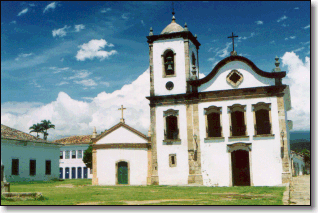 In 1660,
the flourishing settlement rebeled, demanding independence from Angra
dos Reis and the status of a village for itself. Thus, in 1667 Paratii
became the Village of Nossa Senhora dos Remédios de Paratii. Worth
mentioning is the fact that Paraty was the first Brazilian city ever
to achieve political autonomy through popular vote. In 1660,
the flourishing settlement rebeled, demanding independence from Angra
dos Reis and the status of a village for itself. Thus, in 1667 Paratii
became the Village of Nossa Senhora dos Remédios de Paratii. Worth
mentioning is the fact that Paraty was the first Brazilian city ever
to achieve political autonomy through popular vote.
Paraty
then develops into a busy trading post due to 3 basic factors:
-
its
strategic geographic location, inside the protected waters of Ilha Grande Bay;
-
the
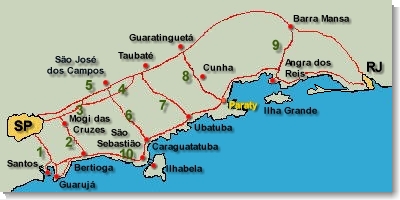
so called "Gold Route of Piedade", a horseback route
between Paraty and Minas Gerais, passing through Guaratinguetá,
Freguesia da Piedade (nowadays the city of Lorena), and then through the
Embu Pass - this was the route ("Caminho do Ouro")
through which slaves carried gold, silver and precious stones from
Minas Gerais to load Portuguese galleons;
-
its
port, at one time Brazil's second most important.
By the
18th century, after as much as 600 tons of gold had been
sent to Portugal and with the extraction's
decadence, Paraty started losing its importance. But the so called
Coffee Cycle, beginning in the early 19th century, and the
need for slaves, revived
the city's former prosperous days of Portuguese colonial times - at
least for a certain time...
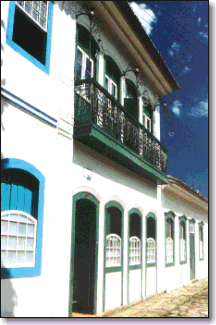 Brazil's
independence in 1822, saw Paraty as one of the major trading cities in
the country: that year's official records registered that "160,914 heads
of both men and animals passed through the city". The Gold
Route continued to played a key role in all this busy activity: initially, it was
the wealth brought by slaves from Minas Gerais to be shipped to
Portugal; later, it was coffee from the Paraíba Valley being exported
to Europe, while European luxury items, slaves, and spices were
imported by the Coffee Barons. Brazil's
independence in 1822, saw Paraty as one of the major trading cities in
the country: that year's official records registered that "160,914 heads
of both men and animals passed through the city". The Gold
Route continued to played a key role in all this busy activity: initially, it was
the wealth brought by slaves from Minas Gerais to be shipped to
Portugal; later, it was coffee from the Paraíba Valley being exported
to Europe, while European luxury items, slaves, and spices were
imported by the Coffee Barons.
By then,
Paraty had ca. 400 houses, some 40 of the typical mansions among them.
Its famous sugar cane pinga, for which the city's name became a
synonym throughout Brazil, was then sold in more than 20 shops. As a matter
of fact, in the year of 1863 alone, more than 700,000 liters of pinga
were produced by ca. 150 distilleries, part of it exported to
Portugal, France, and then to the rest of Europe. Nowadays, only 5
distilleries still exist, and the most famous sugar cane plantation, open to
visitors and worth a visit, is probably the 300-year old Fazenda
Murycana.
But, in
1877, the new railway link between Rio de Janeiro and São Paulo,
along the Paraíba Valley, deemed the old horseback
trail through the Serra do Mar (the mountain range along the coast)
obsolete. Impact on Paraty's trade activity was immediate, and a second
economic decadence was just beginning. A few years later, in 1888, slavery
abolition was declared in Brazil, and with it came total decadence:
from the ca. 16,000 inhabitants in 1851, only "some 600 elderly
people, women and children" remained by the turn of the 20th
century.
A new
road to Guaratinguetá was opened in 1925, partly using the old Caminho
do Ouro, but leaving most of the original trail untouched,
especially on the Serra do Mar. Thanks to this, the ruins of the
famous Casa de Registro, as well as part of the original
cobblestone-paved track was preserved, and can nowadays be visited (Sítio Histórico e Ecológico do Caminho do Ouro). The first
automobile to arrive in Paraty through this new road, in 1929, never
made it back to Guaratinguetá, so difficult were the conditions !
In the
next year, 1930, tanks and other army military vehicles used during
the Revolução de Trinta, on their way to São Paulo, totally
destroyed the road. For more than two decades it would remain
abandoned...
Not even
the attempt to build a railroad between Paraty and Guaratinguetá,
during the first decade of the 20th century, proved
successful.
Neglected
by the rest of the country, Paraty remained isolated for long
decades... At the time new roads were being built throughout Brazil,
Paraty remained unaccessible except by boat from Angra dos Reis, and, from
1954
on, through the lousy dirt "road" winding down the Serra do
Mar range from the city of Cunha. This road, still in use to this day,
has always been so precarious that it becomes useless in rainy seasons.
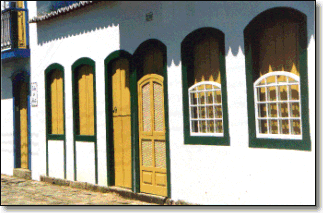 Paradoxically,
it was that very same involuntary isolation that preserved Paraty's
colonial architecture and its social customs. Paradoxically,
it was that very same involuntary isolation that preserved Paraty's
colonial architecture and its social customs.
When the
Rio-Santos highway was opened to traffic in the beginning of the 80's,
Paraty once again revived an economic boom. In the beginning, the
reason for Paraty to exist was the gold from Minas Gerais, later came
the coffe from the Paraíba Valley, and now it's the tourists flowing
in from all over the world !
First
declared a State Heritage in 1945, an then National Artistic and
Historical Heritage in 1958, Paraty finally rose to National Monument
status in 1966. Pending UNESCO's approval, Paraty will soon
become a World Heritage Monument.
After
your charter, you may find the cobblestoned streets a bit tricky underfoot,
especially because the roads dip in the middle to allow the spring tide to sweep the streets once a
month, but spending at least a couple of days in Paraty should be part
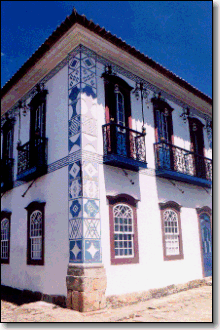
of your program. The white stucco buildings, with brightly colored wood trim and inviting courtyards
lining these narrow streets, make really beautiful pictures. Cars are prohibited within the historic section of the town; deliveries to stores and restaurants are made by donkey and cart.
Perhaps
it is the colonial architecture... or maybe the lush rainforest
surroundings and the 65 islands and 300+ beaches... or perhaps, the
real indians selling their art along the streets... or, who knows,
that back-to-the-past sensation as you listen to pirate, gold, and slavery
stories while strolling through the preserved, historic
settings... One thing must be taken for granted: Paraty is not
to be missed !
|
SOURCES:
- Assessoria de
Comunicação da Secr. de Turismo e Cultura de Paraty
- Bastide, Roger
e Fernandes, Florestan. Brancos e Negros em São Paulo Cia.
Editora Nacional. 1959.
- Bastide, Roger.
Estudos Afro-Brasileiros. Editora Perspectiva.
- Câmara
Cascudo, Luiz da. Dicionário do Folclore Brasileiro.
Instituto Nacional do Livro. 1962.
- Costa, Lúcio.
Projeto Arquitetônico de Paraty in Tricentenário de Paraty.
- Freyre,
Gilberto. Carnaval. Grandes Acontecimentos da História.
Revista nº 9. 1974.
- Gurgel, Heitor
e Amaral, Edelweiss. Paraty, Caminho do Ouro. Livraria São
José.1973.
- Maia, Thereza
Regina de Camargo. Paraty, Religião & Folclore. Cia.
Editora Nacional. 1974.
- Mello, Diuner
José. Paraty - Notas Históricas. Instituto Histórico e Artístico de Paraty. 1994.
- Mello, Diuner
José. Roteiro do Visitante. Informativo Turístico e
Cultural. Paraty,1976.
- Mello e Souza,
Marina. Paraty - A Cidade e Suas Festas. Ed. Tempo Brasileiro.
- Pizarro, J.S.A.
e outros. Tricentenário de Paraty Notícias Históricas.
- Maya, Thereza
& Maia, Tom. Paraty.
- Cotrim, Cássio
Ramiro Mohallem. Paraty: Um Perfil Histórico de sua Riqueza
Econômica.
- Ribas, Marcos
Caetano. A História do Caminho do Ouro em Paraty.
- Knivet, Anthony.
Vária Fortuna e Estranhos Fados de Anthony Knivet.
|
HOW TO CORRECTLY SPELL "PARATY"...
 Paraty, in the local tupi indian
language, means "river fish" or "place where fishes
live". This was how the Guaianás indians called the place where the city was built. In fact,
the paratis (Mugil Brasiliensis fishes) came and still come
during winter to breed in the rivers that flow into Paraty Bay, to
later on return to sea. Paraty, in the local tupi indian
language, means "river fish" or "place where fishes
live". This was how the Guaianás indians called the place where the city was built. In fact,
the paratis (Mugil Brasiliensis fishes) came and still come
during winter to breed in the rivers that flow into Paraty Bay, to
later on return to sea.
The first settlers, by their turn,
kept the original tupi name. By then, it was spelled with two
"i"s, as in Paratii. The traditional spelling with
"y" only appears in the 18th century and was
considered official until 1943, when the Brasil-Portugal Ortographic
Convention supressed the "y" from the portuguese alphabet.
Thus, Paraty became Parati.
Nonetheless, the very
traditional local community continued to use the y-spelled version. Such double
spelling co-existed until 1972, when senator Vasconcelos Torres submitted,
in Brasília,
a law determining that historic cities and monuments were allowed to
officially spell their
names in the traditional, prior to 18/jan/1944, way.
Paraty with y: the
exception that became a rule !
SOURCES:
- Diuner José
Mello. Tribuna de Paraty. 07/08/1992.
- Departamento de
Comunicação e Marketing da Secretaria de Turismo e Cultura de
Paraty
| DON'T
TAKE PINGA FOR CACHAÇA... Pinga
should not be mistaken with cachaça (a sort of sugar cane
brandy), although both products are very similar in appearence,
both are made from sugar cane, and few people (including
paratienses) know the difference. 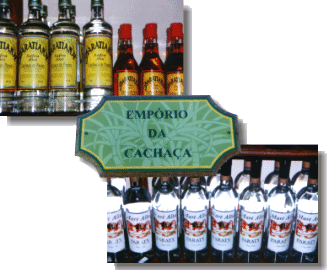 And
never mind that one of the best places to buy pinga in Paraty
is called "Empório da Cachaça", and that a few
pingas from Paraty are simply sold as cachaça: the only
liquor produced in Paraty has always been pinga ! And
never mind that one of the best places to buy pinga in Paraty
is called "Empório da Cachaça", and that a few
pingas from Paraty are simply sold as cachaça: the only
liquor produced in Paraty has always been pinga !
The distilling
process for cachaça starts with the dreg or molasses of sugar
cane, or in other words, with the by-products of sugar
production. Technically, because of these raw materials,
cachaça is of inferior quality when compared to pinga.
Pinga, on the
other hand, starts from garapa (cane broth), which is then fermented
and distilled. The resulting liquid, after ebullition and
evaporation, "drops" at the spout (the verb "to
drop", in Portuguese, means "pingar", therefore
the name pinga).
The Paraty
Pinga Festival takes place yearly, usually on the 3rd
week of August, with live MPB shows, active night-life, etc.
We only use the
best quality pinga from Paraty to prepare our caipirinhas
aboard, but this is another story...
|
THINGS
TO DO ASHORE IN PARATY...
-
Caminho do Ouro
(Gold Route)
-
Fazenda
Murycana
-
Explore Trindade beach
-
Visit the many art galleries
-
Pinga
destilleries (alambiques)
-
Waterfalls
-
Stroll along the
historic center's cobblestoned streets
-
Have an espresso
and a brigadeiro (a typical Brazilian sweet) at Bombom da
Maga, in the historic center
-
Nightlife, cafés, restaurants, MPB, etc.
|
|
|
|
SOME
INTERESTING LINKS...
|
|