|
Latin
America's largest country, the size of the lower 48 United States,
Brazil has a booming developing economy. The capital
is Brasília, specifically built to this purpose in the early
60s. São Paulo is one of the largest cities in the world, while Rio
de Janeiro is by far Brazil's most famous.
 Inflation has
been a major economic problem for many years, but in the
past decade this problem apparently became under control. Political
and corruption issues every now and then still remind us of the old motto "Brazil
is the country of the future - and will always be", but the economy is now very solid when compared to other South
American nations. Inflation has
been a major economic problem for many years, but in the
past decade this problem apparently became under control. Political
and corruption issues every now and then still remind us of the old motto "Brazil
is the country of the future - and will always be", but the economy is now very solid when compared to other South
American nations.
Initially known only for the coffee, Bossa Nova,
Carnaval, beaches, soccer, and F-1 pilots, Brazil is nowadays also globally
recognized for its aerospace industry, architecture, oil prospection,
genetic research, and of course, for some of the world's most
beautiful top models.
One may find wealthy
condominiums, fancy imported cars, and the world's third largest biz-jet
and private helicopter fleet, right next to very poor
neighborhoods, and villages with little electricity, inadequate sanitation,
and illiteracy - but with satellite TV and cell
phones !
What makes Brazil so
attractive ? Try to understand what an American visiting Ilha
Grande recently told us: "The U.S. and Europe are so good, everything is so
organized and clean, but at the same time, things are sooooo bad. On the other
hand, Brazil is so disorganized, sometimes things are really bad, but at the same time,
it is soooooo
god !". So, whaterver may your personal interpretation
be...
Welcome to Brazil,
the exotic country of beautiful landscapes, warm hospitality, and big
contrasts !
 ENTRY
REQUIREMENTS...
ENTRY
REQUIREMENTS...
A passport and visa
are required for foreigners traveling to Brazil for any purpose.
Brazilian visas must be obtained in advance from the Brazilian Embassy
or consulate nearest to the traveler's place of residence. There are
no "airport visas," and immigration authorities will refuse
entry to Brazil to anyone not possessing a valid visa.  All Brazilian
visas, regardless of the length of validity, must initially be used
within 90 days of the issuance date or will no longer be valid.
Additionally, visitors must present an inoculation card indicating
they had a yellow fever inoculation or they may not be allowed to
board the plane or enter the country. Minors (under 18) traveling
alone, with one parent or with a third party, must present written
authorization by the absent parent(s) or legal guardian, specifically
granting permission to travel alone, with one parent or with a third
party. The authorization (in Portuguese) must be notarized and then
authenticated by the Brazilian Embassy or Consulate.
All Brazilian
visas, regardless of the length of validity, must initially be used
within 90 days of the issuance date or will no longer be valid.
Additionally, visitors must present an inoculation card indicating
they had a yellow fever inoculation or they may not be allowed to
board the plane or enter the country. Minors (under 18) traveling
alone, with one parent or with a third party, must present written
authorization by the absent parent(s) or legal guardian, specifically
granting permission to travel alone, with one parent or with a third
party. The authorization (in Portuguese) must be notarized and then
authenticated by the Brazilian Embassy or Consulate.
For current entry and
customs requirements, travelers may contact the Brazilian Embassy through e-mail, and consulates
jurisdictions may be found at the Brazilian Embassy website.
Foreign citizens also
possessing Brazilian nationality will not be issued Brazilian visas
and must obtain a Brazilian passport (from the Brazilian Embassy or
Consulate nearest to their place of residence) to enter and depart
Brazil. In addition to being subject to all Brazilian laws affecting
foreign citizens, dual nationals may also be subject to other laws
that impose special obligations on Brazilian citizens. For additional
information, please contact the nearest Brazilian embassy or
consulate.
CUSTOMS
REGULATIONS: Brazilian customs authorities may enforce
strict regulations concerning temporary importation into or export
from Brazil of items such as firearms, antiquities, tropical plants,
medications, and business equipment. It is advisable to contact one of
Brazil's consulates for specific information regarding customs
requirements.
DRIVING
IN BRAZIL...
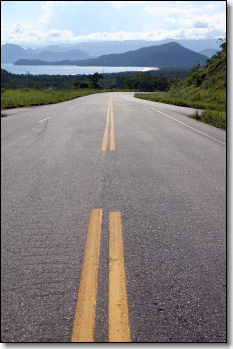 Renting
a car in Brazil is fairly easy,
but then driving is another story... Although some people tend to
compare Brazil to Italy when it comes to driver's behaviour, driving
in Brazil can be challenging mainly due to road conditions. Renting
a car in Brazil is fairly easy,
but then driving is another story... Although some people tend to
compare Brazil to Italy when it comes to driver's behaviour, driving
in Brazil can be challenging mainly due to road conditions.
There
are occasional stretches of modern divided highway (especially in São
Paulo State), but signs, shoulders, exits and merge lanes tend to be
haphazard. There are many potholes, sometimes marked with a tree
branch protruding from the hole, and asphalt is frequently uneven and
bumpy. Many cities and towns have erected speed bumps ("lombadas"),
which are sometimes severe and may be unpainted and unmarked.
Pedestrians, bicyclists, and horse-drawn vehicles all can be
encountered (e.g. Rod. Rio-Santos BR-101), and can pose hazards even
on major routes.
Most
traffic accidents in Brazil are attributable to driver error, so great
care should be taken by drivers and pedestrians alike. The fastest
way to summon assistance in an emergency anywhere in the country is to
dial 193, a universal number staffed by local fire departments (this
service is in Portuguese only). Many drivers in major urban areas
and more developed parts of the country carry cellular phones, and can
be asked to assist in calling for help.
Driving
in big cities, especially in São Paulo's rush hour, will probably
require a lot more attention than in your hometown. This is due to
motorbike couriers, the so called "motoboys" or
"motoqueiros",
who drive in a dangerous and aggressive manner, risking their own
lives and other people's property. Very sadly, reports say that one or
two of these "motoboys" die each day in São Paulo.
But passenger
car travel will be reasonably safe in most areas if one takes into
account the prevailing conditions described above and exercises due
prudence and caution. In other
words: careful
and defensive driving is all you will need for a safe trip.
DIRECTIONS:
The
Brazilian Federal Government maintains a (Portuguese) website
with up-to-date information on road conditions throughout the country.
It also has downloadable state roadmaps.
When
driving from São Paulo to Paraty, for example, you will be driving on
safe, first-world class, divided, toll highways like Rodovia Ayrton Senna and Rodovia
Carvalho Pinto (SP-070)*. Then, after some 6 km of usually heavy
traffic on Dutra (BR-116)*, you will arrive in Taubaté. From
Taubaté to Ubatuba, the undivided, windy Rodovia Oswaldo Cruz
(SP-125)* will require extra attention. From Ubatuba to Paraty, the
undivided scenic Rodovia Rio-Santos (BR-101)* is fairly well
maintained - at least until you enter Rio de Janeiro State: the ca. 25
km from that point until Paraty can, especially in rainy seasons,
offer bad surprises, from fallen rocks to potholes in
the pavement.
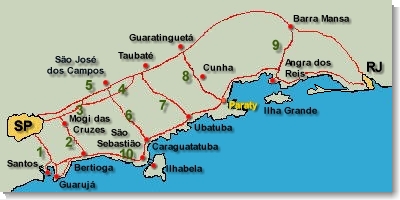 |
1 -
Rod. Anchieta
(SP-150)
2 - Rod. Mogi-Bertioga
(SP-160)
3 - Rod. Ayrton Senna
(SP-070) *
4 - Rod. Carvalho Pinto
(SP-070) *
5 - Rod. Presidente Dutra
(BR-116) *
6 - Rod. dos Tamoios
(SP-099)
7 - Rod. Oswaldo Cruz
(SP-125) *
8 - Rod. Paraty-Cunha
(SP-171)
(9.6
km dirt road - to be avoided in rain !)
9 - Rod. Barra Mansa -
Angra dos Reis
10 - Rod. Rio-Santos
(SP-55/BR-101)*
* indicate
roads you'll take from SP to Paraty.
|
DRIVING IN BRAZIL BASICS:
A new
Brazilian highway code strengthening and consolidating Brazilian
traffic laws entered into force on January 22, 1998. While the law
establishes a system of sometimes severe penalties for a number of old
and new traffic offenses, enforcement varies, and highway officers can
be corrupt, so drivers should not assume that others will
necessarily follow even the most fundamental and widely accepted rules
of the road. Some important local rules and customs include the
following:
-
Minimum
age: 18 years.
-
Seat
Belts: law enforced.
-
International
and U.S. driver's licenses are accepted.
-
Highway
speed limits varies, and are
widely ignored, although there is enforcement. Unmarked electronic/photographic devices
to verify speed and take photos of
violators' cars and license plates as a basis for issuing speeding
tickets are very common on highways. Basic limits:
-
City
speed limits are variable, depending
on the road and the nature of the neighborhood. Many towns and
cities have marked electronic/photographic devices ("Fiscalização
Eletrônica"), which verify speed and snap photos of
violators' cars and license plates as a basis for issuing speeding
tickets, so keep an eye on speed signs all
the time !
-
 Driving
Under the Influence: Drivers are in violation of the law if
blood/alcohol level reaches 0.6 percent. Driving
Under the Influence: Drivers are in violation of the law if
blood/alcohol level reaches 0.6 percent.
-
City
traffic in SP and RJ can be huge, especially at rush hour.
-
Left
lane is for passing.
-
Turns
on Red Lights: Not permitted, except for right turns where there
is a sign with an arrow pointing right and the words "Livre
à Direita".
-
Yielding
the Right of Way: drivers must yield the right of way to cars on
their right. Stop signs are rarely enforced, so many drivers
simply take them for yield signs.
-
Penalties
for Drivers Involved in an Accident Resulting in Injury or Death:
In addition to possible criminal charges and penalties,
compensatory and punitive damages may also apply.
-
Local
Driving Customs: Drivers often use flashes or wave a hand out of
the window to signal other drivers to slow down. Drivers will
often break suddenly to slow down for the electronic speed traps
mentioned above. On the other hand, most drivers think they have
right-of-way over pedestrians, even on pedestrian "zebra"
crossings.
-
Rental
car companies offer automatic transmission car only on request;
most cars have manual transmission.
-
Major
rental companies: Herz,
Avis, Unidas,
Localiza.
MONEY
MATTERS...
 After many decades of huge inflation, Brazilian economy is fairly
stable nowadays. Brazilian currency is the Real (R$),
pronounced "hay-ahl", and Reais ("hay-ice") for the plural. Newspapers
usually inform the official exchange rate, and what you have to look
for is the "DOLAR TURISMO" rate.
For todays rate, follow this LINK.
After many decades of huge inflation, Brazilian economy is fairly
stable nowadays. Brazilian currency is the Real (R$),
pronounced "hay-ahl", and Reais ("hay-ice") for the plural. Newspapers
usually inform the official exchange rate, and what you have to look
for is the "DOLAR TURISMO" rate.
For todays rate, follow this LINK.
Bank notes in circulation are: R$1 - R$2 - R$5 - R$10 - R$20 - R$50 - R$100
Coins in circulation are: R$0,01 - R$0,05 - R$0,10 - R$0,25 - R$0,50 - R$1,00
U.S dollars can easily be exchanged at hotels, banks, travel agencies and currency exchange offices.
As a rule of thumb, you will get a lower exchange rate for traveller's
cheques
than for cash.
Credit cards are widely accepted throughout Brazil (except in very
small
towns), VISA being the most popular.
Most
Brazilian banks offer ATMs, but it is advisable to check your card's
acceptance in advance.
A few
useful tips:
-
Airports: porters may charge as much as $1 per bag
-
Taxis: Tipping is not expected, yet many people choose to round up the fare. Drivers in some cities charge for help with baggage
-
Hotels
and pousadas: a $1 tip is OK for chambermaids and bellboys
-
Restaurants: a 10% gratuity will often be included in the bill
-
Sales Taxes: advertised prices on store windows and bills will always include sales taxes.
-
The
usual taxi fare between Paraty and our base (PPYC)
is R$ 20,00 (ca. US$7), never more than that.
LANGUAGE...
Portuguese is the official language. Except for the languages spoken by Indian tribes living in remote
areas, Portuguese is the only language the majority of the population
speaks. Don't expect to find English-speaking people outside hotels, although in
certain pousadas, restaurants, and shops in Paraty, Spanish,
English, and sometimes French, is spoken as well.
There are no
dialects, but depending on the regional accent, it may be hard to
understand what people are saying, even for other Brazilians. Brazil is the only Portuguese-speaking country in South America.
ELECTRICITY...
Voltage throughout Brazil is either 110/127V or 220V, 60 Hz, so it is
advisable to check your appliance's manual before you plug anything
in. Wall power outlets will usually accept American-standard plugs,
but you may eventually need an easily available conversion plug,
depending on your equipment.
Our
yacht is equipped with a 110V inverter, so it is possible to recharge
camcorder and cellphone batteries if you can adapt to this voltage.
WATER
& FOOD...
 Water in
Brazil is usually safe and treated in public plants, although drinking
non-filtered tap water is not recommended. Drinking only filtered or
mineral water is a good idea if you want to avoid any
risks. Water in
Brazil is usually safe and treated in public plants, although drinking
non-filtered tap water is not recommended. Drinking only filtered or
mineral water is a good idea if you want to avoid any
risks.
Brazilian
typical cuisine varies according to the region you will be visiting,
and can sometimes be spicy, heavy and strong, depending on the
menu. Worth of interest is São Paulo's international reputation for
the quality of its restaurants - one can find from pizzas to sushi, or
from Italian to Arabian restaurants, many times much better than the
original ones in their homelands.
A complete
experience in Brazil should include a tasty feijoada, seafood, and churrasco.
YOUR
HEALTH...
Rule #1:
do not understimate sunburn consequences ! Sunshine, in Brazil, can be
extremely strong, especially during summertime and near the sea - and
the ozone layer isn't getting thicker. Some important tips:
-
Avoid
oily tan lotions, and use only SPF 30+ sunblock.
-
Cloudy
weather can be tricky - you will get burned the same way !
-
The
wind, while sailing, burns and dehydrates too !
-
Don't
forget your sunblock lip balm and sunglasses.
-
Avoid
sun exposure between 10:00 and 15:00.
-
Avoid
dehydration: drink as much water as possible. You may also try
coconut water.
 A yellow fever vaccination certificate
may be required only if, within the last 90 days, you have
travelled to any of the following countries: Angola, Bolivia, Benin, Burkina, Cameroon, Colombia, Democratic Republic of Congo, Ecuador, French Guyana, Gabon, Ghana, Gambia, Republic of Guinea, Liberia, Nigeria, Peru, Sierra Leone, Sudan or
Venezuela. Yellow fever vaccination
is advisable if your destinations in Brazil will also include any of the following Brazilian states: Acre, Amapá, Amazonas, Federal District of Brasilia, Goiás, Maranhão, Mato Grosso, Mato Grosso do Sul, Pará, Rondônia, Roraima and/or Tocantins. A yellow fever vaccination certificate
may be required only if, within the last 90 days, you have
travelled to any of the following countries: Angola, Bolivia, Benin, Burkina, Cameroon, Colombia, Democratic Republic of Congo, Ecuador, French Guyana, Gabon, Ghana, Gambia, Republic of Guinea, Liberia, Nigeria, Peru, Sierra Leone, Sudan or
Venezuela. Yellow fever vaccination
is advisable if your destinations in Brazil will also include any of the following Brazilian states: Acre, Amapá, Amazonas, Federal District of Brasilia, Goiás, Maranhão, Mato Grosso, Mato Grosso do Sul, Pará, Rondônia, Roraima and/or Tocantins.
Quality
medical service and well equipped hospitals can be found in São Paulo
and Rio de Janeiro, Albert Einstein Hospital in São Paulo being
regularly used by U.S. Government personnel. Smaller towns, like Paraty and Angra dos Reis
offer only limited public hospitals.
In case
of major emergencies, quick evacuation to São Paulo, either by
helicopter or by aircraft is possible, as both Paraty and Angra dos
Reis have local airports. But do not forget to check if your
medical insurance covers medical care overseas, emergency expenses
such as medical evacuation included.
Many
travel agents and private companies offer insurance plans that will
cover health care expenses incurred overseas, including medical
evacuations. When making a decision regarding health insurance,
consider that many doctors and private hospitals require payment in
cash prior to providing service and that a medical evacuation to the
United States, for example, may cost well in excess of US$50,000.
Uninsured travelers who require medical care overseas often face
extreme difficulties. When consulting with your insurer prior to your
trip, please ascertain whether payment will be made to the overseas
healthcare provider or if you will be reimbursed later for expenses
that you may incur.
The
bottomline here is: avoid hurting yourself badly !
CRIMINAL
PENALITIES...
While in
a foreign country, tourists are always subject to that country's laws
and regulations, which sometimes differ significantly from those in
their homeland and may not afford the protections available to the
individual under their country's laws. Penalties for breaking
the law can eventually be more severe than in your homeland for
similar offenses.
Persons
violating Brazilian laws, even unknowingly, may be expelled, arrested
or imprisoned. Penalties for possession, use, or trafficking in
illegal drugs in Brazil are very strict, and convicted offenders can
expect jail sentences and heavy fines.
PIRACY...
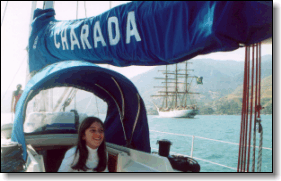 Sometimes
people ask us about piracy in Brazilian waters and the safety of our
cruising grounds, especially after America's Cup and Withbread/Volvo
Round-the-World champion, Sir Peter Blake, was killed in 2001 during a round-the-world
expedition, in Belém, Pará State. Although piracy reports worldwide
are on the rise, we can testify that Paraty, Angra dos Reis and Ilha
Grande are very safe cruising grounds, with no piracy reports
so far. Sometimes
people ask us about piracy in Brazilian waters and the safety of our
cruising grounds, especially after America's Cup and Withbread/Volvo
Round-the-World champion, Sir Peter Blake, was killed in 2001 during a round-the-world
expedition, in Belém, Pará State. Although piracy reports worldwide
are on the rise, we can testify that Paraty, Angra dos Reis and Ilha
Grande are very safe cruising grounds, with no piracy reports
so far.
In the
specific case of Sir Peter Blake, "port rats" (as
these armed bandits are known), from nearby poor neighborhoods,
boarded his yacht, and demanded money, valuables, etc. Peter Blake
reacted, and the very sad result is known to everyone. These "port
rats" also act in Santos and Rio de Janeiro ports, but they
basically target cargo ships, not cruising sailboats.
Another
specific case was reported against a German sailor, anchored in
Iguape Bay near Maragogipe, Bahia State. But then again, the yacht was anchored near poor
areas.
So,
differently from the Caribbean, piracy, dinghy & outboard theft,
as well as unauthorized boardings, are extremely rare situations in
our selected cruising areas.
SAFETY
ISSUES...
There is
no need to be over-apprehensive about
your personal safety in Brazil, but common-sense and attention should
never be left at home ! Unfortunately, however, petty crimes occur everywhere: as in any major
city around the world, you do need to be careful when walking in the
streets or talking to strangers, so here is some information that will
make your trip a safe and pleasant one...
Political and labor strikes and
demonstrations can occur sporadically in metropolitan areas and may
cause temporary disruption to public transportation. All protests have
the potential to turn violent. While it is unlikely that foreign
citizens would be targeted during such events, tourists are advised to
take common-sense precautions and avoid any large gatherings or any
other event where crowds have congregated to demonstrate or
protest.
Crime rates throughout Brazil have
increased, but remain highest in the larger cities of São Paulo and
Rio de Janeiro. The incidence of crime against tourists is greater in
metropolitan areas surrounding beaches, hotels, discotheques, bars,
nightclubs, and other similar establishments that cater to visitors
and is especially prevalent during Carnaval. Occasionally, crime
against tourists has been violent and has led to some deaths. While
the risk is greater at dusk and during the evening hours, street crime
can occur during both the day and night, and safer areas of these cities
are not immune. Incidents of theft on city buses do exist, and such
transportation should better be avoided. Several Brazilian cities have
established specialized tourist police units to patrol areas
frequented by tourists.
As in any major city, there can be
pickpocketing at airports, hotel lobbies, bus stations and other
public places . Carry-on luggage, briefcases, and laptop computers are
particularly targeted. Travelers should "dress down" when
outside and avoid carrying valuables or wearing jewelry or expensive
watches.
"Good Samaritan" scams are
common. If a tourist looks lost or seems to be having trouble
communicating, he or she may be victimized by a seemingly innocent and
helpful bystander. Care should be taken at and around banks and
internationally connected automatic teller machines that take U.S.
credit or debit cards.
Brazil's advanced developing economy
has created huge social contrasts: very poor neighborhoods, known as
"favelas" (in Rio de Janeiro often located on steep
hillsides), are found right next to luxury condominums, throughout
Brazilian cities. "Favelas" are sites of uncontrolled
criminal activity, and are often not patrolled by police. Tourists are
advised to avoid these unsafe areas.
While the ability of Brazilian police
to help recover stolen property is limited, it is nevertheless
strongly advised to obtain a "boletin de ocorrência", or
"B.O." (police report) at a "delegacia" (police
station) whenever any possessions are lost or stolen. This will
facilitate the traveler's exit from Brazil and insurance claims.
The loss or theft of a foreign
passport should be reported immediately to the local police and your
country's nearest embassy or consulate.
SÃO PAULO: While similar
incidents may occur elsewhere, all areas of São Paulo have a high
rate of armed robbery of pedestrians at stoplights. There is a
particularly high incidence of robberies and pickpocketing in the Praça
da Sé, downtown section of São Paulo, and in the eastern part of the
city. If renting a car, ask for an air-conditioned one, and keep
windows closed and doors locked all times. Extra attention should be
paid at stoplights, and eventually treat stoplights as mere stop signs
at night.
RIO DE JANEIRO:
The
city continues to experience a high incidence of crime. Tourists are
particularly vulnerable to street thefts and robberies on and in areas
adjacent to all the main beaches in the city. Walking on the beaches
can be very dangerous at night. Recent efforts of incarcerated drug
lords to exert their power outside of their jail cells occasionally
result in serious disruptions in the city, violence directed at the
authorities and incidents of crimes against property, including
after-hours shootings and explosions set off outside hotels and
restaurants frequented by tourists. While these occurrences have so
far not resulted in any injuries, visitors and residents alike should
be aware that inconveniences such as closed shops and disrupted
municipal services are likely. In Rio de Janeiro City, drivers are
allowed to treat stoplights as mere stop signs between the hours of 10
p.m. and 6 a.m. to protect against holdups at intersections. All
incidents should be reported to the tourist police.
But, on the other hand...
The
areas we cruise are normally safe and friendly, and Paraty's
major business is tourism - so they need to keep it safe - and that's
the way you will feel there ! Since common-sense and attention are key factors to a happy and safe stay in
any country - Brazil being no exception - remember:
Do:
-
ask your hotel for safety information about the areas you plan to visit;
-
leave valuable items, including jewelry, travel documents and most of your money in a safe at your hotel;
-
travel
in group whenever possible, and especially at night;
-
ask police for help if necessary;
-
take only what is necessary to the beach;
-
behave like an experienced
traveller as opposed to a tourist;
-
remember that you represent
your homeland;
-
hide your wallet and other valuable items in an inaccessible
place inside your bag - and watch it at all times;
-
if
renting a car, ask for one with air conditioning, and keep the windows closed all times;
-
have the time of your life
!
Do Not:
-
keep valuable items in your back pockets or in the outside pockets of your purse or bag;
-
wear flashy jewelry
(or expensive items, such as designer glasses and valuable watches) in the streets;
-
travel
by yourself in unfamiliar or dangerous areas;
-
display your money;
-
leave
your personal belongings unattended;
-
keep
your car's windows open, especially at stop lights;
-
think it can't happen to you;
-
get involved in illegal activities
(anything illegal in your homeland is probably illegal in Brazil
too !)
-
react,
if robbed at gunpoint; while your belongings are replaceable, your
life is not !
SOME
USEFUL LINKS...
|
