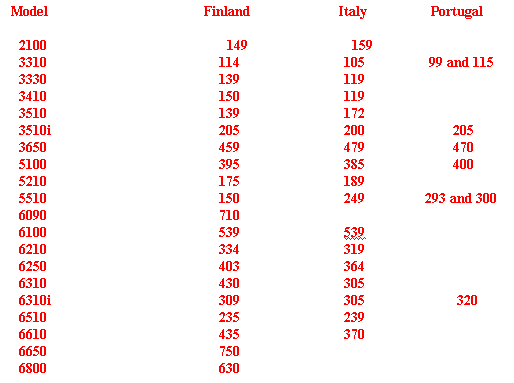
CHARGES OF THE MOBILE OPERATORS IN ITALY, IN GREAT BRITAIN AND IN FINLAND
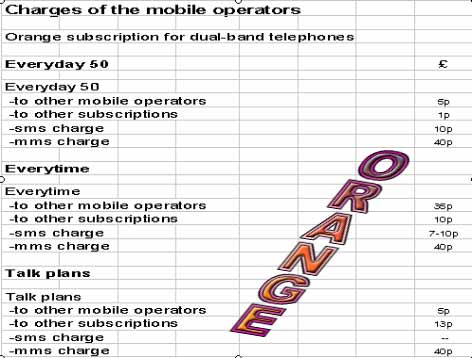
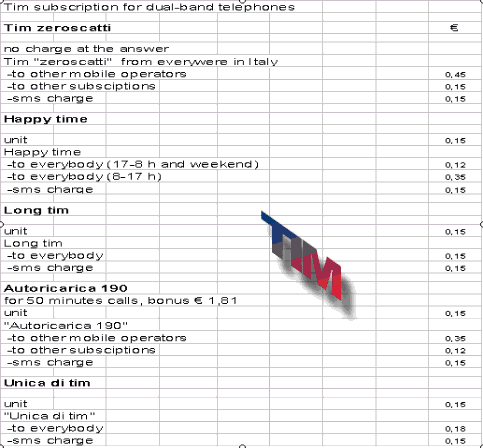
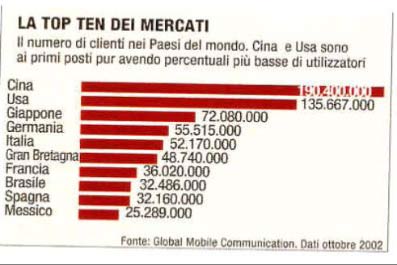
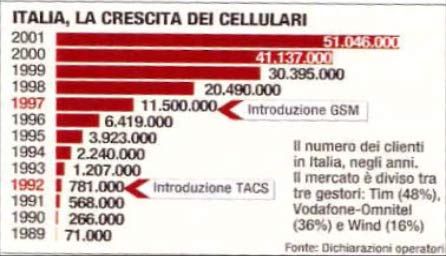
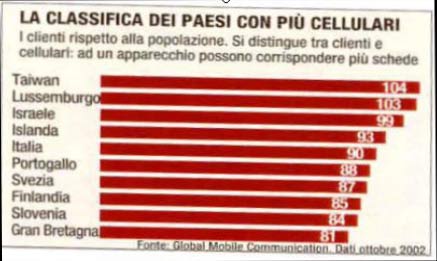
In a competitive environment, featuring a high rate of market penetration and rapid technological innovation, TIM has consolidated its leadership position. Top Management commitment has enabled TIM to confirm its role, not only in a traditional framework of the mobile business, but also as a major player in the development of the TLC mobile phone sector. Beginning with the introduction of the Family tariff in 1993 and the Pre-paid service in October 1996, the continuous innovations and segmented offers (TIM Universal Number, "Autoricarica", the revolutionary concept of the self-recharging mechanism, the collect-call service TIM 4888 and Last Minute) TIM has proved to be a dynamic leader in market development. By September 30, 2002 the penetration rate of active lines in Italy was in excess of 92% of the resident population which makes it one of the most advanced markets in Europe, undoubtedly a mass market country. In this new scenario the business model chosen by TIM for the supply of new interactive services and access to Internet websites (offered with the brand name i-TIM) is an "open" model based on the integration of numerous technological platforms (UniTim, Simtoolkit, WAP and now GPRS). Furthermore TIM is currently making a name for itself as a platform supplier for content providers by striking up partnerships and business synergies, confirming the Company's capability to create real value for final customers. Significant events, such as the introduction of WAP in May 2000 and the partnerships and commercial agreements with primary content and service providers, such as the agreements signed with Seat-Tin.it, Yahoo!Europe, Sonera Zed, Caltanet, Kataweb, Sit.com and Excite, along with agreements with the most important banks and financial institutions for the development of on-line trading and mobile banking,
TIM HIGHLIGHTS ON LATEST INNOVATIONS
In a competitive environment, featuring a high rate of market penetration and rapid technological innovation, TIM has consolidated its leadership position. Top Management commitment has enabled TIM to confirm its role, not only in a traditional framework of the mobile business, but also as a major player in the development of the TLC mobile phone sector. Beginning with the introduction of the Family tariff in 1993 and the Pre-paid service in October 1996, the continuous innovations and segmented offers (TIM Universal Number, "Autoricarica", the revolutionary concept of the self-recharging mechanism, the collect-call service TIM 4888 and Last Minute) TIM has proved to be a dynamic leader in market development. By September 30, 2002 the penetration rate of active lines in Italy was in excess of 92% of the resident population which makes it one of the most advanced markets in Europe, undoubtedly a mass market country. In this new scenario the business model chosen by TIM for the supply of new interactive services and access to Internet websites (offered with the brand name i-TIM) is an "open" model based on the integration of numerous technological platforms (UniTim, Simtoolkit, WAP and now GPRS). Furthermore TIM is currently making a name for itself as a platform supplier for content providers by striking up partnerships and business synergies, confirming the Company's capability to create real value for final customers. Significant events, such as the introduction of WAP in May 2000 and the partnerships and commercial agreements with primary content and service providers, such as the agreements signed with Seat-Tin.it, Yahoo!Europe, Sonera Zed, Caltanet, Kataweb, Sit.com and Excite, along with agreements with the most important banks and financial institutions for the development of on-line trading and mobile banking, confirm TIM's technological leadership. In the first quarter of 2001, TIM launched the first GPRS offer for corporate customers in Italy. Service for the consumer segment started in May 2001: GPRS service represents the breakthrough in the evolution of second (GSM) to third (UMTS) generation mobiles. In June 2001, the GSM Association, the organ representing major cellular operators world-wide, announced radio mobile players' co-operation in order to trace clear guidelines for handset suppliers and software developers, for the development of a common technological platform for multi-media services. This is an important step within a new business model: inter operability, specific features and economies of scale are increasing the use of services and accelerate their take-off. In May, 2002, TIM, a record in Europe, launched MMS, the new Multimedia Messaging Service, representing a step in the evolution of the SMS and EMS, and the first example of the multi-medial services available on the new GPRS handsets. In the summer of 2002 approx. 2 milion MMS were sent on TIM's network. As a differentiating lever, TIM combines innovatio and a thorough knowledge of the costumer's life-cycle which reflect itself in growing levels of satisfaction and loyalty. TIM's ability to adopt and utilise a global CRM strategy based on the development of highly advanced system of analysis and customer management was recognised by Gartner who awarded TIM was the European Customer Relationship Management (CRM) Excellence Award 2001 this summer.
INTERNATIONAL STRATEGY
Being at the forefront of new technological standards in the global framework in which TIM operates, the company is re-enforcing its international competitiveness in a global context. TIM is not just a national brand name but is present in South America and in the Mediterranean Basin. On September 30, 2002 TIM counted 12.7 million lines attributable to customers abroad (18.6 million including Telecom Italia subsidiaries) corresponding to almost 5.5 million in terms of proportionate customers. Since the end of 2001 in accordance with Telecom Italia Group's strategic plan, which aims at focalising on strategic core business and the sale of subsidiaries in which the Company holds minority stakes, TIM, has disposed its minority shares in France (Bouygues), in Austria with Mobilkom and in Auna, Spain. TIM's return on these operations is 1.710 milion euro, with capital gains for 845 milion euro. In addition to our Italian license TIM currently holds one UMTS license: in Greece, through the subsidiary Stet Hellas (assigned at the cost of 147 million Euro). "In-Europe", TIM's pan-European tariff, was launched in April 2001; this global offer was put together thanks to preferential roaming agreements among TIM, its foreign subsidiaries and other European partners, soon allowing TIM clients to speak in an area covering 30 countries using the same tariff. In countries where it is present, TIM approaches the third generation business model as it does in Italy. TIM is focusing its efforts on becoming a technological and marketing partner for its subsidiaries, developing offers of "Plug & Play", introducing successful tariff structures, innovative services and turnkey processes (network know how, billing, customer care and marketing) in order to achieve economies of scale both flexibly and quickly as well as to realize fast start-ups. A concrete example of this synergy is the recent commercial launching of TIM Peru (Peru) and the launch of IS TIM (Turkey). TIM gears its strategy for international development on consolidation in pan-regions, where its objective is to gain a position of control, and to the development of new markets. In February 2001 TIM acquired PCS licenses in Brazil in the regions of S. Paolo, in the southern states and soon in the Rio de Janeiro area. TIM has thus extended its footprint on a national level in Brazil moving a step closer to the creation of a national network and then the first GSM network in South America.
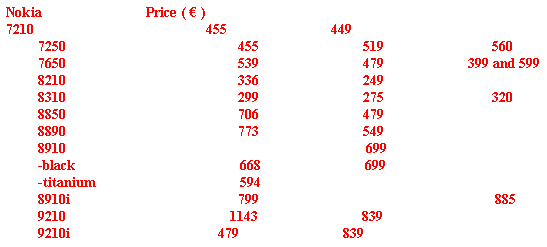
COMPARISON OF PRICES OF SOME NOKIA MOBILEPHONES IN FINLAND, ITALY AND PORTUGAL Price ( � )