ITALIAN STUDENTS:
Daniela Beccia
Manuel Graziani
Gaia Lucchesi
Alessia Massi
2003/2004
1 - Updating of the main changes of I.T. and mobile phone industry over the last 3 years (through the Italian Press)
Il settore dell'IT e quello della telefonia sono senza ombra di dubbio al
centro dell'attenzione del mondo economico.
The attention of economic world is today focused on Information Technology and mobile phones.
Molti i punti di vista dai quali osservare tali settori:
- Tecnologia, risvolti produttivi e scelte strategiche
- Marketing
- Economia e politica industriale (integrazione verticale caratteristica
del settore telefonia/integrazione orizzontale tipica del settore IT)
- Finanza (possibili evoluzioni dal punto di vista delle alleanze e degli
assetti proprietari)
There are many points of view from which to look at these sectors:
- Technology, productive aspects and strategic choices;
- Marketing;
- Industrial economy and policy (vertical integration as a characteristic
of the mobile phone field/horizontal integration typical of I.T. field);
- Finance (alliances and shareholding possible evolutions)
Mentre gli studenti delle quattro scuole partner di questo progetto Comenius dedicavano la loro attenzione al settore, queste le outlines emerse, almeno a giudicare da come la stampa specializzata del nostro Paese (Il sole 24 ore, Italia oggi) ne ha seguito le vicende.
This is how, while the students of four partners schools of this Comenius project were analysing the sector, the specialized press of our country (Il Sole 24 ore, Italia Oggi) followed the events.
What follows is a press review of some relevant Italian Newspaper:
11/7/2002 Italia Oggi - sezione marketing
Intera pagina dedicata al dominio Nokia sul mercato della telefonia mobile,
evidenziando in particolare l'abbinamento tra le funzioni telefoniche e
le caratteristiche dei pc palmari. Dal sondaggio proposto si riscontrava
l'esistenza di 2 ben precise tipologie di utenti:
- utilizzatori della sola funzione "telefonica"
- utilizzatori che gradiscono altre funzionalità quali quelle dei
palmari, le suoneri, i loghi, gli screen saver, la fotocamera
Il testo evidenzia inoltre il giudizio degli italiani sulla Nokia: commenti
positivi sulle innovative funzioni, sulla ricezione, sul peso e sui prezzi.
Critiche sull'aspetto estetico, sull'assistenza e l'eccessiva attenzione
ai gadget.
11th July 2002 Italia oggi - Marketing pages
A hole page dedicated to Nokia's strong role on the mobile phone market. What is mainly stressed is the possibility to join mobile functions and pc characteristics.
The survey showed the existence of 2 precise types of users:
- users of the phone function only
- users that appreciate the other functions such as the features of the
"palmari", rings, logos, screen savers and camera.
The text stresses besides the opinion of the Italians about Nokia: positive
notes about the innovative functions, the "ricezione", the weight
and prices. Criticism instead on the aesthetic aspect, assistance and gadgets.
18/1/2003 Il Sole 24 Ore - inserto Alf@ sezione imprese e soluzioni
Ampia trattazione sulle novità proposte dalla Nokia: la funzionalità dei terminali di nuova generazione si rivolgono ad ogni categoria di utente: c'è il mobile economico, quello per gli sportivi, per chi ama il design con altissima tecnologia ed innovativo. Proposta del N - Gage (miniconsole portatile per i videogames in collaborazione con SEGA - il colosso giapponese dei videogiochi- che consente a più utenti di sfidarsi. (Si rivelerà un flop)
18th January 2003 Il Sole 24 Ore @lfa insert
This article dealt widely with the innovations introduced by Nokia: there
is a choice of economic mobile phones, such as the perfect one for sportsmen
or even for people interested in innovative design and high technology.
Evidence to the N-Gage proposal (portable mini-console for video games in
collaboration with Sega - the Japanese Colossus of video games - that allows
different users to challenge each other). No commercial success for this
attempt.
17 febbraio 2003 Il Sole 24 Ore del lunedì - speciale Affari privati
Grande enfasi sulle novità proposte dai produttori, in particolare sull'introduzione del colore nei display
17th february 2003 Il Sole 24 Ore - Monday edition - Private Affairs section
Widely emphasized the new proposals of the producers, such as colour display
18/2/2003 Il Sole 24 Ore - sezione Mercati
Breve articolo sulla sfida tra la Microsoft ed i produttori di telefonini.
Citato il caso Samsung, che avrebbe introdotto sul mercato un telefonino-computer
con software Microsoft, sebbene abbia anche deciso di entrare nel capitale
Symbian per promuovere la sua tecnologia contro la minaccia proveniente
da Bill Gates.
18th February 2003 - Il Sole 24 Ore - Market section
Description of the challenge between Microsoft and Nokia: Samsung case is mentioned since it is supposed to have launched a mobile phone with Microsoft software, while buying Symbian shareholding to promote its technology agiainst Bill Gates threat.
9 giugno 2003 - Il Sole 24 Ore - sezione Economia Italiana
Inchiesta sulla fisionomia della popolazione attraverso le abitudini "telefoniche"
9th June 2003 - Il Sole 24 Ore - Italian Economy page
Reportage about Italian habits through mobile use survey.
6/11/2003 Il Sole 24 Ore - inserto Alf@ - imprese e soluzioni
La Nokia diffonde il cellulare multimediale: la televisione in tasca. Si potrà così ridare vigore ai vecchi mezzi di comunicazione. Forse tra 10 anni sarà tascabile uno strumento per accedere ad ogni tipo di media.
6th November 2003 - Il Sole 24 ore - @lfa insert
Nokia introduces multimedial mobile: pocket tv is the hit of the moment. In the future possibility to have a pocket instrument to link to any different media channel
________________________________________________________________________-
2 - Updating of the main changes of I.T. and mobile phone industry over the last 3 years (through the International Press)
While the Comenius project was in progress, the Italian students tried to
follow also on the Internationl Press the signals about the fatal attraction
existing between Microsoft and Nokia: the Titans of respective sectors.
On the Internet the main aspects seem to be focused by the three following artcles:
1. Alliance tactics in mobile software
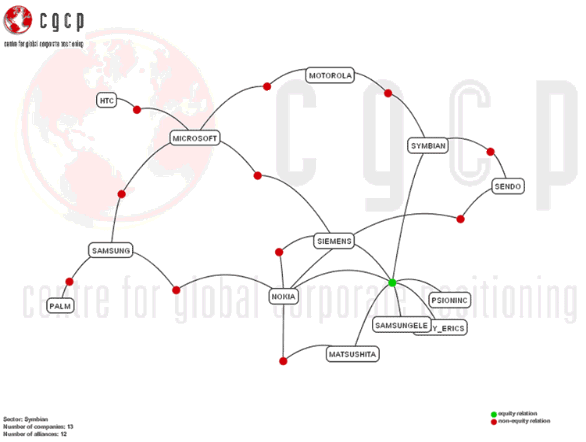
A simple alliance map may tell quite a story. This map shows the most important
alliances in an area where one of the fiercest alliance battles of the moment
takes place: operating software for mobile handsets. It illustrates the
tactics firms employ to get their technology to market. Microsoft has developed
an operating system for handheld devices, which it would like to turn into
the standard software, like Windows is on the pc. The manufacturers of handsets
Nokia, Motorola, Sony Ericsson and Matsushita decided not to use Microsoft's
software on their products. They feared that a powerful Microsoft would
squeeze their profit margin. Instead they set up a joint venture called
Symbian, which aimed to develop software developed by Psion into the standard
for mobile handsets. Leader of the pack is Nokia. The joint venture was
established in 1998. At a later date Siemens and Samsung joined this joint
venture. These two companies however did not put all their eggs in one basket:
Siemens also licensed the Microsoft software, whereas Samsung licensed Microsoft
software and the software of another company active in this market: Palm.
These two companies hedge their bets. Sendo is a company that first belonged
to the Microsoft camp, but defected when it licensed Symbian software.
Nokia did not sit on its hands and developed a user interface for Symbian
software that it licensed to Samsung, Matsushita, Sendo and Siemens. This
increased Nokia's dominance in the Symbian alliance to such an extent, that
instead of seeing Microsoft as the biggest threat, Motorola decided that
now Nokia became too powerful. Motorola sold its shares in the Symbian joint
venture to Nokia and Psion, making Nokia the largest shareholder in Symbian.
Motorola did not sever all its ties with Symbian: it continued to license
the Symbian software, but it also licensed Microsoft software. To be complete:
it also uses the open source software of Linux for a part of its product
portfolio.
One other company is interesting in this picture: HTC. This is a handset
manufacturer. When Microsoft saw it could not sell its software via the
easiest route to market, namely by selling to handset manufacturers, it
entered into direct relationships with telecom operators like T-Mobile and
Orange. Microsoft offered them handsets with their own brand and Microsoft
software. As Microsoft does not produce handsets itself, it requires a partner
to deliver the handsets and this is HTC. Motorola by now follows a similar
strategy offering telecom companies handsets with their own brand.
In the battle for market dominance, alliance tactics are the key. By means
of setting up an alliance group to counter a possible threat (Symbian vs.
Microsoft), hedging risks (Siemens, Samsung, Motorola) and changing position
in the alliance network (e.g. Motorola leaving Symbian), companies try to
promote their own interests.
2. The Register: biting the hand that feeds IT
Microsoft's masterplan to screw phone partner - full details
By Andrew Orlowski in San Francisco ([email protected])
Published Monday 6th January 2003 10:07 GMT
If Microsoft's extended family of lawyers was thinking it could now kick
back and anticipate a kind of extended Spring Break for the rest of this
Bush administration, the pre-Xmas filing by British phone company Sendo
could yet be the cause of a few unexpected late nights.
Sendo's 27-page filing in a Texas court - disclosed here for the first time
- is a rich litany of double dealing, betrayal and larceny - if the dramatic
(and at times apoplectic) allegations can be believed.
Until November, Sendo was Microsoft's flagship phone OEM. It then announced
that its four-times-delayed Z100 Stinger phone would be canned, and threw
its lot in with Nokia, terminating the Microsoft agreement.
Formally, Sendo is throwing the book at Microsoft. The handset manufacturer,
created in 1999 with some of the best Philips and Motorola talent, was to
be Microsoft's "go to market partner" for the Stinger smartphone
platform, and even received an equity investment from Redmond, and it's
now very, very angry.
The claim alleges - are you ready to start counting? - misappropriation
of trade secrets, common law misappropriation, conversion, unfair competition,
fraud, breach of fiduciary duty, two counts of negligent misrepresentation,
two counts of breach of contract, fraudulent inducement and tortious interference.
Phew.
If Sendo's case progresses, it's likely to add new stars to the litigation
firmament - one which has already brought us phrases such as "cut off
the air supply", "knife the baby" and faked videotape evidence,
and the most likely star in this turn should be one Marc Brown, who simultaneously
served as a Sendo director while being employed by Microsoft. More on Marc
in a moment.
The case alleges a "Master Plan" to swindle the Brum-based startup
out of its trade secrets. Sendo says it delivered a unique industry insight
to Microsoft through this partnership, insight that the industry (as represented
by Nokia, Ericsson, Motorola and the Japanese manufacturers) weren't themselves
willing to share.
But it was never a partnership of equals, alleges Sendo, and after promising
that StinkerOS was ready in the middle of last year, Microsoft used the
delays to uncover Sendo's integration secrets and carrier relationships,
and then cut off their air supply, using this knowledge to promote its new
sweetheart, the Orange SPV instead.
Sendo's tale
Here's how it runs.
In February 2001, Microsoft and Sendo formalize and publicly announce their
partnership, and Microsoft buys $12m of Sendo shares, and a seat on the
board. Microsoft promises to ship its part of the deal, the "code complete"
StingerOS to the manufacturer by June. That's good, because Sendo had planned
to ship the first phones in August and December.
Both parties are delighted. Sendo has been operating for less than two years,
and the deal gives it an opportunity to be first to market with a phone
that has Microsoft massive marketing budget behind it. Microsoft is pleased:
although it has been toting its software to cellphone manufacturers for
several years, Sendo is the first OEM to bite. As it dryly notes in its
filing:
"Microsoft had been unable to successfully access the wireless market
because the handset manufacturers would not use their software."
Only summer comes, and the code isn't ready. It isn't ready in the autumn,
either, and this starts to play hell with Sendo's budgets. December rolls
round, and according to Sendo, bugfixes that carriers have requested are
being refused by Microsoft. Sendo is in a cash crisis, and a call to VCs
is spurned. So Sendo asks Microsoft for a further cash injection, which
is declined:
"Microsoft refused with the full knowledge that this refusal would
push Sendo to insolvency", claims Sendo in the filing.
How did it know? Well, meet Marc Brown, who was by now acting in his capacity
as a Sendo board member while continuing his day job as the director of
Microsoft's corporate development and strategy group.
At this point Brown suggests that Microsoft convert the share deal into
a loan, repayable in three stages, and in February (last year), Sendo agrees.
Stinker still hasn't shipped, so Sendo can't sell a phone. Microsoft refuses
to pay Sendo some capital that was scheduled under the earlier agreement,
Sendo alleges, and by spring the relationship has deteriorated to the level
of legal threats.
However on the surface, all appeared to be cordial, and at a board meeting
in May last year Brown pledged that Microsoft was "not working with
anyone else as an 'initial go to market partner'".
This we now know to be false.
From May onwards, says Sendo, Microsoft aggressively demanded technical
meetings which extracted valuable technical and commercial information out
of Sendo. Then demands got funny: Sendo claims that Microsoft demanded it
cease all other development to ship the Stinker; and asked for an expensive
and onorous test run of 300 Z100 prototypes.
Now, remember that Microsoft had no business relationships with carriers
as a handset provider, while Sendo staff were pretty well versed in what
to do. This, Sendo alleges, is what Microsoft's "Master Plan"
was all about. As it claims:
"They were not entitled to such information under the terms of the
SDMA" - the precursor to the February 2001 agreement that the two inked
in the fall of 2000.
In fact, this SDMA turns out to have been Sendo's death warrant. As the
company explains:
"Under the SDMA, in the event of a Sendo bankruptcy, Microsoft would
obtain an irrevocable, royalty free license to use Sendo's Z100 intellectual
property, including rights to make, use, or copy the Sendo Smartphone to
create other to create other Smartphones and to, most importantly for Microsoft,
sublicense those rights to third parties."
And that's the crux of the case.
Sendo's description of a "master plan" to rob it of its secrets
might look like paranoid nonsense, were it not for the fact that in that
SDMA, Sendo's demise was in foretold. Microsoft had far more to gain than
it had to lose by seeing its partner fall.
This being a civil case, we're not quite sure where the burden of proof
lies [reader advice is as ever, welcome]. Were Sendo a bunch of incompetent
klutzes who didn't know how to integrate the perfect phone software they
received from Microsoft in a timely fashion? Or was Microsoft lying when
it said it could ship a carrier-grade phone OS to Sendo in the summer of
2001?
From the Orange SPV buglist, it still doesn't look like Microsoft can ship
a carrier-grade phone OS eighteen months later. But this is a court case,
and Sendo must prove it. If the discovery phase is half as imaginative as
it could be, we're in for a treat.
Background
Microsoft's dalliance with cellphones is interesting for a couple of reasons.
Firstly, because phones are morphing into a computer platform of great social
value in unimaginably great volumes, only they're pouring into a terrain,
a business that Microsoft doesn't yet own or fully understand. Microsoft
was clever enough to understand that volume economics worked, when Bill
Gates with great foresight engineered the PC DOS license. So Microsoft understands
volume economics. That we know.
More interesting than that, though, is how this battle pitches two models
of capitalism against each other. These are two worlds apart, and the "OS
War" between Microsoft and Symbian/Nokia is a symptom, but it isn't
the real story.
To Americans, the telecom world's model of promoting growth through vertical
investments (a Nokia or an Ericsson bails out the carriers) and through
IP sharing (yeuch!), and promoting common standards (that's goddam Communism!),
must look like a filthy and incestuous business.
To Europeans and Asians, though, the red-blooded, last-man-standing American
model as exemplified by Qualcomm and Microsoft - backed as they are in trade
negotiations by the armed might of the US Government, the world's only superpower
- looks like the odd fellow.
They're a bunch of geeks who don't share their hoard and don't know how
to partner a relationship, the market tells us. They act like children!
And the world seems to be stampeding - irrationately or not, you decide
- to the Euro-Asian model, even adopting technologies that don't really
work just yet - such as WCDMA, rather than Qualcomm's smarter cdma2000 -
because they offer the buyers a choice of multiple (non-US) suppliers. Which
maybe isn't so irrational if you think about it.
Back in 1998, the phone companies decided to pool their resources on a wannabe
smartphone OS from PDA-pioneer Psion Computer. The formation of Symbian
caused Bill Gates much agitation [as these now-legendary memos (http://www.theregister.co.uk/content/archive/11074.html)],
but it's to his credit that he identified the company as Microsoft's No.1
enemy. In this case, at least, Microsoft's paranoia was fully justified.
3. Economis.com - The fight for digital dominance
Nokia v Microsoft
The fight for digital dominance
Nov 21st 2002
From The Economist print edition
The convergence of mobile phones and computers is bringing the giants of the two industries into direct conflict
IT MAY look like a mobile telephone, but the Orange SPV, launched last month, is much more than that. With its colour screen, garish icons and musical ringtones, it resembles other handsets on the market. But it has one far more significant feature: the software inside, indicated by a familiar-looking four-coloured logo on its screen. For the SPV is the first "Windows-powered smartphone"-in other words, it runs software from Microsoft. It is the software giant's attempt to stake its claim in the new market created by the convergence of mobile phones and computers. It is no less than a declaration of war.
By putting new technologies into consumers' hands in an easy-to-use form,
the new handsets seem to be succeeding where the PC has failed
The market for smartphones is still small. But it is growing fast, as new
features are added to handsets, making them ever smarter. Of the 400m mobile
phones that will be sold this year, around 16m will have built-in cameras.
Nokia, the world's largest handset maker, expects to sell 50m-100m colour-screen
handsets next year. A new report from Analysys, an industry consultancy,
predicts that by 2007 nearly 300m Europeans will be carrying handsets with
colour screens, cameras, music players, support for downloadable games,
and other features that are now available only in the most advanced models.
Such features are already common in Japan and South Korea, and they are
starting to appear in Europe and America. These advanced handsets are, in
effect, pocket computers-but they have emerged from the consumer-electronics
industry rather than the world of computing.
By putting new technologies, such as digital photography and electronic
messaging, into consumers' hands in an easy-to-use form, the new handsets
seem to be succeeding where the PC has failed. Mobile phones have a far
broader appeal than PCs (see chart 1). The lone exception is North America,
where PC ownership exceeds mobile-phone ownership. But even there phones
are catching up.
In Europe, more people now send and receive short-text messages on their phones than use the Internet, according to figures from Gartner, another consultancy. This year, users of mobile phones around the world passed the 1 billion mark. The number of mobile phones is now greater than the number of fixed-line ones.
The walkie-talkie PC
PC sales, meanwhile, have stagnated, and innovation has slowed: today's
PCs are really just like those of a year ago, or two years ago, only faster.
Sales of handheld computers, or personal digital assistants (PDAs), at around
10m a year, are dwarfed by sales of mobile phones. It looks increasingly
as though the "personal computer" was a misnomer. The truly personal
digital device today is the phone.
That does not mean that PCs will vanish. Just as mainframes continue to hum in companies' back offices 20 years after the emergence of the PC, so too PCs will continue to have an important role. But their appeal is far from universal; no matter how cheap they become, there are limits to the number of people who want to buy one. Microsoft's once-visionary mission statement-"a computer on every desk and in every home"-now seems dated. Instead, the company talks of "empowering people through great software, any time, any place and on any device". This is an acknowledgment, concedes Ed Suwanjindar of Microsoft's mobility division, that the PC is no longer king, and that "mobile devices are totally critical to the new extended vision for the company."
It might seem an odd time to enter this market, given the uncertainty and technical difficulties surrounding the switch to "third-generation" (3G) mobile networks. But the possibility that mobile phones might be taking over from PCs as the focus of the entire technology industry means that Microsoft has no choice. Hence the launch of the SPV.
The SPV is the first of a new range of devices intended to extend Microsoft's dominance into the new mobile realm
With its Windows-based software, the SPV is, in effect, a PC crammed into the casing of a mobile phone, complete with scaled-down versions of Microsoft's web browser, e-mail and media-playback software. It is the first of a new range of devices intended to extend Microsoft's dominance of the computer industry into the new mobile realm. Microsoft is hoping for a replay of what happened in the PC market, where hardware became a commodity and Microsoft established an enormously profitable monopoly with its Windows software. (Figures that emerged for the first time this week show that Microsoft's profit margins on its Windows software are 85%, whereas many of its other divisions are making losses.)
Yet even as Microsoft tries to get into this new market, the established mobile-phone makers, chief among them Nokia, are determined to stop it. They have seen how Microsoft's Windows monopoly turned PC makers into commoditised box-shifters, and they are determined not to suffer the same fate.
Symbianics
The first obstacle thrown into Microsoft's path by the handset makers was
their refusal to license its software-a complete reversal of what happened
in the computer industry. There, PC makers queued up to license Windows.
The largest mobile-phone makers, on the other hand, established a software
consortium called Symbian to produce smartphone software of their own. Their
aim was to achieve the benefits of Windows (a single, common software standard)
without what they regard as its chief drawback: that the predatory Microsoft
owns it. "We want to fend off Microsoft-we don't want to go the way
of the PC business," says a spokesman at one handset maker.
Several Symbian-powered handsets have already come to market. The latest is the Nokia 7650, with a built-in camera and colour screen. It was launched in the summer and sales are expected to exceed 2m by the end of the year. More Symbian handsets will appear over the next few months. Besides Nokia, Symbian's backers include Motorola, the world's second-largest handset maker, Siemens, the number two in Europe, SonyEricsson, Panasonic and Samsung. Between them, Symbian licensees account for almost 80% of all handsets sold (see chart 2).
Quite how the market will evolve, and what sorts of devices will prove popular, is not yet clear, says David Levin, Symbian's chief executive. But just as car makers can make several entirely different models on the same "platform", or chassis, the Symbian software is flexible enough to allow handset makers to try out many different designs without having to start from scratch every time. Some phones will focus on photography and picture messaging; others on playing music or games; yet others on corporate e-mail access. When Henry Ford launched the Model T, notes Mr Levin, he had no idea that the sport-utility vehicle or the Winnebago would follow. The handset business, he suggests, will also evolve in unexpected ways.
An interesting twist on the Symbian model has already emerged. The Symbian
software provides the underlying features that are essential to a smartphone
operating system, such as support for telephony, graphics, security and
Internet access. But Symbian licensees and software developers are able
to examine and modify its innards, unlike handset makers who use Microsoft's
software. Licensees may also change the software's on-screen menus and graphics,
or "user interface". Nokia, for instance, has developed a user
interface called Series 60, and has licensed it to other phone makers, including
Samsung, Siemens and Panasonic.
Series 60 could end up as the standard user interface for smartphones-much
as Windows has for PCs. Microsoft is sceptical, of course. "Every one
of Nokia's Series 60 licensees is a competitor in the hardware arena,"
Mr Suwanjindar observes. "If you're Siemens, does Nokia have your best
interest at heart?" Yet the only large handset maker to have licensed
Microsoft's competing smartphone software is Samsung. And Samsung is well-known
for licensing everything: it has Symbian and Microsoft licences, and it
has also launched phones that use the Palm operating system, the dominant
software in the niche PDA market. So Samsung's support for Microsoft's software
is not the ringing endorsement it might seem.
Worse, Microsoft suffered a setback this month when one of the few licensees of its smartphone software, a tiny British handset maker called Sendo, defected to the Symbian/Nokia camp, announcing that its forthcoming phones would use Series 60. Sendo cited its inability to gain access to the source-code of Microsoft's software as one reason for switching.
Microsoftly, softly
Having failed to sign up the large handset makers, Microsoft has decided
instead to get round them by going directly to their customers: the mobile-network
operators, which buy handsets in bulk and sell them to their subscribers.
Microsoft is able to do this because a significant proportion of mobile
phones (26% this year, according to figures from Strategy Analytics, a consultancy)
are made by contract manufacturers, to which handset makers outsource some
or all of their manufacturing. Some contract manufacturers, such as HTC
of Taiwan, also design products and are known as "original design manufacturers"
(ODMs). The SPV phone is a joint venture between Microsoft, HTC and Orange,
a European mobile-network operator. HTC designed and built the hardware,
Microsoft provided the software, and Orange agreed to buy the phones.
For operators such as Orange, the appeal of this approach is that they can customise the phone and brand it with their own logo, differentiating themselves from rival operators. For Microsoft, the appeal is that it can get phones into the marketplace without the support of the large handset makers. In the long run, it hopes that the industry will develop as the computer industry did: away from a vertically integrated model, in which the same companies make hardware and software, and towards a horizontally layered model in which software is supplied by Microsoft and hardware becomes a commodity made by firms such as HTC.
But there are a number of problems with this vision. The main one is that the economics are skewed in favour of the large handset makers, which produce far bigger volumes. Nokia, Motorola and Samsung produce handsets in quantities measured in millions. An operator placing an order with an ODM, in contrast, will order a few hundred thousand handsets at best. With fewer economies of scale, this makes the handsets more expensive.
Matti Alahuhta, president of Nokia's handset division, insists that his company has nothing to fear from contract manufacturers. About 20% of Nokia's production is outsourced, and this provides a reference, enabling Nokia to ensure that its own manufacturing facilities stay competitive.
Vertical integration will continue to make sense in such a fast-moving industry, says Mr Alahuhta. He concedes that handsets are becoming a commodity-but only at the very bottom of the market, and even there he claims that Nokia's superior logistics mean it has better margins than its smaller competitors. At the top end of the market, though, where Microsoft is trying to compete, Mr Alahuhta insists there is no sign of commoditisation.
It is too early to conclude that Microsoft's attempt to by-pass the handset makers will fail. But the omens from its previous joint venture with HTC, a hybrid PDA-phone running Microsoft's Pocket PC software, are not good. Sales of the device, known as the XDA in Britain, the MDA in Germany, and the "T-Mobile Pocket PC Phone Edition" in America, have been slow. A British operator, O2, has sold only 12,000 XDAs since its launch this summer, despite a massive advertising campaign. This may reflect a lack of enthusiasm for PDA-like devices, but it also highlights another problem with the ODM approach: the lack of a strong brand.
Mobile phones are fashion items, and branding matters to their users. Once again the large handset makers, and Nokia in particular, have the upper hand. Surveys show that consumers rate Nokia above all other mobile-phone brands, whether or not their present phone is a Nokia. Its customers are also more loyal to Nokia than to their mobile operator, although operators such as Vodafone are now doing their best to promote their brands above those of the handset makers.
The powerful pull of monopoly
So far, then, Microsoft's plan to invade the mobile-phone market is not
going well. "Microsoft have their work cut out to have any major impact
on this market as things stand," says Ben Wood of Gartner. The company's
best hope, he suggests, is to use its traditional weapon for attacking new
markets: its Windows monopoly. By tightly integrating its smartphone software
with its desktop and server software, Microsoft might be able to appeal
to corporate users. For example, the SPV can, with the help of Microsoft's
software, gain access to e-mail, calendars and databases on both PCs and
servers.
But there could be legal problems with this strategy. Microsoft's competitors have already complained to the European Commission, which is investigating the company, that its next-generation e-mail server, codenamed Titanium, is being designed to favour those mobile devices that are running Windows.
It is far too early to count Microsoft out. It is nothing if not determined. Its lucrative Windows franchise will be able to fund its forays into loss-making new markets for years to come, and it is sitting on $40 billion in cash. The troubled switch to 3G technology means that the mobile-telecoms industry is in turmoil, and Microsoft may be able to capitalise on the confusion. If all other strategies fail, it could always resort to the drastic step of buying an operator or handset maker.
Mr Suwanjindar insists that it is still early days, and that Microsoft continues to negotiate with handset makers about using its software. As for Nokia, which he agrees is Microsoft's biggest competitor in this arena, Mr Suwanjindar admits that "we have a tremendous amount of respect for them as a handset manufacturer"-in other words, only as a hardware company.
Smartphones, says Mr Suwanjindar, are an entirely new class of device. Although they resemble phones, that does not give Nokia and other handset makers a "birthright" to the market. "There is a contribution we can make to the mix," he says.
In Nokia, however, Microsoft may have met its most Microsoft-like competitor to date. Comparisons between the two firms are difficult to avoid. Mobile-network operators grumble that Nokia has too much clout, much as PC makers grumble about Microsoft. They also worry that with Club Nokia, its loyalty programme, Nokia is encroaching on the operators' own turf, just as Microsoft was wont to do. Club Nokia offers Nokia-specific features, such as ringtones, games and logos, which customers can take with them from one network provider to another.
Moreover, Nokia's Series 60 software could yet emerge as the mobile equivalent of Windows. "Nokia is the Microsoft of mobile phones, the gorilla of the industry," says Gartner's Mr Wood. (It is also, he might have added, the equivalent of Dell, whose superior logistics have made it the number one PC maker.)
Yet, for all their similarities, Microsoft and Nokia differ in one crucial respect. Microsoft's dominance stems from its closely guarded ownership of Windows. But the mobile-phone industry, in which Nokia is top dog, is based on open standards. The use of common standards that are not owned by any particular vendor has benefits. For example, it enables handsets based on the GSM standard to be used in most parts of the world. But it also has drawbacks: Europe's proposed standard for 3G does not work yet. Nokia has achieved its dominance not through ownership of proprietary technology, but from its ability to innovate around open standards, from its strong brand, and from its impressive logistics. In other words, in several respects it is not like Microsoft at all.
Nokia's attitude to Microsoft is revealing. "We are not in competition, but approach convergence from different sides," says Mr Alahuhta, choosing his words carefully. He is right: Microsoft is so insignificant in the mobile-phone market that it is not a competitor-at least, not yet. But as their industries collide, the firms are sure to become opponents in what promises to be a long and bitter fight.
_______________________________________________________________________
4- International press review
From the International Press, the best we could do was to ask for a qualified
help: this is what Financial Times found for us
1. Financial Times (London, England), February 10, 2004 Tuesday, London
Edition 2, COMPANIES: EUROPE; Pg. 26, 560 words, EUROPE: Smart money on
the unstoppable phone: Symbian chief sounds the death knell for the personal
mini-computer, telling Chris Nuttall why he thinks the PD, By CHRIS NUTTALL
2. Financial Times (London, England), February 10, 2004 Tuesday, London
Edition 1, FRONT PAGE - FIRST SECTION; Pg. 1, 454 words, Nokia steps up
smart-phone duel with Microsoft, By CHRISTOPHER BROWN-HUMES and MAIJA PESOLA,
STOCKHOLM
3. Financial Times (London, England), February 10, 2004 Tuesday, London
Edition 1, LEX COLUMN; Pg. 20, 246 words, About a Borg THE LEX COLUMN:
4. Financial Times (London, England), February 10, 2004 Tuesday, London
Edition 1, COMPANIES: INTERNATIONAL; Pg. 26, 416 words, INTERNATIONAL: Symbian
buy is gamble for Nokia, By CHRIS NUTTALL, LONDON
5. Financial Times (London,England), October 28, 2003 Tuesday, CREATIVE
BUSINESS - Wireless World Special; Pg. 2, 1536 words, Turning point for
the wireless world Most people in the developed world have phones, and poorer
countries offer wafer-thin profits. So the mobile industry now has to persuade
consumers to pay for new wireless services, By FIONA HARVEY
6. Financial Times (London,England), August 30, 2003 Saturday, London Edition
2, COMPANIES INTERNATIONAL; Pg. 5, 407 words, Motorola to offload stake
in Symbian TELECOMMUNICATIONS:, By ROBERT BUDDEN and ASTRID WENDLANDT, LONDON
7. Financial Times (London,England), August 20, 2003 Wednesday, London Edition 1, FEATURES; Pg. 10, 1348 words, A big test for a smart operator: Symbian is bidding to become the Windows of the mobile phone world. But it faces some serious competition, writes Fiona Harvey, By FIONA HARVEY
1 of 7 DOCUMENTS
Copyright 2004 The Financial Times Limited
Financial Times (London, England)
February 10, 2004 Tuesday
London Edition 2
SECTION: COMPANIES: EUROPE; Pg. 26
LENGTH: 560 words
HEADLINE: EUROPE: Smart money on the unstoppable phone: Symbian chief sounds the death knell for the personal mini-computer, telling Chris Nuttall why he thinks the PD
BYLINE: By CHRIS NUTTALL
BODY:
The PDA is dead - the smartphone has killed it.
This bald identification of victim and murder weapon by David Levin, chief
executive of Symbian, may appear premature. But it is a mantra he has been
repeating for years. When he was chief executive of Psion, he took the decision
to shut down production of its consumer personal digital assistant - the
handheld mini-computer it pioneered - in the belief that a new breed of
phones would wipe out its market.
In that context, Psion's sale of its stake in Symbian yesterday is another
step in the funeral march of the PDA as we know it.
Nokia can now invest in, and accelerate the development of, Symbian to power
its own smartphones as well as those made by Sony-Ericsson, Samsung, Panasonic,
Siemens and others. While worldwide PDA shipments totalled 11.5m last year,
compared with 6m-7m smartphones, that was a decline of 5.3 per cent on 2002.
Smartphones are expected to overtake PDAs in sales this year.
"The mobile phone is a very flexible device and it's fairly straightforward
to couple it with some specific products," says Mr Levin.
Phones such as Sony-Ericsson's Symbian-based P900 already combine high-
quality cameras, personal information management (PIM) tools, sophisticated
games and music players.
"The PDA is just the first segment the phone is going to eat. We see
good evidence the same thing is happening in the camera segment and the
same will happen in gaming and in music.
"The reason this will happen is that everybody has a phone and the
economics of putting a combined product together is cheaper than doing two
separate products, particularly when the device is being subsidised by an
operator."
Mr Levin's comments are likely to be taken with a pinch of salt by rivals
such as Microsoft and Palm. The Symbian operating system, which has more
than 95 per cent of the smartphone market, is seen as having an Achilles
heel in the enterprise space where PDAs and other companies still hold sway.
"The PDA does have an enterprise future, without a doubt," says
Brian Gammage, vice-president for client platforms research at Gartner.
"There are groups of users that derive real benefit from PDAs, and
support on the Microsoft platform in terms of integration with back-end
systems is superior due to the legacy it has there in computers."
Microsoft has been touting figures by the Canalys research firm suggesting
Hewlett-Packard PDAs running its Windows mobile software had 33 per cent
of the European market in the fourth quarter, against 25 per cent for Palm.
Microsoft said this represented 190 per cent year-on-year market share growth
for its software. However, Microsoft's emphasis on its success in PDAs is
understandable, given that it has made little headway against Symbian in
the smartphone market.
The figures also highlight difficulties for Palm. It merged with Handspring
last year in an attempt to make an impression in the smartphone market as
its PDA business waned. It has also split the company in two - palmOne producing
devices, and PalmSource developing an operating system that can work in
PDAs and smartphones. Its Treo smartphones have been well received but have
only a fraction of the market.
Meanwhile, Psion has decided it is not big enough to stand with Nokia against
Microsoft and is retiring to its Teklogix business to develop rugged mobile
hardware for the enterprise.
2 of 7 DOCUMENTS
Copyright 2004 The Financial Times Limited
Financial Times (London, England)
February 10, 2004 Tuesday
London Edition 1
SECTION: FRONT PAGE - FIRST SECTION; Pg. 1
LENGTH: 454 words
HEADLINE: Nokia steps up smart-phone duel with Microsoft
BYLINE: By CHRISTOPHER BROWN-HUMES and MAIJA PESOLA
DATELINE: STOCKHOLM
BODY:
Nokia, the world's leading maker of mobile phones, stepped up its battle
with Microsoft yesterday by taking control of Symbian, the leading supplier
of smart-phone operating systems.
The Finnish group, which was already Symbian's biggest shareholder and customer,
plans to buy 31.1 per cent of Symbian from Psion for an estimated Pounds
135.7m, to take its total stake to 63.3 per cent.
The move will give Nokia more influence over Symbian's development as it
battles to stop
Microsoft gaining the same dominance in mobile software as it has in personal
computers. Symbian has 95 per cent of the fast-growing smart-phone market.
But analysts said there could be a backlash if Symbian was seen as Nokia's
proprietary system, rather than an open standard with broad support in the
handset manufacturing community. Symbian's other shareholders include Nokia
rivals Sony Ericsson, Ericsson, Samsung, Siemens and Panasonic.
Psion shares fell 30.75p to 65p, as investors reacted to the sale of the
company's most important asset and the price achieved.
Nokia is paying an initial Pounds 93.5m for Psion's Symbian stake and will
pay a further 84p for every device sold with a Symbian operating system
in 2004 and 2005. Analysts expect around 18.7m Symbian devices to be sold
in 2004 and 31.5m in 2005.
The agreement values Symbian at Pounds 436.2m, more than a third higher
than the Pounds 300m it was valued at last autumn when Nokia and Psion agreed
to buy Motorola's 19 per cent Symbian stake.
There has been speculation since the Motorola deal that Nokia would either
bid for Psion outright or seek to acquire the company's Symbian stake.
Rachel Lashford, analyst at Canalys, said: "The other shareholders
will be concerned about financing a major competitor." Those shareholders
have proportional pre-emption rights over the Psion shares, but it is thought
unlikely that they would challenge Nokia's move.
Antti Vasara, Nokia vice-president of technology sales, said the company
wanted to ensure that Symbian had "staying power in an extremely competitive
market". He admitted that Nokia and Symbian could be regarded as the
same entity, potentially deterring some users.
"It is clearly a risk, but we are aware of it," he said. "We
are committed to making sure Symbian remains an independent company."
The sale of Symbian leaves Psion to focus on its core Teklogix business,
which makes wireless handheld computers for industrial use by companies
such as DHL and Toyota, and accounts for about 90 per cent of the company's
revenues.
Alistair Crawford, Psion chief executive, said funds from the stake sale
could be used for acquisitions to bolster the Teklogix business or returned
to shareholders. Lex, Page 20 Gamble for Nokia, Page 26
3 of 7 DOCUMENTS
Copyright 2004 The Financial Times Limited
Financial Times (London, England)
February 10, 2004 Tuesday
London Edition 1
SECTION: LEX COLUMN; Pg. 20
LENGTH: 246 words
HEADLINE: About a Borg THE LEX COLUMN:
BODY:
"Resistance is futile. You will be assimilated." Star Trek fans
will be familiar with the Borg, an irresistible force absorbing everything
in its way.
Is the market for mobile operating systems going the same way?
The Symbian joint venture was set up to counter the threat of Microsoft
dominance. It has achieved an estimated market share of 80 per cent in smart-phone
operating systems. Ironically, Nokia, the world's dominant handset maker,
is set to take control.
After Motorola's sale of its stake last autumn, Psion held 31 per cent of
Symbian, while Nokia held 32 per cent - giving both a blocking vote. As
a financial shareholder Psion's focus was on achieving profitability quickly,
en route to an initial public offering. Nokia's interest is more strategic
and the Psion stake sale is a recognition of the Finnish group's growing
control. A more competitive royalty structure may result, while an IPO has
receded as an eventual outcome.
Nokia has offered reassurance that it is committed to keeping Symbian independent.
But it may now be perceived more as a Nokia proprietary system rather than
an open standard. This could deter potential users and dent its chances
of becoming an industry standard.
However, the business model has not changed. All licensees have access to
the source code and can differentiate their products. Nokia's control is
by no means complete, but it is growing. Rival handset makers may feel the
only choice is between the Borg and the Klingons.
4 of 7 DOCUMENTS
Copyright 2004 The Financial Times Limited
Financial Times (London, England)
February 10, 2004 Tuesday
London Edition 1
SECTION: COMPANIES: INTERNATIONAL; Pg. 26
LENGTH: 416 words
HEADLINE: INTERNATIONAL: Symbian buy is gamble for Nokia
BYLINE: By CHRIS NUTTALL
DATELINE: LONDON
BODY:
Nokia's decision to take control of software maker Symbian represents a
high-stakes gamble in its battle with Microsoft for dominance in the burgeoning
smartphone market, according to analysts.
Nokia's move - paying Pounds 135.7m (Dollars 252.2m) to Psion to nearly
double its stake in Symbian to 63.3 per cent - is seen as necessary to boost
the development of Symbian's operating systems. But it could antagonise
operators and rival handset makers.
"The big advantage of Symbian in the past was that it was owned by
multiple companies and was setting the standard against Microsoft,"
said Torsten Frankenberger of Droege, a consultancy. "But now it is
linked to one company with a big market share, from the perception of the
operators, this is too much power and they won't like it."
Ben Wood, an analyst at Gartner, said handset makers might take a more charitable
view, in spite of them becoming more dependent on a rival for a key component
of their phones. "Nokia has been Symbian's biggest shareholder and
customer for some time now and licensees such as Samsung, Siemens, Panasonic
and Sendo have already decided to base (their graphical user interface)
on Nokia's own Series 60 interface anyway," he said.
SonyEricsson will be more concerned. Its interface is the Symbian-developed
UIQ and the company would have noted assurances from Nokia yesterday that
Symbian would continue to support this.
Nokia's move is believed to have been prompted by recent advances by Microsoft
in the smartphone market - it has persuaded Motorola and Samsung to make
handsets that will use its operating system for the first time.
"Smartphones are a key part of Nokia's strategy and it was in a position
where Symbian was not necessarily able to deliver what it wanted in terms
of providing the technology in the time it needed it to come to market,"
said Mr Wood. "So it was left with little option but to invest more
in Symbian in order to deliver key components."
Symbian is currently dominant in the smartphone market, where 6m-7m handsets
carried its operating system last year compared with an estimated 200,000
for Microsoft.
Richard Windsor, Nomura telecoms equipment analyst, said it would make sense
financially for Nokia to absorb Symbian entirely. It would mean the Dollars
100m it was paying out to run Symbian along with about Dollars 350m in earnings
would come on to its own balance sheet.
But for those concerned about Symbian's independence, it might drive the
industry towards Microsoft or to Linux.
5 of 7 DOCUMENTS
Copyright 2003 The Financial Times Limited
Financial Times (London,England)
October 28, 2003 Tuesday
SECTION: CREATIVE BUSINESS - Wireless World Special; Pg. 2
LENGTH: 1536 words
HEADLINE: Turning point for the wireless world Most people in the developed world have phones, and poorer countries offer wafer-thin profits. So the mobile industry now has to persuade consumers to pay for new wireless services
BYLINE: By FIONA HARVEY
BODY:
In the beginning there was the mobile phone. It gave us the power to communicate
with whomever, whenever and wherever we may be. Later we were given the
internet, which showed us the way to surf the world wide web and e-mail,
and lo, the message then came that the two would be combined to create a
new world of wireless communications.
When Microsoft, the world's biggest software company, struck a deal with
Motorola, the handset maker and Orange in September, it signalled another
step towards the brave new wireless world. Bill Gates has long had his eyes
on the mobile phone market, chiefly as a platform for the Windows operating
system and a way of extending Microsoft's hegemony into one of the few areas
of technology that had so far eluded him.
Mobile phone operators also seem to be picking themselves up from the rubble
caused by the burst of the telecoms bubble and massive debts from 3G licences.
"We are going through another type of evolution because customers are
clearly learning there are more things they can do with these devices,"
says Sol Trujillo, chief executive of Orange.
But the road to the promised land is not going to be an easy one. The causes
of the doldrums of the past few years have yet to be addressed. Growing
saturation of the mobile phone market in the developed world, advances in
technology that have brought us handsets that are now good enough for many
people's needs, the slow take-up of third generation mobile technology,
and the debts that operators incurred in buying their 3G licences: all of
these, added to the hangover from the late 1990s boom and sluggish economies
worldwide, have produced a more difficult market than any mobile players
were prepared for.
A wireless world, where the mobile phone is used for everything from shopping
to dating to payment, is the ultimate panacea for the saturation problem.
After ramping up gradually from the late 1970s, the mobile phone industry
finally reached critical mass at some point in the 1990s, when the costs
of hardware and subscriptions declined enough in developed countries to
let mobiles reach the mass market. Now that the penetration of mobile phones
has reached about 80 per cent of the population of western Europe, there
is little room for more growth, as only the very young and the very old
and a few other groups now do not have phones. Gartner predicts 87 per cent
penetration by 2008. In north America, some room remains, as only half the
population has a mobile phone and penetration is predicted to grow to 66
per cent by 2008.
Operators and handset makers are now looking for revenue growth through
data services such as picture messaging and downloads and are hoping that
consumers in the west will follow their counterparts in Asia. In Japan,
operators have managed to sell consumers added services from polyphonic
ringtones to games, and fun services from mobile flirting to picture messaging.
Through increased use of data services they are hoping to lay the ground
for 3G mobile usage in the near future.
However, the going has been hard work for operators and handset manufacturers,
as consumers have been slow to use premium services such as e-mail on the
move or Wap-style internet browsing. SMS, or text messaging, is the only
true non-voice service that consumers are willing to pay for today according
to Paul Jackson, analyst at Forrester Research. "Only 24 per cent of
mobile users say they would be willing to pay for any mobile application
via their mobile phones."
Sales of handsets that had been buoyed by people upgrading to sleeker, smaller
and lighter models also look set to slow, as most handsets have reached
a point where mainstream users are relatively happy with them. Jackson points
to "low consumer interest in added phone functionality" - in other
words, our phones have progressed from the ugly bricks of a few years ago
to a point where most people get enough out of them already.
The search for revenue could pose a risk of increased costs and the loss
of a highly profitable revenue stream. In Japan, the operators offer large
subsidies for handsets, while attempting to stimulate mass data adoption
could lead to the loss of SMS revenue, says Enders Analysis.
Of course operators can look for growth in areas of the world where mobile
technology has not yet taken off. Latin America, Eastern Europe and Asia
Pacific look better prospects, as penetration in Eastern Europe in particular
is forecast to double in the next five years. China and India also represent
a huge market, with only 230m mobile connections so far.
Other developing countries, lacking China's impressive growth rate, do not
look so attractive, but even there the lack of sufficient land lines has
led the International Telecommunications Union to predict that mobile operators
will leapfrog landline providers in developing countries, setting up a mobile
infrastructure instead. For handset makers, developing countries are unattractive
markets as margins are razor thin and it is hard to avoid commoditisation
of handsets.
But in developed countries, operators need to increase the revenues they
generate from each customer. They should target two early adopter profiles,
who will lead the adoption of GPRS and 3G services, says Jackson of Forrester.
One group is young women, who make up 14 per cent of the mobile population
and use their phones for entertainment. This means more than gaming services,
which generally target young men. Entertainment encompasses services such
as news and horoscopes, but also picture messaging, mobile dating and instant
chat. These services will fuel handset growth, as people upgrade to camera
phones - forecast to make up a substantial part of the handset market next
year. The other early adopters tend to be male, with high incomes and ambitious
career goals. To these customers, operators need to stress the benefits
of organising work tasks, accessing e-mail, and eventually offering synchronisation
with corporate systems. Jackson believes that many corporate users will
adopt GPRS in 2004 for these reasons, and that by the start of 2006 they
will be ready to embrace 3G.
It seems that may be how long we have to wait for 3G to fulfil its promise.
So far, the UK's 3G network 3 has only 115,000 subscribers, according to
the latest figures dating from August. However, the crucial test will be
the Christmas market, when many people buy phone upgrades as presents.
Other operators planning to launch services in 2004 will watch with interest
the marketing tactics 3 employs this year. The company has firmly pitched
its services to men, say analysts. "The 3 device is all about videos
and sports, a bit of a boy's toy, targeted at men who have the required
income and who are (technology) enthusiasts," says Eden Zoller, analyst
at Ovum.
And what of the Microsoft deal with Motorola and Orange? Microsoft is investing
billions of dollars to try to compete with Nokia and become a dominant force
in the emerging "smartphone" market, where handsets are becoming
multimedia devices.
At this point, it is unclear whether smartphones will be able to find a
market beyond business users. However, the deal is a warning shot at Symbian,
the dominant supplier of mobile phone operating systems backed by Nokia,
and the mobile operators.
David Levin, chief executive of Symbian, argues that Microsoft remains a
relatively small force: "Our main competition comes not from Microsoft
but from the (internally developed) operating systems of the handset manufacturers."
Microsoft has also announced a tie-up with Vodafone in an initiative designed
to bring mobile data services to the personal computer. The news that the
two companies will launch a device that users can attach to their PCs enabling
them to pay via their monthly mobile phone bills for goods and services
bought over the internet left many people scratching their heads. However,
it seemed to signal an improving relationship between the software giant
and mobile operators.
While the market may not have taken off as fast as some expected, most observers
within the industry remain optimistic. Nikesh Arora, chief marketing officer
of T-Mobile International, notes: "What we consider as optional or
marginal will become mainstream for future generations," in much the
same way as any new technology, from cars to telephones, TVs, the internet
and DVDs.
Devices with a much richer range of functions, from gaming to music playing
to digital cameras and personal digital assistants, will entice more consumers
into the market, argues Levin of Symbian: "Devices are now encompassing
the full range of functions - you can build nearly any item of consumer
electronics into a mobile phone."
We have heard these visions, before - these were the prophecies which led
to the mad rush for 3G spectrum. "I see no reason cars, cameras, music
players, parking meters, home and business systems, infrastructure and machines,
payment and delivery cannot be connected wirelessly and, in time, they will
be," says Arora.
It may not be fantasy, but the crucial question both operators and handset
makers are asking themselves is when will it happen and how can they hasten
the move towards this wireless world.
mailto:[email protected]
6 of 7 DOCUMENTS
Copyright 2003 The Financial Times Limited
Financial Times (London,England)
August 30, 2003 Saturday
London Edition 2
SECTION: COMPANIES INTERNATIONAL; Pg. 5
LENGTH: 407 words
HEADLINE: Motorola to offload stake in Symbian TELECOMMUNICATIONS:
BYLINE: By ROBERT BUDDEN and ASTRID WENDLANDT
DATELINE: LONDON
BODY:
Microsoft's attempt to challenge Symbian's dominant position in the market
for smartphone operating systems received a boost yesterday after Motorola,
the world's second-largest handset manufacturer, unveiled plans to sell
its stake in Symbian.
Publicly, Motorola said it remained committed to launching more Symbian-powered
phones following the launch this week of its first phone using the Symbian
operating system.
But analysts said the manufacturer's decision to dispose of its 19 per cent
holding in Symbian signalled its intention to strengthen its partnership
with Microsoft, particularly in the development of phones for the business
market.
Richard Windsor, analyst at Nomura, predicted Motorola would not launch
any more Symbian handsets but would focus on Java technology and Linux,
the open source operating system, for its consumer phones and use Microsoft
for business devices.
Ben Wood, principal analyst at Gartner, the research group, said Motorola
had abandoned Symbian in an effort to differentiate its handsets from those
made by Nokia, the market leader.
Yesterday's decision by Motorola to sell its stake on the first possible
day after a five-year lock-in period demonstrates the handset maker's desperation
to quit the venture.
Symbian was founded in 1998 by handset makers to prevent Microsoft from
towering over the market. The joint venture is owned by Nokia, Panasonic,
Sony Ericsson, Ericsson, Samsung, Siemens and Psion.
Nokia said it intended to buy part of Motorola's 19 per cent stake for Pounds
39m (Dollars 61m), taking its holding in Symbian to 32.2 per cent and making
it Symbian's largest shareholder. Psion wants to buy part of Motorola's
stake, or the remaining 5.8 per cent, lifting its holding to 31.1 per cent.
But some analysts fear Nokia's increased ownership and influence over Symbian
could provide greater opportunities for Microsoft.
"Microsoft welcomes this news as it gives it the opportunity to lobby
very hard with Motorola and even the other owners of Symbian such as Siemens
and Samsung," said Per Lindberg, analyst at Dresdner Kleinwort Wasserstein.
Every manufacturer that uses Symbian software in their phones pays the company
a royalty fee of between Dollars 5 and Dollars 7 per handset together with
consultancy fees for using the software platform. The company has about
a 50 per cent share of the software market for smartphones - handsets with
the latest applications such as games and e-mail.
7 of 7 DOCUMENTS
Copyright 2003 The Financial Times Limited
Financial Times (London,England)
August 20, 2003 Wednesday
London Edition 1
SECTION: FEATURES; Pg. 10
LENGTH: 1348 words
HEADLINE: A big test for a smart operator: Symbian is bidding to become the Windows of the mobile phone world. But it faces some serious competition, writes Fiona Harvey
BYLINE: By FIONA HARVEY
BODY:
David Levin's offices sit on a small, dusty side street beside a housing
estate in an unpromising area of south London. The modest setting seems
incongruous for a company bidding to be the face of mobile telephony.
Symbian was set up in June 1998, the brainchild of the veteran British technology
company Psion and a joint venture with Nokia, Ericsson and Motorola, three
leading mobile phone makers. David Levin gave up his post as chief executive
of Psion to head Symbian in April 2002.
The company makes an operating system for mobile phones. Like that of a
computer, this software controls the interface through which the user operates
the phone, and it brings to phones many of the capabilities of a computer
including e-mail, calendars, address books and the power to take pictures
or show images. Symbian provides the "face" of devices including
the Nokia's 9210 and 3650 handsets and the N-Gage mobile games device, the
Siemens SX-1 and the Sony Ericsson P800.
Mobile phones are the next battleground for software companies. The dominance
of the Windows PC operating system has created a virtuous circle for Microsoft:
the more personal computers use it, the more applications are written for
Windows and therefore the more PC users want it. The same prize is potentially
up for grabs in the mobile phone market.
Symbian was set up to ensure that Microsoft, with its smartphone operating
system based on a cut-down version of Windows, would not extend its desktop
hegemony to the phone. The fear is that if Microsoft wins the battle, the
phone manufacturers' margins will come under threat from the commoditisation
of phones, as happened to the PC makers.
However, Symbian faces several rivals. Not only is there Microsoft but also
many phone makers produce their own operating systems, further complicating
its effort to get into as many phones as possible.
Tomorrow, Symbian will publish second-quarter results that are expected
to show a substantial rise in the number of units delivered. If the company
has maintained its progress, about 2.5m to 3m Symbian-equipped handsets
will have been dispatched in the quarter. Most units generate a licence
fee of Dollars 5 (Pounds 3) and a few Dollars 7.50; and some extras are
available, giving revenues of between Dollars 5 and Dollars 8 a handset,
which would equate to total royalties for the quarter of Dollars 12.5m to
Dollars 18m.
Historically, and as an unlisted company, Symbian has been reluctant to
give out financial data, prompting speculation that its recent openness
- the company released first-quarter figures this year - is a prelude to
a stock market listing.
Mr Levin states firmly that, although his shareholders have indicated their
preference for an initial public offering, now is not the time.
For Symbian, the figures should provide a boost in its fight against Microsoft.
In December 1999, when Microsoft announced a collaboration with Ericsson
in the mobile market, shares in Symbian's parent, Psion, immediately plummeted
40 per cent.
Since then, Symbian has suffered further blows, as other shareholders have
looked at collaboration with Microsoft, or pulled out of the businesses
that gave rise to their interest in the joint venture. Ericsson, for instance,
put its handset business into a venture with Sony, while Psion abandoned
its handheld computer business in the face of fierce competitive pressure.
Motorola also rocked Symbian when it announced an alternative deal with
Palm and when rumours emerged of an arrangement with Microsoft. In addition,
Motorola is developing its own smartphone operating system and trying to
create a separate phone operating system based on the free software, Linux.
Some of Symbian's other customers are similarly pursuing several options
for operating system development.
"Our main competitor is not Microsoft," says Mr Levin. "It's
the proprietary operating systems of the handset manufacturers themselves."
But, to most observers, Microsoft remains the biggest threat. It has formidable
strengths and, whereas Symbian fights shy of the fully fledged handheld
computer market, Microsoft spans all kinds of mobile devices, including
personal digital assistants, smartphones, web tablets and laptops.
However, Microsoft has run into serious problems with its smartphone software.
Last October, the UK mobile phone maker Sendo broke off a widely publicised
agreement to use Microsoft's product in its phones, in favour of Symbian.
Sendo says Microsoft was not able to deliver its software in time. The company
also cites as a factor the access to its source code that Symbian provides,
allowing much greater customisation of the software.
This summer, Microsoft had to admit that its planned launch of a phone in
conjunction with T-Mobile would be delayed, with the operator citing concerns
over the software's quality.
Branding has also emerged as a sensitive issue, as handset manufacturers
and operators vie to make their product identifiable to the end user. If
Microsoft owns the branding of the user interface, handset makers may find
themselves squeezed out in favour of low-cost, no-name phone manufacturers
and mobile operators may find it hard to differentiate their services to
users.
Microsoft declines to disclose how many handsets have been dispatched bearing
its software but analysts cite estimates of little more than 100,000. It
has only five licensees, mostly minor operators, to Symbian's nine. And
Symbian has gathered more software applications to its platform, with an
estimated 1,200 compared with about 500 from Microsoft. Applications will
be vital to any smartphone's success, just as they have been to that of
PCs.
Given these factors, and its head start, analysts predict Symbian will win.
Jessica Figueras, analyst at Ovum, says: "Symbian is easily ahead of
Microsoft." Nomura recently predicted that Symbian would take 40 per
cent of the smartphone market and Microsoft 20 per cent. This month, Bernstein
praised Symbian's "brilliantly designed operating system", saying:
"We expect Symbian phones to dominate."
However, Symbian's ride will not be smooth. As well as fighting Microsoft,
it must also fight the perception that it is a European technology. Ken
Smiley, an independent analyst in the US, observes: "There is still
the ongoing issue of lack of adoption in North America and many of my clients
view Symbian as a 'Europe-only' solution and are therefore unwilling to
purchase Symbian-based solutions."
In addition, the strategic interest of several of Symbian's shareholders
in its success has dimmed. Motorola is working on alternatives; Ericsson
has moved out of handsets; and Psion has quit PDAs. Of the founding shareholders,
only Nokia retains as strong an interest in Symbian's success as it had
in 1998. Does this shifting allegiance bode ill for the joint venture?
The main shareholders appear to be standing firm. Psion is believed to be
committed to retaining its stake. Ericsson says: "Even in today's perspective,
after the establishment of the Sony-Ericsson joint venture for mobile handsets,
Ericsson has a key interest in technology development in the mobile communication
sector, as manifested in our mobile platforms business. This includes strategic
interest in such key technology areas as operating systems." Motorola
declined to comment on its plans for its stake but said Symbian remained
crucial to its software strategy.
Last, Symbian must keep its focus on technology, and in particular the openness
of its technology, warns Ms Figueras: "Fragmentation could be a problem.
As the Symbian technology is adapted to many different devices, it risks
breaking into different versions" - which may eventually become incompatible.
Tomorrow's results mark another early staging post in the race for dominance
in mobile phones. Mr Levin says Symbian, now running at a loss of about
Pounds 40m a year, will break even when it delivers 20m units a year. Analysts
expect that towards the end of 2004.
In the next three to five years, it should become clear whether Symbian
will remain on a dusty side street off the technology thoroughfare.