| Toward the end of Book Five, Socrates and his Glaucon begin talking about what knowledge is, and how in compares to opinion and emotion. We see the introduction of the Philosopher King, and from there on out it turns into a discussion about knowledge and truth.
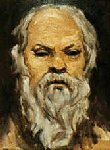 In Book Five, the Philosopher King is mentioned, though Socrates does not talk as much about the king himself as much as he talks about distinguishing knowledge from other things, such as opinion. (The Philosopher King is discussed in more detail in Book Six.) Socrates says, "Unless philosophers become kings in our cities, or unless those who now are kings and rulers become true philosophers, so that political power and philosophic intelligence converge, and unless those lesser natures who run after one without the other are excluded from governing, I believe there can be no end to troubles, my dear Glaucon, in our cities or for all mankind." What a blow to every political leader of that time. No wonder they all wanted him dead. But whether anyone wants to admit it or not, Socrates is so true with this point. However, he does not go into too much more detail about the king himself. At this point he begins to discuss the values of knowledge and the truth about opinions. He begins by explaining that if a person loves something, they love all of it, or else they really love none of it. So, true philosophers love all wisdom, and not simply fragments of it. Thus, anybody that is only half-heartedly in love with wisdom is not a true philosopher. Socrates then explains about opposite things- ugly and beauty, justice and injustice, good and bad, etc. He says that even though they are opposites, each exists none-the-less and still has distinct traits; they appear in many forms but each is still distinct in their own respect. The same is true for people who love wisdom and people who like it. In particular, Socrates is separating the philosophers from the artists. (This is where Socrates really lands a blow against the playwrights.) An artist can love sites and sounds, but is he really able to see beauty itself? How can one see beauty? Well, if you think beauty could exist, but you don't think it ever will, then you are dreaming; only those who are awake can understand what beauty really is. Socrates explains that the dreamer only has opinions of beauty, since he can only make assumptions and cannot clearly see beauty. However, the person who is awake knows beauty, and thus has knowledge of beauty. If all a person can do is cling to other people's opinions, then those opinions will consume him and hold him captive from being able to form his own opinions. These type of people are poor debaters, because rather than speak out of knowledge, they speak with opinions and are not able to defend their words. They then begin speaking out of passion and anger, but it is the duty of the others in the discussion to speak to him calmly so as not to anger him more. Socrates then provides us with quite an interesting paradox: "Does a man who knows know something or nothing?" Well, can you answer that? Glaucon responds "He knows something." Socrates immediately asks "Is it something that is or is not?" By this point, I would have given up, but somehow Glaucon retains his sanity and declares that it would have to be something that is, because someone could not know something that is not. (I hope you're still with me here...) So Socrates tells his that "That which entirely is is entirely knowable, but that which in no way is is entirely unknowable." So he then describes that knowledge is knowing something that is, while ignorance is "knowing" something that is not. With this, Socrates differentiaties opinion and knowledge- while knowledge and ignorance deal with reality and unreality, respectively, opinion deals with something in between. After all, you have to have something in order to have an opinion, but you would not have knowledge of it if you do not completely know it. Socrates' last big idea comes on the last couple of pages. He explains how things that are beautiful can sometimes appear ugly, and things that are just can sometimes appear unjust, just as most anything can appear in its opposite form. So, wouldn't these things exist between reality and unreality? In other words... if something can appear in two forms, wouldn't it be an opinion? I say something is beautiful, but you might see it as ugly. Concluding with this point, Socrates explains that if someone beholds "many beautiful things but cannot see beauty itself- and will not permit another to guide them as to where it is", then they can only have opinions and will never know knowledge. However, if someone loves to think and is always seeking answers, they are a lover of knowledge- otherwise, a person is merely a lover of opinion. Last, Socrates explains that the Philosopher King can look upon tragedies with a comical outlook and look upon comedies and begin forming ideas. For example, if a wise philosopher were to watch Oedipus, he would immediately dismiss the fact that all that could happen. However, if he were to see Lusystrada, where the women hold back sex from men to get the men to work harder and fight stronger, he might begin to say, "Hey... this could really work..." In Book Five, the Philosopher King is mentioned, though Socrates does not talk as much about the king himself as much as he talks about distinguishing knowledge from other things, such as opinion. (The Philosopher King is discussed in more detail in Book Six.) Socrates says, "Unless philosophers become kings in our cities, or unless those who now are kings and rulers become true philosophers, so that political power and philosophic intelligence converge, and unless those lesser natures who run after one without the other are excluded from governing, I believe there can be no end to troubles, my dear Glaucon, in our cities or for all mankind." What a blow to every political leader of that time. No wonder they all wanted him dead. But whether anyone wants to admit it or not, Socrates is so true with this point. However, he does not go into too much more detail about the king himself. At this point he begins to discuss the values of knowledge and the truth about opinions. He begins by explaining that if a person loves something, they love all of it, or else they really love none of it. So, true philosophers love all wisdom, and not simply fragments of it. Thus, anybody that is only half-heartedly in love with wisdom is not a true philosopher. Socrates then explains about opposite things- ugly and beauty, justice and injustice, good and bad, etc. He says that even though they are opposites, each exists none-the-less and still has distinct traits; they appear in many forms but each is still distinct in their own respect. The same is true for people who love wisdom and people who like it. In particular, Socrates is separating the philosophers from the artists. (This is where Socrates really lands a blow against the playwrights.) An artist can love sites and sounds, but is he really able to see beauty itself? How can one see beauty? Well, if you think beauty could exist, but you don't think it ever will, then you are dreaming; only those who are awake can understand what beauty really is. Socrates explains that the dreamer only has opinions of beauty, since he can only make assumptions and cannot clearly see beauty. However, the person who is awake knows beauty, and thus has knowledge of beauty. If all a person can do is cling to other people's opinions, then those opinions will consume him and hold him captive from being able to form his own opinions. These type of people are poor debaters, because rather than speak out of knowledge, they speak with opinions and are not able to defend their words. They then begin speaking out of passion and anger, but it is the duty of the others in the discussion to speak to him calmly so as not to anger him more. Socrates then provides us with quite an interesting paradox: "Does a man who knows know something or nothing?" Well, can you answer that? Glaucon responds "He knows something." Socrates immediately asks "Is it something that is or is not?" By this point, I would have given up, but somehow Glaucon retains his sanity and declares that it would have to be something that is, because someone could not know something that is not. (I hope you're still with me here...) So Socrates tells his that "That which entirely is is entirely knowable, but that which in no way is is entirely unknowable." So he then describes that knowledge is knowing something that is, while ignorance is "knowing" something that is not. With this, Socrates differentiaties opinion and knowledge- while knowledge and ignorance deal with reality and unreality, respectively, opinion deals with something in between. After all, you have to have something in order to have an opinion, but you would not have knowledge of it if you do not completely know it. Socrates' last big idea comes on the last couple of pages. He explains how things that are beautiful can sometimes appear ugly, and things that are just can sometimes appear unjust, just as most anything can appear in its opposite form. So, wouldn't these things exist between reality and unreality? In other words... if something can appear in two forms, wouldn't it be an opinion? I say something is beautiful, but you might see it as ugly. Concluding with this point, Socrates explains that if someone beholds "many beautiful things but cannot see beauty itself- and will not permit another to guide them as to where it is", then they can only have opinions and will never know knowledge. However, if someone loves to think and is always seeking answers, they are a lover of knowledge- otherwise, a person is merely a lover of opinion. Last, Socrates explains that the Philosopher King can look upon tragedies with a comical outlook and look upon comedies and begin forming ideas. For example, if a wise philosopher were to watch Oedipus, he would immediately dismiss the fact that all that could happen. However, if he were to see Lusystrada, where the women hold back sex from men to get the men to work harder and fight stronger, he might begin to say, "Hey... this could really work..."
There are not really too many connections between this wave and the human soul, since Socrates technically isn't talking about the City in Speech. Basically, the only thing you can relate here is the fact that the wise part of a person's soul should be the part leading it, rather than passion or anger.
In conclusion...
- If someone loves something, they should love all of it
- Knowledge and opinion are distinctly different
- Things such as beauty and justice have opposites, and are objects of opinion unless a person knows beauty and really loves it
- A person should let the wise part of their soul rule their soul
A riddle is mentioned in this part of Book Five-
A man who was not a man, seeing and not seeing a bird that was not a bird upon a branch that was not a branch, struck it and did not strike it with a stone that was not a stone.
A eunuch with imperfect eyesight threw a pumice stone at a bat that was sitting on a reed and missed.
|