| When Socrates is finished discussing his ideas behind sexual equality, he easily allows it to lead into his next topic- eradication of families. He discusses many interesting points, and again causes quite and commotion among his companions. Socrates is immediately attacked with the problem of incest, to which it is clear he had already anticipated and was ready with an answer. Other key points are his ideas of rewarding the valiant warriors with more women. From what you read about Wave One, why do you think Socrates suggests rewarding the strong warriors in this way?
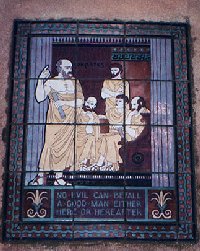 After Socrates explains why men and women should be treated as equals and given equal positions as guardians, he explains the purpose of this idea by suggesting that family units no longer exist. He says to Glaucon "that all the women shall belong to all the men and that none shall cohabit privately; that the children should also be raised in common and no child should know its parent nor the parent its child." Whoa, what? Is he saying that parents should give up their child to the state, never knowing who their child really is? Socrates really shocks his listeners with this one, but he is quick with his reasoning. The lawgiver of the city will have selected the strongest men and the strongest women that best match the men in nature. They will all live together in a house, and there will be no private property; everyone lives, eats, and exercises together. Socrates asks Glaucon, The necessities of nature, I presume, would see to it that they will also mate with one another. Or is necessity too strong a word?" Glaucon responds: "Not if you mean the necessities of love. They attract and compel most people with far greater force than all the geometric necessities posited by the mathematicians." However, Socrates strictly suggests that marriages in a society must be as sacred as possible in order to ensure that no irregularities in love occur. He goes back to his analogy of the dogs, asking Glaucon how breeders select which ones to breed. Of course, they breek the strongest male and female dogs together. Should humans not operate in the same way, mating the strongest men and strongest women together, to produce the stronest possible offspring? But Socrates realizes this is a difficult task. He tells Glaucon that the leader of the city would have to fabricate some lies to the public in order for this to work. However, he calls this type of lie "medicine," because it is curing the public of its ill qualities. But who would the leader be lying to? Well, if the strong mate with the strong... then that would leave the weak to mate with the weak. However, in order for there to be no jealousy or feeling of non-importance among the cobblers (and even to make sure the guardians do not become stuck up), a large marriage ceremony will take place with the citizens. The date of the ceremony is selected by the leader; it does not happen too often but it happens just enough, so that the population is neiter too big nor too small. Socrates tells Glaucon that some sort of "ingenious" lottery would need to be invented so that the weak men and women can only blame their outcome on pure luck. Of course, this would be one of the medicated lies, because the system would be completely false and the strong would also be with the strong, while the weak would always be with the weak. After the children are born, the strong ones are placed together in a group, according to when they were born, and are taken care of by all the guardians who mated in accordance with those children. So, it is a group of parents taking care of a group of children. If the children are born with any iregularities, they are placed with the inferior children to be taken care of by the cobblers. If a child is born of wedlock (and they can tell, because children can only be born around a certain period of time after the festivals) then he is also placed with the inferior children. As they children grow, they are taught to either be good guardians or good cobblers. The guardian children even go to war with the guardian parents to learn the art; however, they are given horses to carry them away in case of danger. This also serves another purpose. If one's offspring are present with them at war, would the warrior not do better in battle? Along with the topic of war, any man that comes home from battle victoriously and did excellent in battle shall have the oppurtunity to receive more women- thus a strong man will be mating more often to produce more strong children; in a similar way, warriors the act cowardly are demoted to cobblers. As this conversation begins to wind down, Socrates is confronted with the possibility of incest. However, he is quick to suggest that since relatives are placed in the same group with one another, this would not happen. Brothers and sisters can also sleep with each other as long as the circumstances allow it and the Oracle at Delphi approves of it. Lastly, Socrates explains that men and women will have a age limit for mating. Men enter their prime when they have successfully shown swiftness in running and can have children until they are 55, where women will begin mating when they are 20 and will continue to do so until they are 40.
We know by now that Socrates has his hidden meanings behind his words. By placing all the strong children together, would he not be suggesting that our emotions and feelings in our soul be placed together? The strong children are all cared after by all the guardians. Similarly, we should allow our emotions and feelings to be look after by our soul, more particularly, ruled evenly by the masculine and feminine sides of the soul. Since there are no possessions among the men and women, and all are treated equally, no one side of the soul should rule all emotions, but instead the emotions should be equally distributed by the soul. Of course, the issue of incest arose. Perhaps this is hinting that if emotions mix with each other, for instance anger and rage, bad things could happen. However, since the children are, for the most part, distinctly labeled in groups, the chance for incest is low. So, if emotions are distinctly separated, then they will have little chance to mix with each other and cause problems.
In conclusion...
- The strong mate with the strong, the weak with the weak
- Strong children are placed together to be ruled by all of the guardians; Emotions should be ruled equally by both parts of the soul
- There is a organized festival at which men and women are married
- The chance of incest is surprisingly low since the children born around the same time are placed together; If one's emotions are equally ruled by both parts of the soul, there will be little chance for them to mix and cause trouble
|