|
|
| Synopsis of Book Five |
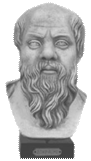 Book Five of Plato's Republic is often viewed as the humorous section of the entire piece. In this section, Socrates and Glaucon analyze three "waves," as they come to be called. The first of these waves deals with sexual equality between men and women. If a man and a woman are skilled at the same job, are they equal by nature? This question is elaborated on, and this wave is found described in more detail here. In the second wave of the discussion, Socrates explains why their city should do away with nuclear families. If women exercise as equals with men then they will become strong. If the strong mate with the strong, will the offspring not be strong as well? Socrates has some interesting ideas in this wave, and the purpose of sexual equality (at least, one of the purposes) is made clear when he introduces its role in the eradication of family. Read more about this wave here. Finally, we get to what Socrates defines as "the greatest of the waves." He tells Glaucon that he "will speak even if it [the wave] break over my head and drown me in a flood of laughter and derision." This wave of the discussion introduces the concept of the Philosopher King. Who can play this most crucial role in society? What is a philosopher? More importantly, what is the difference in opinion and knowledge? Is there a difference? This section is rather straightforward; it doesn't really have any hidden meanings except that the human soul should be ruled by its Wise portion rather than its more passionate ones. The greatest of the waves is broken down into more detail here. Book Five of Plato's Republic is often viewed as the humorous section of the entire piece. In this section, Socrates and Glaucon analyze three "waves," as they come to be called. The first of these waves deals with sexual equality between men and women. If a man and a woman are skilled at the same job, are they equal by nature? This question is elaborated on, and this wave is found described in more detail here. In the second wave of the discussion, Socrates explains why their city should do away with nuclear families. If women exercise as equals with men then they will become strong. If the strong mate with the strong, will the offspring not be strong as well? Socrates has some interesting ideas in this wave, and the purpose of sexual equality (at least, one of the purposes) is made clear when he introduces its role in the eradication of family. Read more about this wave here. Finally, we get to what Socrates defines as "the greatest of the waves." He tells Glaucon that he "will speak even if it [the wave] break over my head and drown me in a flood of laughter and derision." This wave of the discussion introduces the concept of the Philosopher King. Who can play this most crucial role in society? What is a philosopher? More importantly, what is the difference in opinion and knowledge? Is there a difference? This section is rather straightforward; it doesn't really have any hidden meanings except that the human soul should be ruled by its Wise portion rather than its more passionate ones. The greatest of the waves is broken down into more detail here.
|
|