 |
|
|
|
Portrait
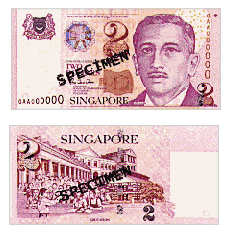
Series - $2
|
|
The
$2 note shows a group of pupils interacting with a
teacher in a "Borderless Classroom". Three
prominent institutions of learning are seen in the
background. From the extreme right, the institutions
are Victoria Bridge School, the old Raffles
Institution at Bras Basah Road, and the College of
Medicine. Besides being closely associated with the
late Encik Yusof at various stages of his life, the
three institutions also symbolically represent the
ideal educational progression in Singapore, namely
primary, secondary and tertiary.
|
|
|
|
Also
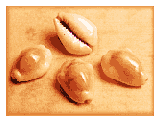
on the front of the $2 note is the Money Cowrie (Cypraea
moneta Linnaeus, 1758). As its name implies, it was
commonly used as a form of currency among the
communities in the Indian and Pacific Oceans during
the past. Humans have carried shells of this
particular species to practically all parts of the
world because of their beauty and remarkable gemlike
shape and handy size.
|
|
The
back of the shell is usually yellow, with a fine
filamentous red ring. This species is found in the
shallow inter-tidal zone of rocky shores and has a
wide distribution in the Indo-West Pacific region.
|
|
Portrait
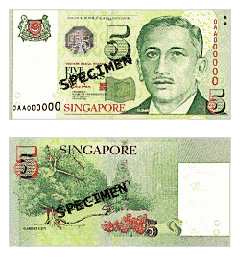
Series - $5
|
|
The
Garden City Theme exemplifies Singapore as a garden
city, the pride of our citizens. The back of the $5
note features a dramatic Garden City landscape
dominated by the portrayal of the old tembusu tree (Fagraea
fragrans) which still stands in the grounds of the
Singapore Botanic Gardens. The majestic tree of more
than 200 years is characterised by its firm and
towering presence. The tree bears small red berries
and has white flowers that are exceptionally fragrant.
The sturdy tree with its highly branched canopy,
epitomises the spirit of Singapore - strong, resilient
and continuously striving for progress.
|
|
|
|
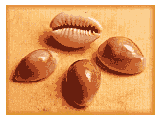
Also
pictured on the front of the $5 note is the
Gold-Ringed Cowrie (Cypraea annulus Linnaeus, 1758).
Like its relative the Money Cowrie, this species is
very abundant and is found living in the inter-tidal
zone, usually in shallow tide pools high above water
level. It is also one of the more variable species in
the genus.
|
|
A
typical Gold-Ringed Cowrie has a greenish-yellow back,
encircled by a bright orange-yellowish band with a
cream-coloured base. The egg cluster, about the size
of the animal, is light cream. Its distribution is in
the Indo-West Pacific.
|
|
Portrait
Series - $10
|
|
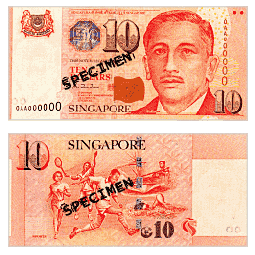
The
Sports Theme is reflected in the $10 note through the
depiction of five popular sports pursuits. On the back
of the note, we see a jogger, a tennis player and a
soccer player on one side, representing the most
favoured land sports in Singapore. On the other side,
swimming and sailing are pictured representing water
sports. These are illustrated against a vibrant
general design to convey the sense of energy and
ruggedness symbolising sporting activities in general.
|
|
|
|
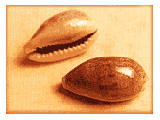
The
note also shows the Wandering Cowrie (Cypraea errones
Linnaeus, 1758). A variable member of the genus, this
species is difficult to describe but easy to recognise
by the mottled green top with a large, brownish and
centrally located blotch. This blotch may vary in
shape and size from specimen to specimen.
|
|
The
size range is between 13 and 43 mm. Having an
Indo-West Pacific distribution, this animal is a
shallow-water resident, found at the inter-tidal zone
and down to a few metres below mean low tide level.
Although its numbers have declined in Singapore, it
still remains the most common cowrie here.
|
|
Portrait
Series - $50
|
|
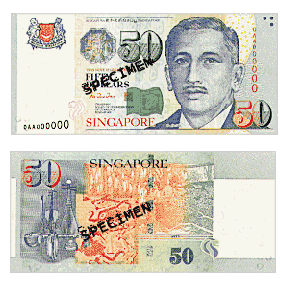
The Arts
Theme as the secondary design for the $50 note
reflects the coming-of-age of the Singapore Arts
scene. The design appropriately depicts a mix of four
ethnic musical instruments. The Chinese Pipa, Malay
Kompang, Indian Veena and Classical Violin epitomise
Singapore as a confluence of Chinese, Malay, Indian
and Western cultures. The instruments are complemented
by portions of two local artworks in the Singapore Art
Museum, entitled "Gibbon" and "Drying
Salted Fish". The works represent the development
and achievements of artists in the country.
|
|
|
|
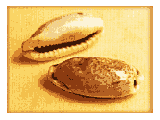
The
Cylindrical Cowrie (Cypraea cylindrica) decorates the
front of the $50 note. The shell of this animal is
cylindrically elongated and its back is bluish grey
with a large central irregular blotch. It is found
widely in central Indo-West Pacific and Micronesia,
ranging from Okinawa, Japan, to northwestern Australia
and from the Malay Peninsula to New Caledonia.
|
|
This
species is moderately common in the inter-tidal and
shallow sublittoral zones.
|
|
Portrait
Series - $100
|
|
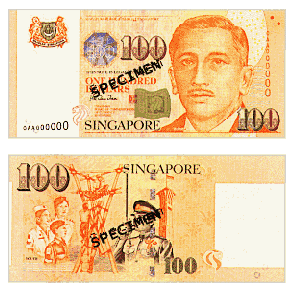
The
Youth Theme exemplifies the aspirations, ruggedness
and community spirit of youths in Singapore. On the
back of the $100 note, these are represented by three
aspects of youth activities, namely Youth in Community
Service, Youth in Action and Youth in Leadership
Development. On the left of the design is a group of
uniformed youths representing the Singapore Red Cross,
St John's Ambulance Brigade and the National Police
Cadet Corps.
A National Service officer bearing a ceremonial sword
stands against a backdrop of the magnificent tower of
the SAFTI military institute.Situated in the centre of
the design is a group of scouts engaged in an outdoor
scouting activity.
|
|
|
|
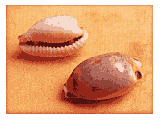
The
$100 note also carries the picture of the Swallow
Cowrie (Cypraea hirundo Linnaeus, 1758). The mollusc
is found over much of the Indo-West Pacific region and
usually lives on wave-beaten reefs at low tide, under
coral slabs and rocks. This species was originally
described from Mauritius and India with other
variations reported from as far as northwestern
Australia and Japan.
|
|
The
shell of this animal has two distinct dark brown spots
on the ends and the surface is bluish green with
minute brown speckles. It is moderately common in
shallow rocky habitats.
|
|
Portrait
Series - $1,000
|
|
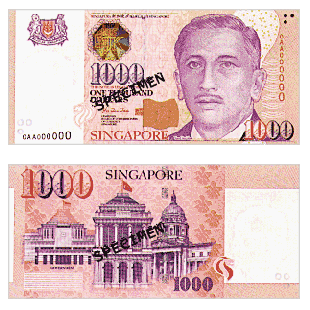
The
back of the $1,000 note features buildings
representing the Executive, the Legislature and the
Judiciary. The Istana building, the official residence
of the President of Singapore, symbolises the
President and the Executive. It is depicted in the
centre of the design. Flanking the Istana are the
Parliament House on the left and the Supreme Court
building on the right. The Parliament House and the
Supreme Court represent the Legislature and the
Judiciary respectively.
|
|
|
|
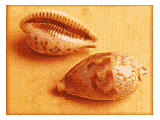
The
$1,000 note also features the Beautiful Cowrie (Cypraea
pulchella Swainson, 1823). This animal was considered
another of the rare gems of the genus until about
1968. The graceful pear shape, contrasting large
chestnut blotches and distinctly marked teeth make
this cowrie unusually attractive. Specimens of this
species are quite common and are usually found
offshore from depths of 30 m to 140 m.
|
|
They
are found over a wide range although most old
collections were reported from the Chinese coast of
Hong Kong.
|
|
Portrait
Series - $10,000
|
|
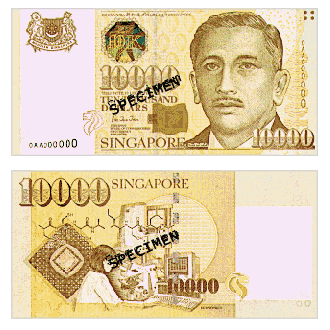
The
back of the $10,000 note depicts the future direction
of our economy, one which is knowledge-based and
technology-driven. It features a research scientist
working on high-technology laboratory equipment. A
microprocessor and a silicon wafer, representing
Singapore's drive to create a high-tech manufacturing
hub, are seen in the backdrop on the left and
right-hand side respectively. Partial sequences of two
proteins, the tyrosine kinase and the tyrosine
phosphatase, representing two important breakthroughs
in research by the Institute of Molecular and Cell
|
|
|
Biology
(IMCB) appear at the top. A subtle background pattern
of the printed circuit board completes the design.
|
|
|
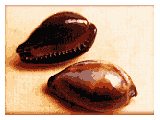
The
Onyx Cowrie (Cypraea onyx Linnaeus, 1758) is also
shown on the $10,000 note. The jet black base, the
brown and usually banded back and the white pearly
overlay on the sides or the whole shell make
identification of this species easy. The mantle of the
live specimen is greyish with many tiny circular dots
very closely distributed on it. A variant of this
animal from Sri Lanka is reportedly considered a food
item.
|
|
An
Indo-West Pacific cowries, this species has been
reported from shallow muddy water in Singapore as well
as at depths of 30 m or more in Japan.
|
| |
|
|


