|
Laws and regulations
Laws
and regulations are one of the most important part of our
project on notes and coins. Although one may claim that he
knows a lot about notes and coins, I believe that there are
some very interesting laws being passed on money.
First
everyone should know that all notes are allowed to be
reproduced so long that they follow the following laws:
| (a)
|
the
use of the reproduction of currency must maintain, and
not detract from, the dignity and image of the
currency and any emblem or design thereon;
|
| (b) |
The
reproduction of currency - |
| |
i) |
must
be in black or white or in the same colours as the
actual currency notes and coins; |
| |
ii) |
must
not show currency notes and coins distorted in shape,
colour, design and in any other manner; |
| |
iii) |
must
not show currency notes and coins protruding from
objects or receptacles, overlaid with any object or
article, or folded or rolled or otherwise depicted in
the shape of any object; |
| |
iv) |
must
not be featured with any design which shows disrespect
to any other country; |
| |
v) |
must
not be used in connection with any advertisement
relating to the consumption of alcoholic drinks or
with the smoking of cigarettes or other forms of
tobacco. |
| |
vi) |
must
not be used for ornamental or decorative purposes |
|
|
|
|
|
|
| (c) |
the
reproduction of currency notes - |
|
| |
i) |
must,
unless the reproduction is in an electronic form, be
at least one-half larger in linear dimension (that is
half the length and half the width longer than the
actual note size) or at least two-fifths smaller in
linear dimension (that is two-fifths of the length and
width shorter than the actual note size); |
|
| |
ii) |
must
be enlarged or reduced in size in the right
proportions; |
|
| |
iii) |
must,
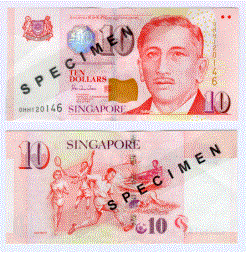
in the case of currency notes depicted flat (whether
partially or wholly), contain the word
"SPECIMEN" in black and bold, lettering
diagonally across the reproduction (but which must not
cover any part of the portrait); |
|
| |
iv) |
must
not be by way of duplex printing (that is the printing
of the design of currency notes on the front and back
of any paper is not permitted); |
|
| |
v) |
must
not be on watermarked currency paper; |
|
| d) |
that
all negatives, blocks, plates and other materials used
in making the reproduction of currency must be
destroyed when they are no longer required. |
|
|
|
|
|
|
An example of a reproduced
note.
Another
feature is the changing of mutilated notes. The board of
currency has allowed mutilated notes to be change for crisp
ones as long as half the serial number of the note has been
retained, and the notes are not disfigured. As for coins, as
long they are not chipped or holed or disfigured in any form. |



