|
1ST
SERIES - THE ORCHID SERIES CURRENCY NOTES (1967 - 1976)
This
series has nine denominations. The dominant feature is a spray
of orchid in the center of the front of each note. On the
front, all notes have the Singapore Arms, a watermark of a
lion's head and the signature of the Minister for Finance and
Chairman of the Board of Commissioners of Currency, Singapore.
With the exception of the $10,000 note, which has two security
threads, each note has a single thread embedded vertically
across the note. A scene of Singapore is depicted on the back.
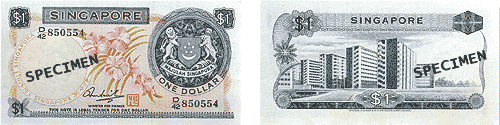
$1-denomination
The
front design is a Vanda Janet Kaneali and the back design is
blocks of flats in a housing estate. The note was first issued
in 12 June 1967. There
are about fifty to seventy generally large monopodial mostly
epiphytic and a few lithophytic and terrestrial species as
well. Although distributed mainly in the Asiatic region,
species are found from Sri Lanka and southern India to New
Guinea and Australia, as well as China, Taiwan and the
Philippines. Species produce a lateral inflorescence bearing
few to many-flowers. Flowers are often very showy yellow-brown
with brown markings medium-sized to fairly large blossoms.
Many species have been used intensively for hybridizing,
resulting in a most stunning array of flower colors, shapes
and sizes. In the 1960s,
people that needed public housing urgently were from the
lower-income group. The Housing and Development Board (HDB)
decided to provide high-rise flats for the people. The HDB
faced several problems such as the lack of land area, the
resettlement of people and the Bukit Ho Swee fire causing
people to be homeless. However, the HDB managed to overcome
the problems with the First Five-Year Building Programme.
Thus, with having flats as the back design, the government
wanted to commemorate HDB’s achievements to improve housing
conditions and solve the problem of housing shortage.
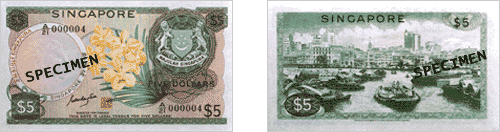
$5
denomination
The
front design is a Vanda T.M.A. (hybrid of Vanda sanderiana and
Vanda Josephine Van Brero) while the back design is a busy
scene on the Singapore River. The note was first issued in 12
June 1967. In
1882 one of Mr. Sanders explorers by the name of Roebelin was
dispatched to the Philippines to search for new species, one
day, as a guest of a "savage" chieftain south east
of Mindanao, he found himself accommodated in a tree house
which was perched high in the canopy of one particularly
large tree, so as to be "well out the way of
animals". Early in the morning whilst it was still dark
he awoke to a deep throated roaring sound and found the tree
swaying wildly, it became apparent that an earthquake had
shaken the forest, and in particular his abode, throwing all
his companions to the ground, destroying his makeshift ladder,
and leaving him isolated in the ruins of the tree house. When
dawn broke, he lay back, gazing forlornly through a hole in
the remnants of his roof, and he noticed some very large
flowers of a lilac and cinnamon colouring growing in the very
tree he had chosen as a campsite, climbing up he identified
the orchid as a new species and named it Vanda Sanderiana. One
of the many popular hybrids, Josephine van Brero has large
sprays of pink or orange flowers, usually twice a year. In the
early days of Singapore, the port was located at the mouth of
the Singapore River, so most of the trading activities were
carried out there. As more and bigger ships arrived, the
Singapore River became overcrowded, as seen in the back design
of the note. Having the Singapore River as the back design of
the note brings back the nostalgic atmosphere, reminding us of
what our forefathers did for a living when they first came
here.
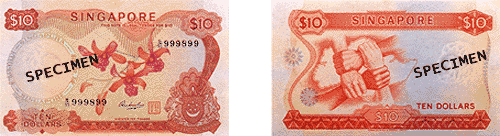
$10
denomination
The
front design is a Dendrobium
Marjorie Ho "Tony Pek", while the back design is a
picture of four clasped hands on a background of a map of
Singapore. The note was first issued in 12 June 1967. Dendrobium
means "living on a tree". Dendrobium is such a large
genus that it could fill a book (or two) all by itself! There
are over 900-1,000 species ranging from India, Sri Lanka,
Japan, Philippines, Malaysia, Indonesia, New Guinea,
Australia, the Pacific Islands, and New Zealand. Most are epiphytic
or lithophytic
in nature. Because species are extremely variable due to their
widely ranging habitat conditions, new species were difficult
to associate with Dendrobium resulting in the dozens of other
genera and new genera filled with them (thus the large genera
synonym list). There have been some attempts and discussion to
split this genus up into smaller units. Someday that may
happen. The picture of
four clasped hands on the background of a map of Singapore is
especially significant as it resembles the four hands of the
four main races in Singapore, namely the Chinese, Malays,
Indians and Eurasians. It tells us that Singapore is united
and has racial harmony, reminiscently reminding us of the 1964
race riots in Singapore. The race riots had shown how easily
the peace and harmony in Singapore could be broken, so the
government now emphasizes on the importance of racial harmony,
if not, a complete breakdown of order would happen again.
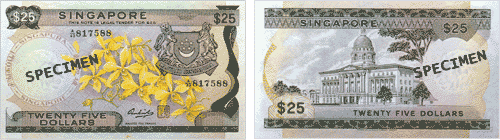
$25
denomination
The
front design is a Renanthopsis
Aurora, while the back design is a picture of the Supreme
Court building. The note was first issued on 7 August 1972.
There are about 15 large vining monopodial epiphytic or
occasionally terrestrial species in the genus distributed in
northeast India, China, Southeast Asia, New Guinea, and the
Philippines. Species produce a branched inflorescence of
orange-red flowers with large lateral sepals. Species are
related to genus Ascoglossum and genus Renantherella differing
only in flower structure. The last classical building to be
completed in Singapore, the Supreme Court opened in 1939 as
the first stage of a grand design to replace Parliament House,
the Victoria Theatre and the Singapore Cricket Club. However,
World War II intervened and the plan was fortunately, shelved.
The Supreme Court is of great historical value to Singapore
and is one of its national monuments. As it is used as the
back design of the note, this shows that the government would
like the future generation of Singaporeans knowing about the
Supreme Court and being proud of it.
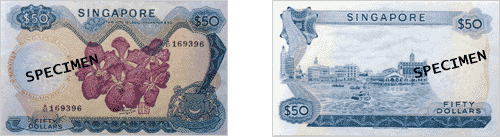
$50
denomination
The
front design is a Vanda
Rothscildiana "Teo Choo Hong", while the back
design is a picture of the Singapore seafront and the Clifford
Pier. The note was first issued on 12
June 1967. Crimson
and yellow. In bud, the petals face downward, but they open up
to a backward arch. It is the bizarre shape of the flower and
its vivid colors that make one gasp at the sight of it! Other
aspects of the plant are unusual; it is a twining vine, with
tendrils coming from the tips of the leaves. Native to
tropical parts of Asia and Africa. Likes full sun to part sun.
Singapore’s
large, natural port has served it in good stead, even before
its "founding" by Stamford Raffles in 1824. By the
end of Queen Victoria's reign, Singapore had become a
strategically-situated bastion of British imperialism in Asia
-- Great Britain's so-called "Gilbrator of the
East." With its business emphasis oriented toward the
sea, Singapore's harbor was a busy place. Local and regional
trade was conducted among the go-downs of Boat and Clarke
Quays on the Singapore River; steamer and freighter visitors
to Singapore would disembark from bumboats at Clifford Pier,
prominently located at Collyer Quay, Singapore's historic
waterfront. The government here is also trying to show another
historical monument of Singapore to the younger generation and
immortalize it in the form of money.
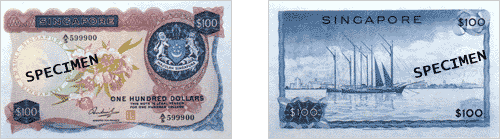
$100
denomination
The
front design is a Cattleya, while the back design is a picture
of a peaceful scene along the Singapore waterfront. The note
was first issued on 12 June 1967. The genus Cattleya is
dedicated to William Cattley, a 19th century English
horticulturist; one of the earliest persons to build a
collection of exotic orchids and who "discovered"
the first Cattleya among some packing material. Generally
called The Queen of Flowers" many of the individual
Cattleya species have their own nicknames, in particular,
Cattleya labiata, the "Corsage Orchid".
There are about 48 epiphytic
species in this genus distributed throughout tropical America.
They are usually found residing in the tops of the wet forest
trees from sea level to 5,000 feet. When you say
"Orchid" to the average person, it's the well-known
Cattleya blossom that will come to mind... and that blossom is
most likely a hybrid. The popular Cattleya genus is perhaps
the most hybridized of the Orchid genera resulting in a very
wide variation in blossom color and form. Cattleya hybrids are
one of the primary interests and challenges to orchid
enthusiasts with many specializing exclusively in these genera
and its hybrids. The peaceful
scene along the Singapore waterfront, more or less signifies
the peacefulness which Singapore has, not having any riots,
strikes or war. The government most probably wants the peace
in Singapore to remain this way and to keep out of trouble.
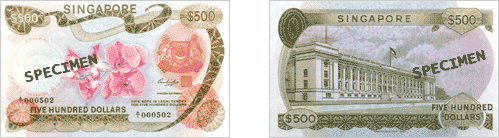
$500
denomination
The front design shows a Dendrobium
Shangri-La and the government offices at St. Andrews Road on
the back. It was first issued on 7 August 1972.
The
government offices on the back design of the note implies that
the government offices are indeed an important landmark in
Singapore. This picture is another place of historical value.
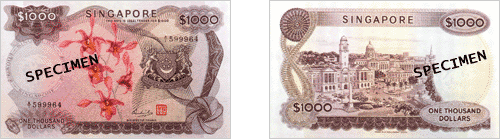
$1000
denomination
The
front design contains a Dendrobium
Kimiyo Kondo "Chay”, with Victoria Theatre and Empress
Place on its back. The note was first issued on 12 June
1976. Needless
to say, both Victoria Theatrre and Empress place were
historical monuments and places that have existed before the
independence of Singapore.
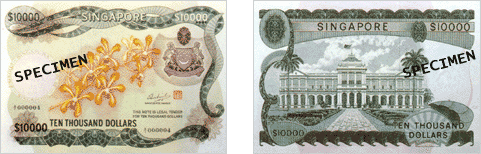
$10
000 denomination
The
front shows an Aranda Majulah while the back shows the Istana.
This note was first issued on 29 January 1973.
The Aranda
Majulah was named after the fancied resemblance of the
flowers to a spider. There are about twenty large, often
climbing monopodial epiphytic species in this genus
distributed throughout Southeast Asia, New Guinea, and the
Solomon Islands. Species produce a highly variable
inflorescence; short or long, erect or pendent, simple or
branched, bearing few to many flowers. The long-lasting
flowers typically have large sepals and petals, a small-hinged
lip, and are often barred in brown color. Species are closely
allied to genus Vanda and Renanthera.
Parallel to the Aranda Majulah, the Istana is one of the most
important buildings in Singapore, as it is the presidential
house, while the Aranda Majulah is a rare and valuable orchid.
|



