|
2ND
SERIES-THE BIRD SERIES CURRENCY NOTES (1976 -1984)
This
series also has nine denominations as in the first except that
a $20 note was introduced to replace the $25 note of the
Orchid series. The dominant feature is a bird on the left side
of the front of each note. The birds depicted on the notes are
noted for their strength, adaptability and independence which
characterize the young Republic of Singapore with the
potential of soaring to greater heights in its progress.
On the front, all notes have the Singapore Arms, a watermark
of a lion's head and the signature and seal of Minister for
Finance and Chairman of the Board of Commissioners of
Currency, Singapore. With the exception of the $1,000 and
$10,000 notes which have two security threads, each note has a
security thread embedded vertically across it.
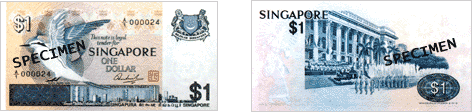
$1
denomination
The
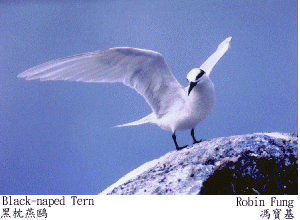
front design is a Black-naped
Tern and the back design is of the National Day Parade.
The note is first issued on 6 August 1976.
One
of the three species of terns that breed during late
May-September on Pelong Rocks, the Black-naped tern is the
smallest tern found on Pelong Rocks. The length combined from
the body and tail is 31cm. It has a wholly - white plumage
with a black crescent on the nape. Its long, deeply forked
tail is visible during flight and its thin bill and feet are
black. Usually, the Black-naped tern lays two eggs on bare
exposed rock. The
bird breeds during late May-September.
Singapore’s national day is in August, which is
inside the period mentioned. The fact that the Black-naped tern is the smallest tern in
Pelong Rocks signifies the size of Singapore as a nation
compared to our neighbours and the rest of the world.
Singapore
entered the 1970s as a politically stable state with a high
rate of economic growth.
Thus, with the National Day Parade as the back design,
the government most probably wanted to cultivate a sense of
belonging to the country and also remind people of the
struggle for survival and prosperity eleven years ago, in
1965.
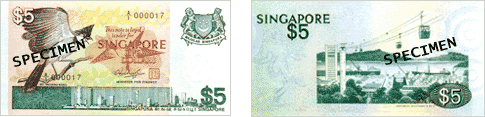
$5
denomination
The
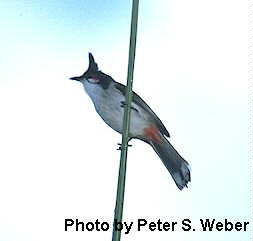
front design is a Red-whiskered Bulbul while the back design
is of the Cable
cars and aerial view of the harbour. The note is first issued in 6 August 1976.
The Red-whiskered Bulbul has a
distinct red ear patch, and red tail coverts. Both features
are very distinctive from other birds. This bulbul averages
seven inches in length and can weigh from 23 to 42 grams. The
birds are brownish above and white below their stomach region
from birth until an age six months. The head is black with a
pointed crest and there is a red patch, the
"whiskers", behind the eye. The beak is slender and
notched. Their nostrils are oval–shaped, and have bristles.
The legs and toes have little strength and are usually short.
The wings are short and rounded and the tail shape varies from
rounded to squared. Immature bulbuls resemble adults except
that they lack the red marking on the head.
The voices of the Red-whiskered Bulbul are loud and
clear consisting of short loud notes and some warbling songs.
This particular bulbul has adapted well to trees and
shrubs in large suburban areas or yards. These birds usually
stay under cover of vegetation, but occasionally perch in the
open. This bird is native to India, Nepal, Bangladesh, Burma,
and the South China coast. It has been introduced to the Malay
Peninsula, Singapore, Nicobar Islands, Mauritius, Australia,
North America, and the Hawaiian Islands. Red-whiskered Bulbul
was first sighted on Oahu in 1965 and is now very common on
Oahu.
From the description of the Red-whiskered Bulbul, we
can find many similarities of it with Singapore.
The bulbul on the $5 note do not have a red marking on
its head, thus is an immature bulbul.
Singapore in 1976 is only 11 years old, a very young,
immature nation. The
description of the bulbul emphasizes its small size, again can
be drawn parallel to Singapore’s size compared to other
nations. The fact
that Red-whiskered Bulbul are loud and clear coincides with
the point that Singapore is a “roaring mouse”, who manages
to get our message across.
The bird was first sighted in Oahu in 1965, which is
also the year when Singapore became a sovereign state.
The back design is on the cable cars.
This is because 1976 was when the cable car network
flourished. Work
on the cableway started in 1972 and was completed two years
later. On 15 Febuary 1974, the Singapore Cable Car System was
offically opened by the former Deputy Prime Minister Dr. Goh
Keng Swee. Built
at a cost of S$5.8 million, the cable car system first started
out with 43 cabins. These first generation cabins were not
automated and had doors that needed to be manually opened and
closed by cable car attendants.
The office, located on the second storey of Cable Car
Towers, consisted of merely 45 administrative staff and cable
car attendants. 1976 saw the number of cable cars grow from 43 to 51.
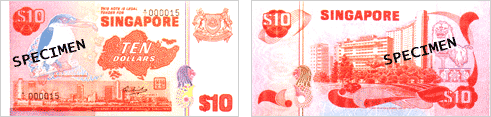
$10
denomination
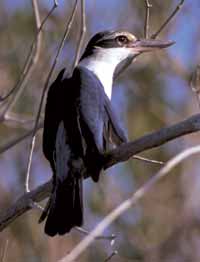
The front design is a white-collared Kingfisher and the
back is about the garden city with high rise public housing in
background. The
note is first issued on 6 August 1976.
By far the most important and significant of the birds
recorded, and arguably the jewel in the mangrove’s crown, is
the white-collared kingfisher (Halcyon chloris).
Represented at Khor Liwa by the subspecies kalbaensis (after
its type and only other locality) Khor Kalba, the
white-collared kingfisher is one of the world’s rarest
birds. The discovery of this species breeding at Khor Liwa
suggests that some young, at least, have dispersed to
establish new breeding grounds.
Most important and significant, words which can also be
used to describe Singapore ambition.
The jewel in the mangrove’s crown would mean
metaphorically, Singapore is the jewel of South-east Asia.
The fact that the young of white-collared Kingfisher
dispersed to establish new breeding grounds show their
survival skills, which Singapore showed during the nation
building period of 1965 onwards and which Singapore want to
instil in its citizens.
The public housing in the back design shows the start
of public housing programme from the government.
In 1979, after the shock of two oil crises, the
Government started a programme of economic restructuring. This
was achieved by modifying education policies, expanding
technology and computer education, offering financial
incentives to industrial enterprises and launching a
productivity campaign. Public housing was given top priority.
New towns sprang up and Housing and Development Board
apartments were sold at a low cost. To encourage home
ownership, Singaporeans were allowed to use their Central
Provident Fund savings to pay for these apartments.
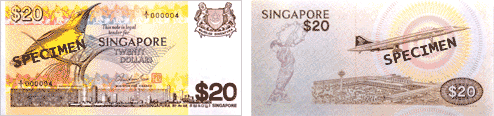
$20
denomination
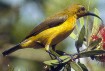
The front design shows a Yellow-breasted Sunbird while
the back design is of Changi International Airport Complex
with the Concorde in the foreground.
The Yellow-breasted Sunbird is the
smallest Sunbird (11cm), bill thin and obviously decurved;
distinctive white tips at outer tail feathers.
The females have upperparts which are dull olive brown,
all yellow, brighter yellow than other female Sunbirds.
They have a darting flight.
It is a very common resident throughout Singapore,
including North and South offshore islands.
Sunbirds form monogamous pairs. The
Yellow-breasted Sunbirds breed in April-August. They build a
hanging flask-shaped nest with an overhanging porch at the
entrance, and a trail of hanging material at the bottom end.
Materials used include plant fibres, mosses, spider's web.
Highly adaptable, they are the most common Sunbird in
Singapore and are found almost everywhere except the deepest
forest.
The description of the Yellow-breasted Sunbird contains
many common facts about Singapore. The smallest sunbird, again emphasizing on the small size of
Singapore. A
darting flight, and highly adaptable, Singapore, being small,
is also highly adaptable to changes.
This can be noted from the restructuring of labour-intensive
industries during the 1960s to late 1970s to hi-tech
industries.
Changi Airport was opened in 1981, meaning construction
had to take place a few years earlier, thus the back design.
Furthermore, Singapore used to have Concordes flying in
and out in the past.
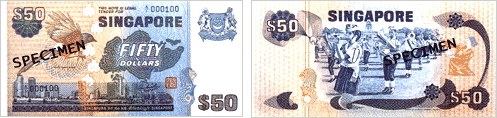
$50
denomination
The front design has a White-rumped Sharma and the back
design is about a school band on parade.
White-rumped Sharma are birds which are native to
South-east Asia, and can be seen in Malaysia and Singapore.
The bird thus represents Singapore in a way.
The school band on parade again emphasizes on the
National Day Parade, which is mentioned in the $1 denomination
notes.
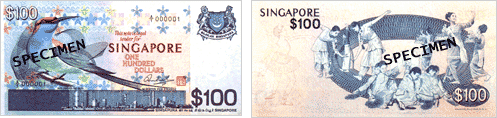
$100
denomination
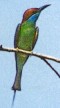
The front design shows a Blue-throated Bee-eater while
the back shows dancers of various ethnic groups.
It is first issued in 1 February 1977.
Bee-eaters get their names from
their diet of stinging insects (bees, wasps, hornets, ants).
They specialise in catching and neutralising these titbits
that other birds find unappetising or dangerous.
Bee-eaters nest in small colonies, usually of 5-20
pairs, but can reach as many as 1,000. They tunnel out a nest
and prefer light sandy soil that allows good drainage;
including beach dunes, sand quarries, even lawns, golf courses
and air fields! The
Blue-throated Bee-eater breeds in Singapore and the Malay
peninsula in April-September, then strangely migrates to
Indonesia thereafter. At the time when they leave, the
Blue-tailed Bee-eater arrives. They are probably the only bird
to breed here and migrate away during the non-breeding season.
They migrate in small groups of not more than 15. In
Singapore, they are found in scrub, mangrove, forest,
cultivated areas.
Bee-eaters diet of stinging insects which are
unappetising or dangerous is somewhat similar to Singapore’s
daring to take risks such as in 1965, opting on independence
when the future seem so uncertain.
However, Singapore has adapted well, paralleling the
bee-eater specialization in catching these insects.
Versatile can be used to describe both the bee-eater
and Singapore as the bee-eater can tunnel a nest out even in
air fields. Singapore’s
versatility would be being highly adaptable to changes in the
world.
The dancers of various ethnic groups reminds
Singaporeans the importance of racial harmony.
The racial riots of the 1960s have not been completely
forgotten and forgiven by the nation and thus the government
in producing these notes wanted the people of the country to
reconcile. The
people at that time must learn to live in harmony with the
other races for Singapore to be survive economically.
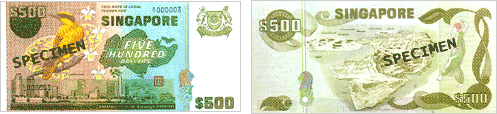
$500
denomination
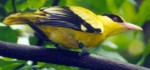
The $500 note shows a Black-naped Oriole on its front
and an oil refinery on its back.
It is first issued in 1 February 1977.
Black-naped Orioles enjoy a wide menu of plants and
animals. They are fond of fruit and berries, particularly
figs. Besides large insects, they also take small animals,
including nestlings. For this reason, during the breeding
season of other birds, Black-naped Orioles are often chased
away by other birds. Black-naped
Orioles rarely descend to the ground. They forage high in
trees and usually say within the canopy. Nevertheless, they
are not birds of the deep forest. Originally from coastal
woodlands and mangroves, they have adapted to cultivated areas
and parks and gardens. Black-naped
Orioles usually forage alone or in pairs. They are most active
in the morning and evenings, making their melodious calls as
they forage.
Versatility again shown as one can call it.
Black-naped Orioles are not restricted in their diet,
able to enjoy a wide menu of plants and animals.
The same goes for Singapore when it comes to
industries.
Oil refineries are important to Singapore economy since
the early 1900s. In
the last 30 years (1970s), Singapore grows to be largest
storage, blending, packing, distribution and bunkering centre
in the East. Thus
the oil refinery on the back of the note.
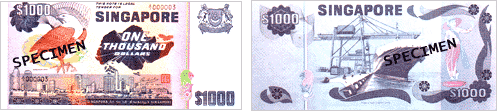
$1000
denomination
The
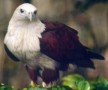
front design contains a Brahminy
Kite and the back is a container terminal.
The note was first issued on
7 August 1978.
Brahminy Kites are very common in
Singapore mostly because they are very tolerant of humans.
Being unfussy scavengers also allow them to survive in a wide
range of habitats, but they still require mangroves for
nesting sites.
It
is believed that their name Brahminy results from their
association with the Indian God Vishnu.
To the Iban of Malaysia it is the Bird-God of War. The
Brahminy Kite's presence is an omen to guide them in major
decisions such on warfare and house building.
Another
bird of versatility, and there has been enough said of that.
The second part of the bird’s description is
interesting, as Singapore also had major decisions to make in
the past.
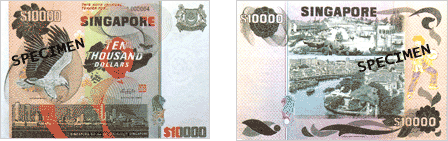
$10
000 denomination
The
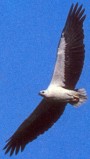
front shows a White-bellied Sea-Eagle while the back shows two
scenes of the Singapore River.
The White-bellied Fish Eagle is the largest raptor in
Singapore: with a wingspan of 50cm and body length of 70cm.
White-bellied Fish Eagles don't appear to be highly
territorial towards others of their kind. But they make loud
harsh cries near important spots like a perch or nest. These
can be heard up to 1 km away, perhaps helping to space out the
birds and avoid confrontations.
In choosing a nest site, White-bellied Fish Eagles go
for height, choosing the tallest objects near coasts or other
large bodies of water (e.g., reservoirs).
From the bird’s description symbolizes many important
aspects of the note and Singapore.
The largest raptor in Singapore is featured in this
note, as this is the largest denomination of the bird series.
The bird try avoid confrontations, as Singapore often
do with its neighbour Malaysia over many economic and social
problems. Going
for height in choosing a nest site is like going for height in
building homes, what the HDB has been doing in building
high-rise flats for Singaporeans.
The Singapore River scenes on the back are appropriate
at that time as the government lauched the Clean Rivers
Project in 1977 and has modified the river noticeably.
The cleaning-up of the Singapore River and Kallang
Basin took ten years to complete. Today, the River and Basin
are used for recreational purposes. The price of land around
these areas has been enhanced, adding to economic and social
development. |