|
The
Banana Notes
Japanese
forces invaded Malaya on 7th December 1942, and
completed their conquest of the Peninsula by 15th
February 1942. Singapore
was renamed Syonan-to, which means Light of the South.
In anticipation of this occupation, the Japanese
government had had special banknotes printed with values in
Malayan dollars. The
first issue, or series, by the military administration was in
denominations of one, five and ten dollars, which values were
intended to circulate at par with the existing British Malayan
currency notes. These
are distinguishable from the later, inflated, issues in that
they are serially numbered like regular banknotes.
Leaders
of the Chinese Communities from the Malayan States were
summoned to Singapore and an exaction of penalty to the tune
of 50 million Straits dollars was imposed on the Chinese of
Malaya and Singapore as ‘tributary money’.
It was a monumental task to raise the sum as most
already had their properties and assets destroyed or pillaged
during the war. The
payment was made possible through the grant of a one-year loan
of $21.25 million from Yokohama Specie Bank at 6% interest.
The incident curtailed the circulation and fomented a
shortage of Straits currency.
During the
month of September in 1942, a large quantity of military
fiduciary notes was issued with the exact number unknown even
to the Japanese themselves, as they did not bear serial
numbers, but only block letters.
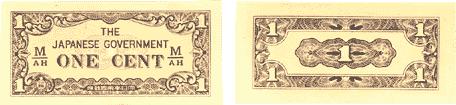
These were the series 2 of the Japanese Invasion Money
of Malaya, and were release in default of scarce Straits
coins. The
different denominations are 1-cent, 5-cent, 10-cent and
50-cent notes.
Japanese
invasion of South-east Asia was to exploit their natural
resources, assets and manpower to support her war efforts in
the ‘China affair’. Conceived
as a geopolitical concept, The Greater East Asia Co-Prosperity
Sphere was reified into an entity that embodied political,
economic and military objectives, with Japan presiding as its
Imperial ruler.
On
the political front, Japan’s objective was to expand her
sphere of influence to include countries within the
Asia-Pacific region. She
capitalized on the alienation of the Asiatics from the Whites;
with her impersonation veneered by the machination of
‘co-prosperity’, she hoped the Asiatics would be beguiled
into accepting her as the liberator from their European
masters. But the
truth was simply the replacement of the European colonial rule
by a Japanese military one.
Driving out
the Europeans and the Americans from their colonies would
secure the necessary leverage to rid herself of the dependency
on their supply of goods and resources.
She could then have the freedom to acquire resources to
sustain her domestic manufacturing industry.
Between 1942 and 1944, 5.2 million tonnes of crude oil,
210 000 tonnes of gutta-percha and 50 000 tonnes of tin ore
were shipped from South-east Asia to Japan.
This induced inflation and breakdowns of economies in
her occupied regions and left its people impoverished.
On the
military front, Japan southern campaign was to vie with the
British and Americans for the ascendancy of the strategic
territories in the co-prosperity sphere.
When the Sino-Japanese war spiralled, Japan’s
requirement for raw material redoubled and the consolidation
of her position in Asia-Pacific became imperative.
Rubber and tin were essential to America’s
manufacturing industry with over 70% of her supply coming from
South-east Asia. Japan’s
successful bid in the occupation of the region would put the
US in a double bind.
The Japanese
ploy in plundering the region’s wealth and resources was to
impose harsh martial laws to subdue the populations while
printing and issuing paper money having no treasury backing in
large quantities for their ‘purchases’.
This brought on a grisly inflation and drastically
devaluated the invasion currency. The resultant erosion of public confidence further weakened
the fiduciary issue, rendering the 1-cent to 50-cent notes
utterly worthless; soon, even the $1 and $5 notes were
relegated to oblivion.
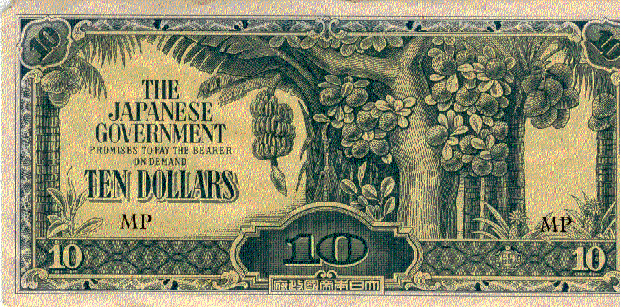
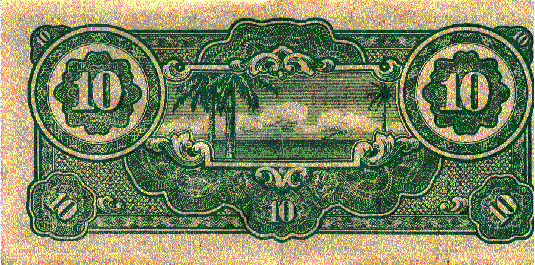
In 1944, the
Southern Development Bank issued the Series 3 invasion notes
under the authorisation of the Japanese government.
They included $100 and $1000 notes with the $10-note
being the lowest denomination.
All of these notes had the assurance “PROMISES TO PAY
THE BEARER ON DEMAND” printed on their faces (unlike the
cent notes).
| 


