
|
|
|
|
|
|
|
|
|
|
|
|
|
|
|
|
|
|
|
|
|
|
|
|
|
|
|
|
|
|
|
|
|
|
|
|
|
Ilê Axé Opô Afonjá |
| visit the official site
of the Ilê Axé Opô Afonjá |

|
|
Afonja Community - Child in Danger Project |
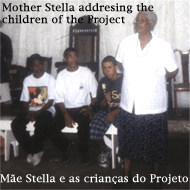
| Candomble was created in Brazil by negros from two different cultures: Sudaneses and Bantos. They are the two main black ethnic groups responsible for the formation of brazilian culture, its architeture, way of life, the day-to-day expressed in music, dance, public festivals, food, dreams and, above all, they are present in the overview brazilians hold on religion and outlook of life. The word 'candomble' has african origin, probably from grunci language according to the ethnographer Pierre Verger. At 'Dicionario Banto do Brasil', its origin is banto as well as for the schoolars A.G.Cunha, Nascente and Yeda P. de Castro. |
|
The main ethnic goup to influence Bahia culture was the yoruba-nago. For the last 4 centuries, the religious feeling has been the support to hold toghether black communities in spite of the imposition of catholic religion by the colonizer. Facing extreme violency, the africans and their descendants were able to preserve their values. Through the imposition of the new culture - which negates the right to be different - imposition which can be seen even today, these black men and women opened their space to receive any one without discrimination of race, collor, ideology, religion or social class, any one wanting their religious advice. Their religion is universal, it is the fundamental base of their culture and action in the world, the catalytic element of their cultural process. As Mother Stella of Oshossi use to say "Orisha doesn't discriminate". In the past, the Bahia's black community use to live at downtown and their rites were celebrated at their own houses. These houses were the symbols of temples and palaces of the ancentrals and the habitat of the Orishas. What we now call the "houses of Saints of Bahia" were born from these micro/macro universes. In those days, Dr.Nina Rodrigues, a man of science, gave "scientific" base, through his writings, to the current discrimination already in society. In one of his articles dated of May of 1905 he wrote: (the black religious manifestations) "are every day being more and more famous among the ignorant blacks who do not permforme their rites on the suburb but at downtown itself". There is no need to remember here the
violency against the "people of Saint", that in spite
of it did not change their human and religious convictions, leaving
their marks in this Brazil we know today. Without their contributions
this Country would not be what it is and what it pretends yet
to become. At the beginning of the twenty century, Eugenia Anna dos Santos, Oba Biyi, Mother Aninha, founded the Ile Axe Opo Afonja. She was daughter of Shango and belonged to a traditional Candomble's House of Bahia, the Engenho Velho - Axe Iya Nasso Oka - the first one of Brazil. She was a strong woman with political and religious influence, being the one who got recognition and freedom for the performance of afro-brazilian religion. Before her energic actions, the practice of the religion was prohibited by law and taken as "a thing of ignorant blacks, a shame of Bahia". While visiting Rio de Janeiro, Capital of Brazil at this time, she had a meeting with the President Getulio Vargas and it was from this meeting that the President signed the document which gave freedom to practice the candomble (doc. nº1202). In Bahia she had the help of Babalao Martiniano Elizeu do Bonfim to continue her work at the Ile Axe Opo Afonja when she created the twelve Obas of Shango, responsible for civil activities of the religious institution. Martiniano was the link between her Candomble's House and Nigeria-Africa. In 1936, Eugenia Anna dos
Santos created the "Sociedade Civil Cruz Santa do Axe Opo
Afonja" (Cruz Saint Society
of the Axe Opo Afonja), to ensure the continuation of her work
and prevent fights for power, giving the direction to follow
to maintain the traditional religious work. |