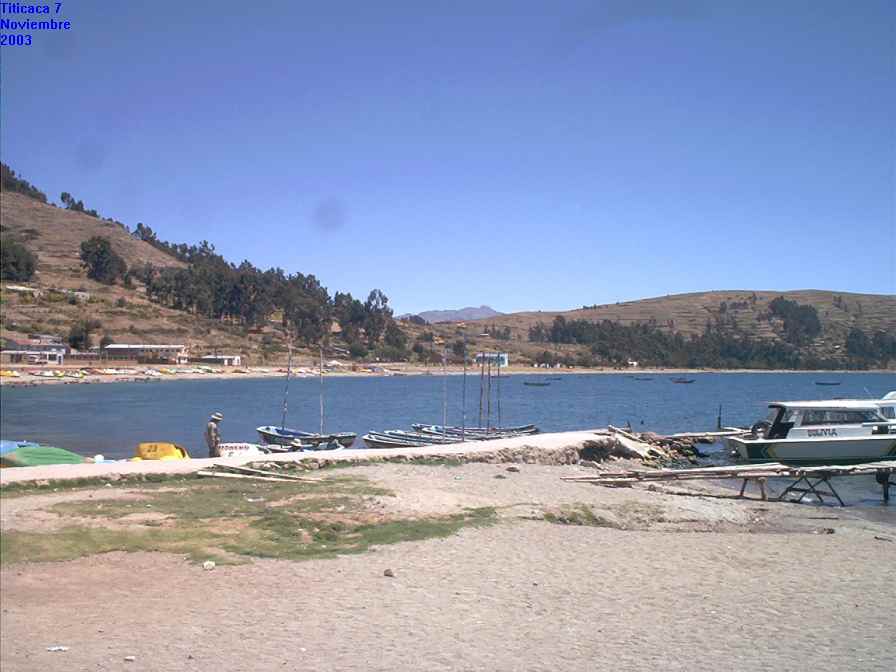
Geologically, Titicaca's origins are disputed, although it was likely a glacial lake. Maverick scientists claim it had a volcanic start; a century ago, Titicaca was popularly believed to be an immense mountaintop crater. A few diehards today stick to the notion that the lake was part of a massive river system from the Pacific Ocean.
Oceanographer Jacques Yves Cousteau spent eight weeks using mini submarines to explore the depths of the lake but found no gold. (What he did discover, to the amazement of the scientific world, was a 60-centimeter (24-in) long, tri-colored frog that apparently never surfaces!)
On the Peruvian side of the lake is Puno, an unattractive commercial center settled as a Spanish community in 1668 by the Count of Lemos. Although today Puno seems unappealing, during the Spanish period it was one of the continent's richest cities because of its proximity to the Laykakota silver mines discovered by brothers Gaspar and Jose Salcedo in 1657. The mining boom drew 10,000 people to an area not far from what is now Puno. It also brought a bloody rivalry that ended only when the ironhanded count traveled to Puno, ordered Jose Salcedo executed and transferred Laykakota's residents to Puno.
At an altitude of 3,827 meters (12,628 feet), Puno is still the capital Peru's altiplano - the harsh highland region much better suited to roaming vicu�as and alpacas than to people. It is also Peru's folklore center with a rich array of handicrafts, costumes, holidays, legends and, most importantly, more than 300 ethnic dances.
Among the latter, the most famous is Devil dance performed during the feast of the Virgin of Candelaria during the first two weeks in February. Dancers fiercely compete to outdo one another in this Diablada, notable for its profusion of costly and grotesque masks. The origins of the dance have become confused over the centuries but it is believed to have started with pre-Inca Indian cultures, surviving through the Inca conquest and the Spanish takeover of the country, with the costumes being modified each time.
The best-known of the islands dotting Titicaca's surface are the Uros, floating islands of reed named after the Indians who inhabited them. Legend has it the Uro Indians had black blood that helped them survive the frigid nights on the water and safeguarded them from drowning.
The last full-blooded Uro was a woman who died in 1959. Other Uros had left the group of islands in earlier years owing to a drought that worsened their poverty - and intermarried with Aymar� and Quechua-speaking Indians. But the Indians who now inhabit this island - a mix of Uro, Aymara and Inca descendants - follow the Uro ways.
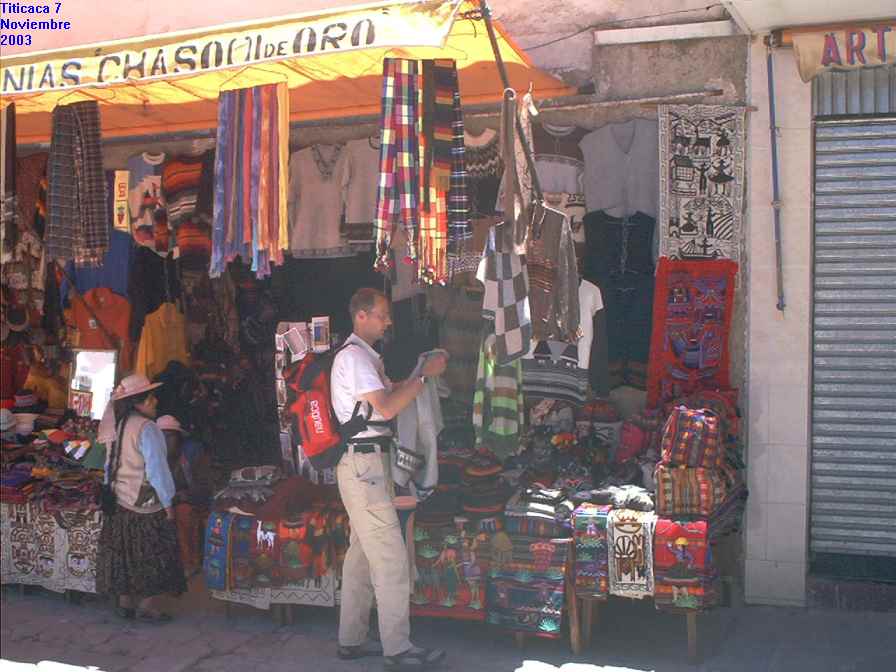
The lower altitude terraces where corn could still grow are still at a level above Lake Titicaca. This means that the "pre-historic" peoples cultivating corn "lived" in the area "before" and "after" the numerous necessarily cataclysmic crustal
deformations and uplifts that raised the Andes. The cataclysmic uplifts caused the terraces where the corn "was" successfully cultivated to be raised to an altitude where the corn would not grow. As the mountains rose cataclysmically the peoples terraced their cornfields successively lower down the mountainsides. There is a stone causeway leading "out" of Lake Titicaca. It has been speculated by some of your archaeologists that the area used to be at sea level and the causeway led out to the Pacific ocean. The causeway now leads out of the lake to nowhere at 9OOO feet altitude.
The six feet of sediment covering the "ancient ruins" around and under the present "water level" of Lake Titicaca was probably deposited by the "Biblical Flood" before the existence of Lake Titicaca.
The huge Flood happened "pre-historically" when the land around Lake Titicaca was closer to sea level.
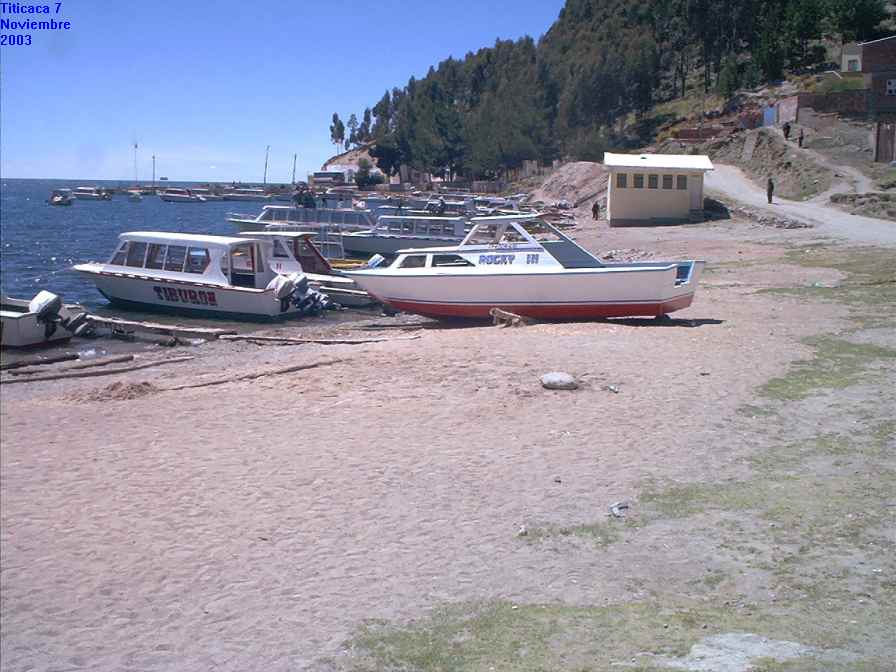
The six feet of sediment covering the "ancient ruins" around and under the present "water level" of Lake Titicaca was probably deposited by the "Biblical Flood" before the existence of Lake Titicaca.
The huge Flood happened "pre-historically" when the land around Lake Titicaca was closer to sea level.
After some weeks blocking the roads to Copacabana, farmers decided to open the roads for 10 days, as a negotiation period. I arrived in the city late afternoon; I left my backpack in the hotel and went to see the sunset in the Titicaca lake. Beutiful, relaxing...
Next day, I made a boat tour to the islands. First we visit the north part of Isla del Sol, 2 and a half hours by boat. We had 2 hours to visit the place, it was not much time. I would have that to walk quickly to the ruins or enjoy the landscape photographing and not seeing everything. I opted for the second.