 |
|
|
|
|
|
|
|
|
|
|
|
|
FOCUS ON -- ARCHAEOLOGY.(Bolivia) |
|
|
|
According to some archaeologists, this stone structure may have served a utilitar ian function as a calendar, a kind of Farmers' Almanac of preInca Bolivia. Or it may have been associated with the sun deity. Its surface is covered with low-relief designs depicting Viracocha, the creator god, on one side and is indented with four deep niches -- perhaps for sacrifices on the other.
If you have time -- and you should allow a minimum of two hours at Tiwanaku -- stroll to some of the other nearby ruins to speculate on what their may once have been.
|
|
|
|
 |
|
 |
|
|
|
There is a small on-site museum here, but visitors should not miss seeing the superb Museo Arqueologico de Tiwanaku on Calle Tiwanaku off the Prado in downtown La Paz. There is also a replica of the Templete Semisubterraneo next to the Hernando Siles Stadium also in downtown La Paz.
Half-day guided tours run frequently to Tiwanaku from La Paz, or you can hire a car with driver and guide. If you're on a group or individual tour in Bolivia, you'll be sure to visit the site; it's included on everyone's itinerary. Our U.S. tour operator, Latin American Escapes, arranged our private tour for us, which enabled us to spend as much time as we wanted at the site.
|
|
Isla del Sol
The Incas, as almost everyone knows, were another great Andean civilization. Although archaeologists say they originated in the area of Cuzco, Peru, about A.D. 1200, they themselves believed that Lake Titicaca in the west central portion of Bolivia bordering on Peru was their ancestral birthplace.
Within 250 years, the empire the Incas created extended from Argentina and Chile to the south, to Ecuador and' southern Colombia to the north and to Bolivia to the east. The Incas were one of the great powerhouses of South America, constructing military and administrative centers as they conquered.
|
|
|
|
 |
|
 |
|
|
|
|
|
The Inti Wata Complex located, a 5-minute walk from the Inca Fountain gives visitors a chance to see llamas and vicunas up close, watch the building of a traditional reed boat similar to one Thor Heyerdahl used (also built by native Bolivian boat-builders) in the early 1970s, view Andean mummies wrapped in hemp baskets and walk along Inca terraces planted with medicinal herbs and Andean crops.
|
|
|
|
|
I was delighted to hear from Latin American Escapes that there were Inca sites on Isla del Sol, an island in Lake Titicaca. I had wanted to visit Lake Titicaca anyway; Inca ruins would be the icing on my travel cake. We chose to join a group to visit the Inca sites by catamaran on an overnight excursion from La Paz.
The 2-day tour we took was divided into two segments. The morning segment visited the Inca Steps and Inca Fountain at the southern end of Isla del Sol. Here, water gushes from a spring and pours down stone channels built by the Incas. When members of our tour group heard that the Spaniards considered the Inca Fountain the legendary Fountain of Youth, a few decided they wanted to spend the rest of their holiday at this spot. As one New Yorker said, "It couldn't hurt."
|
|
|
|
|
|
|
 |
|
|
|
|
|
Strangely, Tiahuanacu was a seaport at one time, although the nearest body of water is Lake Titicaca. There are many theories on how this came to be - mostly lined to changes in sea level through the millennia.
On the rock cliffs near the piers and warfs of the port area of the ruins are yellow-white calcareous deposits forming long, straight lines indicating pre-historic water levels. These ancient shorelines are strangely tilted, although once they must have been level. The surrounding area is covered with millions of fossilized sea-shells. It appears, from the tilting of the ancient shoreline striations and the abundant presence of fossilized oceanic flora and fauna, that a tremendous uplift of land has taken place sometime in the ancient past. Geologists estimate that this happened roughly around 100 million years ago.
|
|
|
 |
|
|
|
|
|
Chincana
But the highlight of Isla del Sol, for me, was the afternoon trek to the Chincana archaeological site at the northern end of the island where we meandered through a mazelike Inca palace called El Labirinto the Labyrinth, high above Lake Titicaca. El Labirinto may have served as residence, fortress or ceremonial complex or maybe all three.
A short walk away is an enormous rock called Titi Khar'ka, Rock of the Puma -- probably the origin of the name Titicaca -- resembling a crouching cat, and, in front of it, an ancient Inca ceremonial stone table that was probably once used for sacrifices.
|
|
|
|
|
|
|
 |
|
|
|
|
 |
|
|
|
|
|
|
Some of the docks and piers in this area are so large that hundreds of ships could dock comfortably - and nothing oceanic near these docks except an ancient coastline made of chalky fossils. Lake Titicaca, languishing miles away, is nearly 100 feet lower than the ruined docks. What tremendous geological upheaval has occurred in the last thousand years that could have tumbled these huge stones while raising the entire altiplano region 2 miles into the sky? None that anyone knows about - but 12,000 years ago might have been a different story.
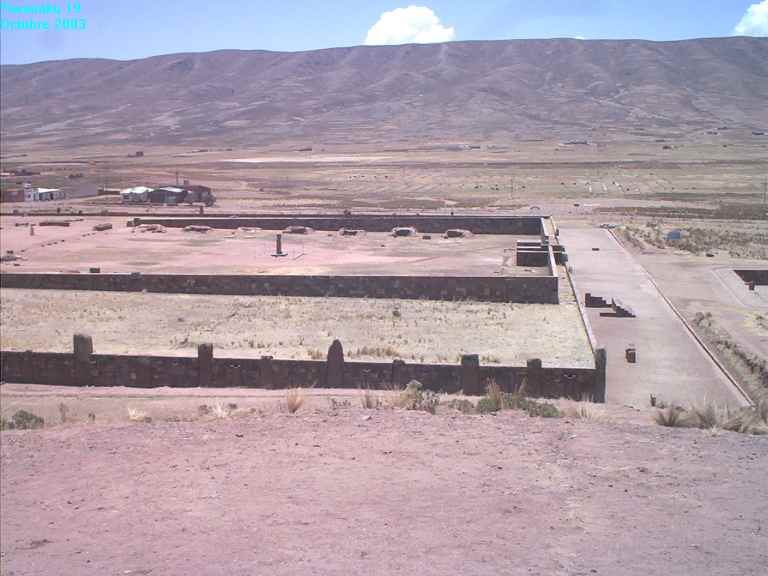
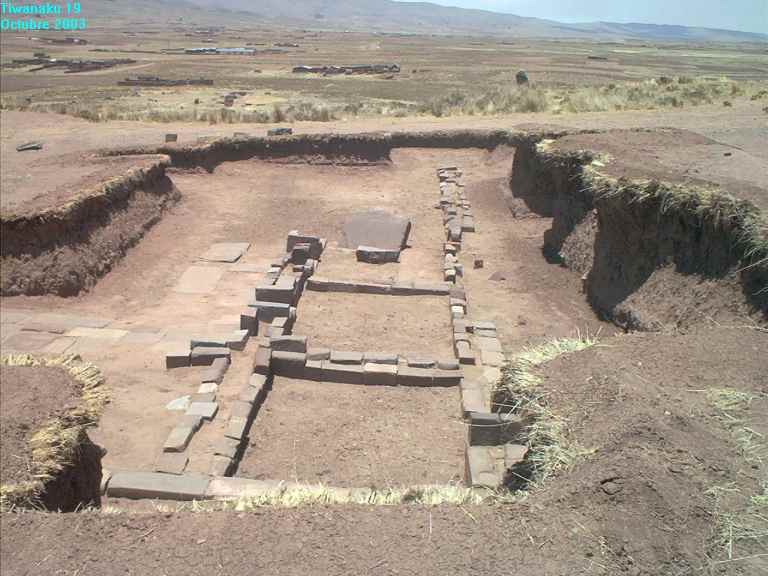
Tiahuanaco was the center of a powerful, self-sustaining empire. The roots of the Tiahuanaco capital can be found in the early village underlying the 1.5-square-mile civic-ceremonial core. The city was settled by 400 B. C. on the Tiahuanaco River, which empties into Lake Titicaca 9.3 miles to the north. The small farming village evolved into a regal city of multi-terraced platform pyramids, courts and urban areas, covering a total 2.31 square miles
|
|
|
|
|
Oceanic creatures live to this day in abundance in the salty waters of the lake, indicating that it was once a part of the ocean, although it is now over 2 miles above sea-level. What seems to be the original seashore is much higher in one place than in another. The port of Tiahuanacu, called Puma Punku or "Door of the Puma," is an area filled with enormous stone blocks scattered hither and yon like matchsticks, and weighing between 100 and 150 tons! One block still in place weighs an estimated 440 tons! One wonders, how were these blocks quarried; also how did the builders handle such huge blocks so skillfully? And what tremendous forces tumbled and scattered these gigantic stones so easily about the site? Many of the blocks, some of them weighing upwards of 200 tons, are held together by large copper clamps shaped like an I, rather than enterlocking shapes as at Sacsahuaman or at Cuzco. Others were held together by silver rivets. The system used here is reminiscent of that used in the Egyptian ruins on Elephantine Island on the Nile. Most researchers believe that the metal was actually poured into shaped-slots carved into the rock. |
|
|
|
|
