 |
|
|
|
|
|
|
|
|
|
|
|
|
A visit to Tiwanaku will take you back in time |
|
|
|
A visit to Tiwanaku will take you back in time to an impressive city built by an extremely technologically advanced pre-Inca society. The Tiwanaku culture is believed to have lasted for 28 centuries from 1600 B.C. to A.D. 1200. In this time, they created some of the most impressive stone monoliths in the world, developed a sophisticated irrigation system, and gained an advanced understanding of astronomy and the workings of the sun. Their territory spread from northern Argentina and Chile through Bolivia to the south of Peru. These people never came into contact with the Incas. By the time the Incas made it to Peru, a 100-year drought had ravaged the Titicaca area. The Tiwanaku people had long ago left the region in small groups and moved to different areas in the altiplano or valleys. |
|
|
|
 |
|
 |
|
|
|
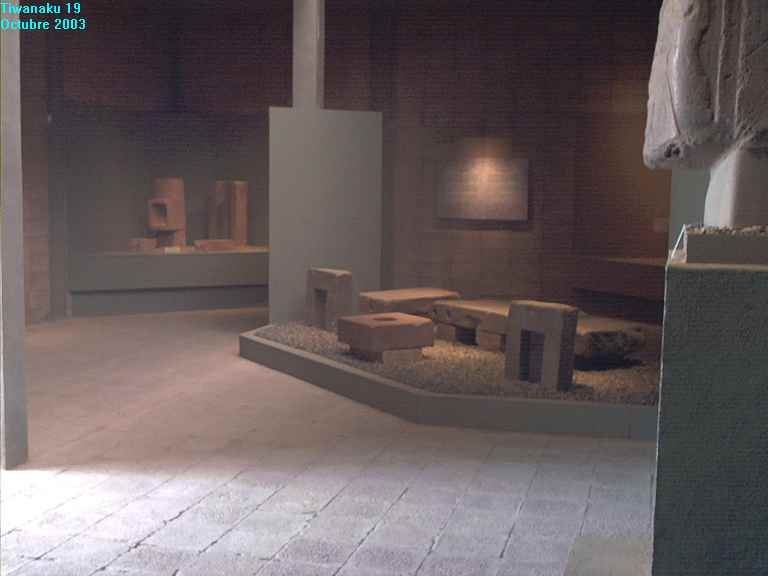
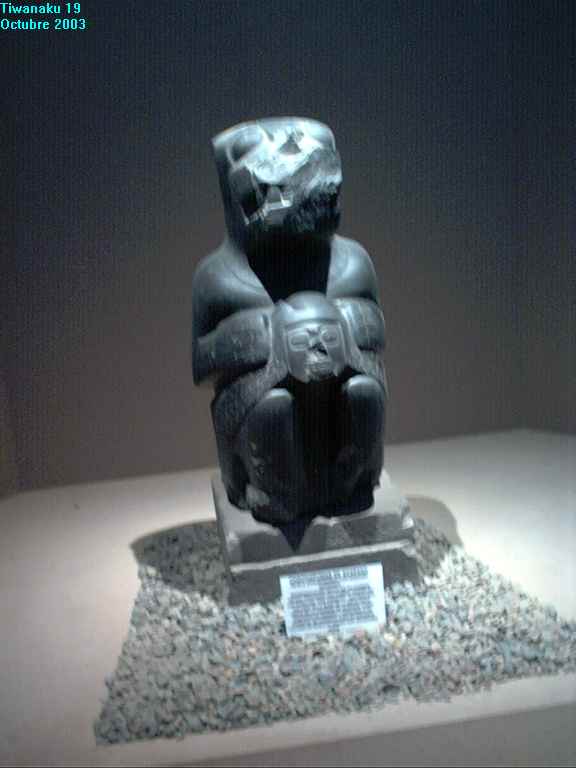
When you visit Tiwanaku, you will first stop in at the museum, where you can observe firsthand the magnificence of the ceramics, monoliths, and figurines found at the site. The exhibits will help you understand a bit of the history of this culture. Armed with your new Tiwanaku knowledge, you can then head out to the site itself, where you'll often have to use your imagination. The Incas and the Spaniards destroyed the site while searching for gold and silver. Even the most respected archaeologists disagree on the meanings of the monoliths and the sun gate. But when you actually see these impressive structures firsthand, you can't help but stand in awe and wonderment of the amazing achievements of this pre-Columbian society. Unlike Machu Picchu, which feels more temporary and modern, here you gain a much deeper insight into the daily life and rituals of the people who inhabited this area for thousands of years. Highlights of the site include the * Semi-Underground Temple, which is decorated with stones carved in the shape of different heads from around the world; the * Kalassaya, the main temple area of the site and believed to be dedicated to the sun; and the Akapana (pyramid), believed to be an observatory and a temple to worship the sky. The museum and the archaeological site are open daily from 9am to 4:30pm. Admission is 15Bs ($2.25). |
|
Bridge When you visit Tiwanaku, you will first stop in at the museum, where you can observe firsthand the magnificence of the ceramics, monoliths, and figurines found at the site. The exhibits will help you understand a bit of the history of this culture. Armed with your new Tiwanaku knowledge, you can then head out to the site itself, where you'll often have to use your imagination. The Incas and the Spaniards destroyed the site while searching for gold and silver. Even the most respected archaeologists disagree on the meanings of the monoliths and the sun gate. But when you actually see these impressive structures firsthand, you can't help but stand in awe and wonderment of the amazing achievements of this pre-Columbian society. Unlike Machu Picchu, which feels more temporary and modern, here you gain a much deeper insight into the daily life and rituals of the people who inhabited this area for thousands of years. Highlights of the site include the * Semi-Underground Temple, which is decorated with stones carved in the shape of different heads from around the world; the * Kalassaya, the main temple area of the site and believed to be dedicated to the sun; and the Akapana (pyramid), believed to be an observatory and a temple to worship the sky. The museum and the archaeological site are open daily from 9am to 4:30pm. Admission is 15Bs ($2.25). |
|
|
|
 |
|
 |
|
|
|
Tiwanaku (also called Tiahuanaco, its Spanish name) is Bolivia's premier archaeological site, located about 40 miles west of La Paz. It's worth every breathless moment to see, even though much of it has been carted off over the centuries as building material elsewhere.
There is disagreement among archaeologists and historians about Tiwanaku's population at its apogee (was it 20,000 or 90,000?), about whether it was a city or a ceremonial center, and even about when it first appeared. But there is no disagreement about the extent of its influence.
|
|
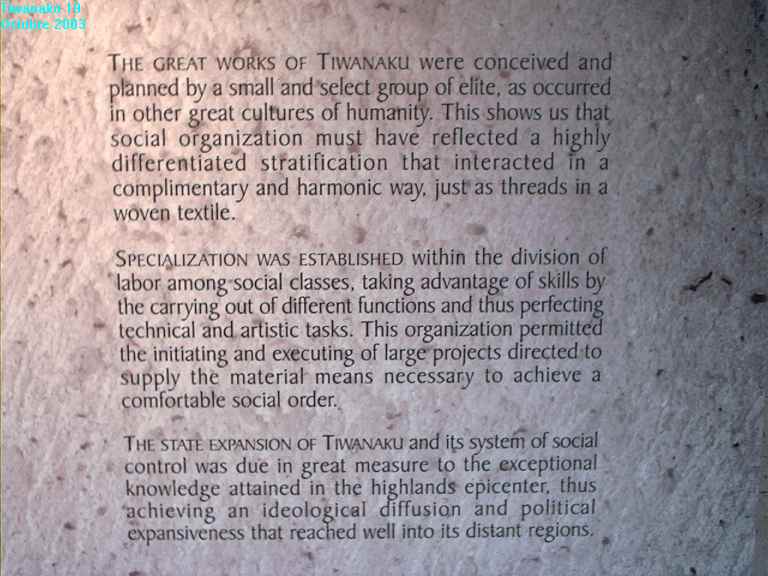
Probably (a key work in, archaeology), Tiwanaku first developed around 1600 B.C. as a modest-size village in a valley near Lake Titicaca. It grew from village to city over a period of 2,000 years, in the process developing a system of water canals that served to increase agricultural output. Population increased and with it a ruling class capable of initiating and carrying through engineering and architectural projects. |
|
|
|
|
|
 |
|
|
|
|
 |
|
|
|
|
|
|
Ceremonial sites
From the top of Akapana pyramid, one sees only a small portion of the once-powerful city-cum-ceremonial center (which is what I believe Tiwanaku was). There are -- in addition to many lesser important areas -- two prime sites no visitor should miss. They, are located beside each other at the base of Akapana.
There is the Templete Semisubterraneo, a sunken stone courtyard, its walls decorated with carved stone faces and three stele in its middle.
|
|
|
|
|
By A.D. 1200 Tiwanaku had begun to collapse. Who knows why? Climatic changes? Internal political problems? War? Most probably some combination of all of these. But Tiwanaku had still managed an existence of almost 3,000 years -- quite an' impressive record, which is why I didn't much mind huffing and puffing to visit what remains of one of the most important sites of pre-Inca South America.
Tiwanaku reached its apogee probably between the fourth and eighth centuries A.D. with the construction of monumental stone buildings, followed by the expansion and diffusion of its culture westward toward the Pacific Ocean and eastward, toward the tropics until it encompassed most of what is present-day Bolivia and Peru as well as northern Chile.
|
|
|
|
|
|
|
 |
|
|
|
|
 |
|
|
|
|
|
|
According to some archaeologists, this stone structure may have served a utilitar ian function as a calendar, a kind of Farmers' Almanac of preInca Bolivia. Or it may have been associated with the sun deity. Its surface is covered with low-relief designs depicting Viracocha, the creator god, on one side and is indented with four deep niches -- perhaps for sacrifices on the other.
If you have time -- and you should allow a minimum of two hours at Tiwanaku -- stroll to some of the other nearby ruins to speculate on what their may once have been.
|
|
|
|
|
Beside it lies the enormous Kalas-sasaya, an open temple built slightly above ground level. In the remnants of an interior courtyard of Kalas-sasaya is the larger-than-life-size Ponce monolith looking like an alien in Bermuda shorts. In a corner of the temple behind this monolith is the El Fraile (Friar) monolith and in the opposite" corner, the Gate of the Sun, which appears on so many Bolivian postcards.
|
|
|
|
|
