|
.
HARRISBURG'S REVITALIZATION STORY
|
The City of Harrisburg struggled
during the late 1960s thru the early 1980s against the trends
typical of other older, northern cities. Although Harrisburg served
as the county seat of Dauphin County and as the State Capital, the
city experienced a continuous loss of private sector employment
opportunities as well as the outmigration of population to growing
suburban communities. Left behind were older and poorer residents, a
aged housing stock in need to renovation and/or replacement, and a
dying downtown. That situation has been dramatically reversed over
the last two decades by the concerted action of elected officials
working with civic and community leaders committed to saving the
best that Harrisburg has to offer and improving on these strengths.
On the first of May, 2003, Mayor Stephen R. Reed, sent the following
letter to Jonathan A. Saidel, Philadelphia's City Controller, who
has been strongly recommending for Philadelphia many of the same
policy changes adopted by Harrisburg:
Dear Mr. Saidel:
This is to acknowledge and thank you for your inquiry of the
other day regarding the split rate tax millage system in place in
the City of Harrisburg. I regret being unable to respond in time
for the April 29th hearing and hope that this correspondence will
serve to add to the record on the matter as the City of
Philadelphia considers the prospect of a land-value tax policy.
The City of Harrisburg is like every other Pennsylvania city,
confined within boundaries that cannot change. Unlike cities in
the South and the West, cities in this State do not have the
ability to incorporate additional areas.
Accordingly, promoting the highest and best use of land is
critically important to the long-term economic development
progress of this City. We have had the land-value tax policy in
place for years and have found it to be an important incentive.
Presently, we have a ratio of 1 to 6 in place, meaning that the
millage rate on improvements/buildings is a tax rate only
one-sixth of the millage rate charged on land.
Such a policy rewards the productive use of land. The greater the
investment, the greater the savings to the owner/developer over a
single tax rate system. In other words, it is a reward for
initiative and private investment risk.
Moreover, a higher millage rate on land tends to discourage real
estate speculation by irresponsible absentee owners -- a genuine
problem in probably every city in Pennsylvania.
The City of Harrisburg was listed as the second most distressed
city in the nation twenty years ago. It had sustained precipitous
decline over nearly three decades -- a decline far greater in
proportion than what has ever been experienced by any urban
community in this state or, for that matter, every other state
with the exception of one.
Harrisburg, in the current era, launched aggressive initiatives
related to economic development, the creation of non-tax revenue
sources and a constant effort to refine and improve the operations
of city government. These remain our triple, equally important
priorities. As part of our economic development incentives, the
land-value tax policy is key and, without it, a significant amount
of new investment would not have occurred here during recent
years.
In the current era, we have registered in excess of $3.1 billion
in new investment. The number of businesses on the City's taxrolls
has increased from 1,908 to more than 5,900. Taxable real estate
values have increased from an aggregate of $212 million to over
$1.6 billion. The number of vacant properties has been cut by 85%.
the crime rate has been reduced 54% and the fire rate has dropped
over 76%. Unemployment, which generally ran in the double digits,
even in times of a good national economy, are normally less than
half those previous rates today.
The land-value tax policy is not a cure-all but, without it, it
would be particularly more difficult to attract and retain taxable
real estate investment. Economic development in an urban community
should not be based solely upon a land-value tax policy. Rather,
the tax policy should be part of a package of other incentives,
which include various low-interest loans, the availability of
low-cost vacant land, tax abatement and the like.
Without hesitation, we can recommend the importance and benefit
of the land-value tax policy. It has worked in Harrisburg and in
other communities where it has existed.
I hope the aforementioned information is of some use to you and
the City of Philadelphia consider your long-range economic
development policies. Please know that you and all of the
officials and citizens of the City of Philadelhpia have our full
support in this important work.
With warmest personal regards, I am
Yours sincerely,
Stephen R. Reed, Mayor
READ MORE ABOUT HARRISBURG'S USE OF TAX POLICY CHANGES TO ACHIEVE THE CITY'S
REMARKABLE REVITALIZATION.
|
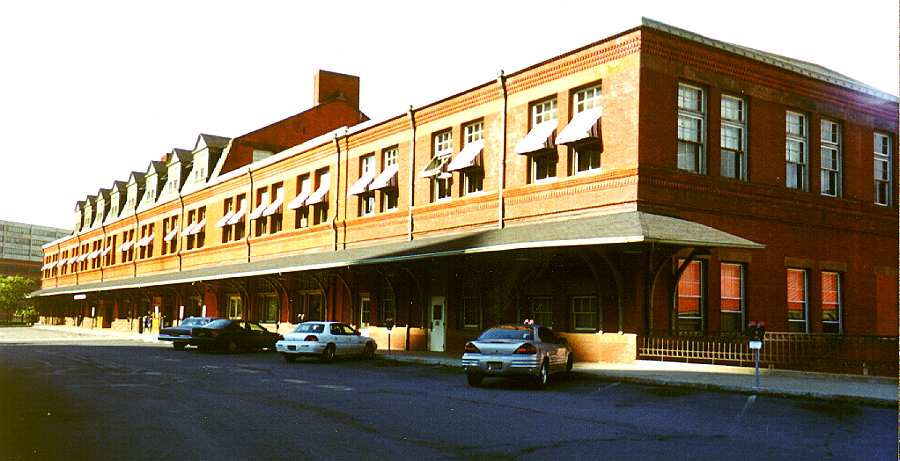
Pennsylvania Railroad Station and The
Capitol Region |
|