ECONOMIC OVERVIEW: Agriculture


A Conference on the Future of Connecticut and Beyond

Affordable Cities: Bringing the Cost of Living Down to Earth

TOP


CONFERENCE INFORMATION
DEMOGRAPHICS
ECONOMIC
HISTORY
ECONOMIC OVERVIEW
Agriculture
Housing
Land Markets
Manufacturing
Real Estate
Tourism
ENVIRONMENT
Land Use
Sprawl
GOVERNMENT POLICY
Current Laws
Recommendations
PARTICIPANTS
READINGS
INTRODUCTION
to the
Council of Georgist Organizations
.

AGRICULTURE

While agriculture no longer holds its once-prominent position in Connecticut’s economy, farming is still important to the state. The most important crops are dairy, poultry, forest and nursery, tobacco, vegetables and fruit.
Agriculture in Connecticut 2000
... W. A. Cowan, Emeritus Professor, Department of Animal Science, University of Connecticut, November 2001
Connecticut Agriculture: A Growing Industry
... Mark Prislow, Associate Economist, Department of Economics and Community Development
Connecticut Department of Agriculture
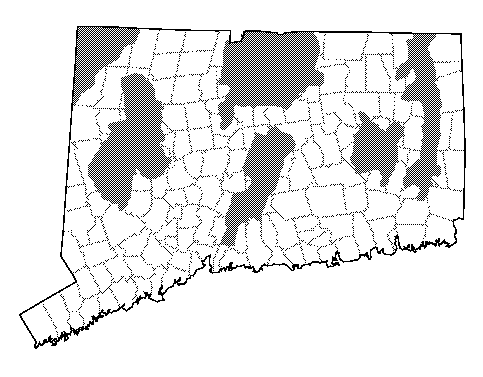
Connecticut Crop Map
... Purdue University, Center for New Crops and Plants Products
Farm Characteristics
... Connecticut State Fact Sheet, U.S. Department of Agriculture, 1992 and 1997
Food Production in Connecticut
... 31 October, 2001
Sustainable Food and Farming in the Connecticut River Valley: A Vision
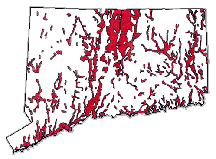
Agricultural Districts (highlighted)


FOOD POLICY COUNCIL

Food Security in Connecticut
... The 2000 Annual Report of the Connecticut Food Policy Council

TAXATION OF AGRICULTURAL PRODUCTS, INCOME, PROPERTY IMPROVMENTS AND FARMLAND

Agriculture in Connecticut, an OLR Research Report, written by Research Analyst Paul Frisman (November 2001). Here is an excerpt from this Report:

" 2. What has Connecticut done to encourage agriculture in the state?

In addition to its broad mission, the agriculture department encourages Connecticut agriculture though a number of specific programs, such as Farmland Preservation, "Connecticut Grown," Agricultural Technology, and the Farm Enhancement Program. The state also established the first Agricultural Experiment Station in the nation, and provides a Cooperative Extension System through the University of Connecticut. These and other programs are described below:

Farmland Preservation. This program (CGS § 22-26aa et seq. and Conn. Agencies Regs. § 22-26GG-1 et seq.) authorizes DOA to purchase the development rights of existing farms. When the state makes this purchase, it gets a permanent easement that prohibits nonagricultural development of the land, while allowing the owner to operate and manage the farm business. The program's goal is to conserve selected agricultural lands, pastures, woods, drainage areas, and open space areas for the benefit of the state and future generations. As of February 2001, Connecticut had acquired development rights to 197 farms, totaling 27,368 acres. More information on farmland preservation can be found in OLR Reports 99-R-1260, 2001-R-0554 and 2001-R-0608.

490 Program. This program, established in 1963, provides owners of farmland with tax relief by assessing farmland, forest, and open space land on the basis of its current use, rather than its market value (CGS § 12-107c)."


RETURN TO TOP

Hosted by www.Geocities.ws

1