|
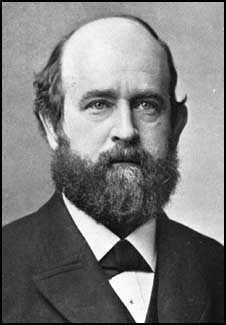
HENRY GEORGEHenry George was born in Philadelphia in 1839 in a working-class family. At the age of 16, he left school to join the crew of a merchant vessel. This experience took him around the world, and eventually to San Francisco, where he settled in 1859. As a young man he had learned to set type, and this skill pulled him into the newspaper business where he polished his skills as a writer and editor. Increasingly, Henry George offered his opinions on the social issues of the day. He could not understand how California could have so quickly turned from a land where opportunity abounded for all who came, to a place where great wealth and deep poverty co-existed. On a visit to New York City in 1869, he was moved to find a solution to the shocking contrast between the wealth and poverty he found there. The fruit of his efforts was the book, Progress and Poverty, published in 1879.
Progress and Poverty was not an immediate success. The book was a serious treatise on political economy by an author without formal training in what was considered a scientific pursuit. Fortune smiled on Henry George, however. He was hired by the leading Irish-American newspaper to visit Ireland and the United Kingdom to report on conditions there. Irish nationalists were agitating for separation from Britain, and Henry George met with the leaders of all parties. He also had ample opportunity to deliver addresses to large public audiences. As his reports were read on both sides of the Atlantic, Progress and Poverty received greater attention and sales accelerated. He returned to the United States a famous person with a growing following for the ideas he espoused in his writings and speeches. PROGRESS AND POVERTYThis 600-page book is subtitled "An inquiry into the cause of industrial depressions and the increase of want with the increase of wealth - the remedy." In it George set out to show that poverty is not caused by any lack in nature's bounty, but by inequitable social arrangements. George examines the natural laws governing the production and distribution of wealth. Consistent with the earlier political economists he called land, labor and capital the factors of production. The wealth produced by the combination of these three factors was described by terms associated with legitimate claims on wealth. To labor belonged wages. To the provider of capital belonged interest. To the community, which granted access to land, belonged rent. This, George argued, was the just distribution of wealth. Societies were plagued with economic problems and with varying degress of poverty because the laws of societies did not protect this just distribution of wealth.
Monopolistic privileges of all forms redistributed wealth from producers to non-producers, George explained. Most serious of all were forms of taxation that confiscated wages and interest from producers while permitting private owners of land to appropriate the rent that rightfully belongs to the entire community.
HENRY GEORGE'S CENTRAL PROPOSAL Henry George's proposed remedy for poverty -- "to abolish all taxation save upon land values" -- eventually became known as the Single Tax. Actually, by George's definition of taxation, he was proposing to abolish all taxation (i.e., the confiscation of wealth produced by the two factors of production, labor and capital). Instead, government would look to the rent fund associated with rising land values as the rightful source of revenue for public expenditures.
Henry George campaigned vigorously for the dismantling of the tax system, to be replaced by the public collection of rent. He also campaigned for the removal of tariffs and other restraints on trade and commerce. In the 1880s he challenged the New York City political machine by running for the Office of Mayor. The corruption of the times ensured he would not win the election (and George admitted he was relieved that the task of running the city had not actually fallen to him). He returned to writing books, tolecturing and eventually to the publication of a newspaper, The Standard. Urged to run again in 1897 for the Office of Mayor, a fatigued Henry George did not survive the campaign.
Throughout the twentieth century, the reform effort began by Henry George lost much of the character of an independent political movement. Mainstream public officials -- Democrats and Republicans -- incorporated George's ideas into their own legislative agendas. Real estate became an increasingly important source of public revenue for local governments. Economists began to specialize in public policy analysis and on tax policies, in particular. A few, such as Harry Gunnison Brown at the University of Missouri, looked upon Henry George's proposals as central to the creation of competive land markets and a full employment economy. Others were not convinced, but were prepared to support a limited transfer of taxes off of property improvements and on to land values. The proposal to tax the assessed value of land parcels at a higher rate than housing and other buildings came to be known as land value taxation.
In the 1920s, the legislature of the
Commonwealth of Pennsylvania amended the
state's constitution to permit the larger
cities to adopt land
value taxation, if they chose to.
Pittsburgh and Scranton did so, and over the
decades these cities have been joined by many
more. Recently, new legislation has extended
the local option to adopt land
value taxation to all of the
state's boroughs. Several boroughs have
already joined the cities. Cities in other
states are now looking closely at the
Pennsylvania experience. SOLVING BROAD SOCIAL PROBLEMSThe successful adoption of land value taxation by cities in the United States, Australia, New Zealand, Denmark, Estonia and several other countries is the result of many years of hard work by several generations of people. These are the people who support and who are member of the Council of Georgist Organizations. The socio-political philosophy we share holds a greater promise than what can be achieved by land value taxation. The real objective is to establish what Henry George described as "a fair field with no favors" -- a civilization where equality of opportunity prevails. |