|
.
.
A BRIEF HISTORY
OF MANUFACTURING IN CONNECTICUT
|
From colonial
times, Connecticut has been predominantly a
manufacturing state and an important source of
the nation's progress in industrial development
When Connecticut was still a colony, its
factories were already important enough to draw
angry complaints from mercantilist producers in
England. Connecticut metal buttons were
replacing imports and were providing the start
of Connecticut’s great brass industry.
Early in the 19th century, Eli Whitney and
Simeon North began making Connecticut firearms
with interchangeable parts. This is generally
recognized as the beginning of modern mass
production. Through the years, Connecticut
industrial genius has given the world such
varied inventions as vulcanized rubber, friction
matches, sewing machines, steamboats, safety
fuses, lollipops, cork screws, mechanical
calculators, cylindrical locks and the
submarine. Today, Connecticut’s
manufacturing industry continues to be highly
diversified. Jet aircraft engines, helicopters
and nuclear submarines have given the state
pre-eminence in the production of transportation
equipment. Connecticut also is a leader in such
highly skilled and technical fields as
metalworking, electronics and plastics.
Connecticut is now the home of United
Technologies, Xerox, G.E., Uniroyal, G.T.E.,
Olin, Champion International, and Union Carbide.
Among its better-known corporate industries,
however are its insurance companies. Connecticut
began to earn its reputation as the Insurance
State more than 180 years ago. Marine insurance,
the great grandfather of all modern forms of
insurance, had its start in Connecticut with
coverage for ships and cargoes which sailed from
the state’s ocean and river ports to the
Caribbean. Fire insurance got its formal start
in 1794; other types - life, accident, casualty,
health - followed over the next century. There
are 106 insurance companies based in
Connecticut. While agriculture no longer holds
its once-prominent position in Connecticut’s
economy, farming is still important to the
state. The most important crops are dairy,
poultry, forest and nursery, tobacco, vegetables
and fruit. |
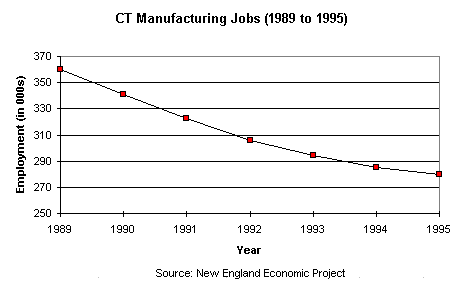
EMPLOYMENT TREND
IN MANUFACTURING |
|