Edward J. Dodson |
During the Depression years of the 1930s, Franklin D. Roosevelt promised his fellow citizens a "New Deal." His years as President of the United States ushered in the era of the planned economy and the introduction of programs ostensibly designed to provide a safety net for those most at risk in our society. The Second World War, destructive in so many ways, brought full employment to U.S. workers, enabled industries to modernize and created an enormous pool of savings unleashed into the economy after the war's end. Millions of young adults married and began to create the "baby boom" generation. All of these factors combined to pull up median household income by 37 percent between 1949 and 1959, and another 41 percent during the 1960s. "Between 1947 and 1973, median family income grew from $20,102 to $40,979, or by 104%," according to data published by the Economic Policy Institute (the "EPI"). The economy was then hit with huge increases in the cost of fossil fuels and entered a prolonged period of stagflation. However, from 1973 to 1997, the EPI reports, "median family income rose an average of 0.35% a year."[1] By the beginning of the 1980s, government policies changed, with the stated objective of stimulating investment in job-creation and economic growth. The results have been rather mixed. On the one hand, the effective tax burden on those at the top of the U.S. economic ladder has been significantly reduced -- while government spending has continued to escalate well beyond its revenue stream, creating a national debt that has passed $6 trillion and is now forecasted to continue rising with no return in sight to a balanced budget environment and a gradual retirement of some portion of the national debt. Accounting for government spending is less than ideal. We do not really know how much the government is spending or on exactly what. In 2002, the director of fiscal policy at the Cato Institute summarized the problem: "Now that the federal government has cracked down on corporate financial mischief, it should turn attention to its own accounts. Congress has passed a bill it thinks will promote sound corporate bookkeeping and punish business leaders who break the rules. Meanwhile, the financial accounts of many federal agencies are a shambles, and Congress breaks budget rules all the time. Companies such as Enron collapsed under piles of hidden debt. But the government is creating its own crisis by amassing trillions of dollars of unfunded retirement liabilities. How our government spends revenue raised from taxation and from the issuance of debt is a matter of great importance to each of us, as citizens -- or should be. Those of us who sincerely care about the plight of the least fortunate in our society need to know where public funds are to be spent and who the beneficiaries are. However, above the problem of public accountability is the overriding question of what ought to be done by government (i.e., what ought to be our public priorities). Although the United States has always promised the opportunity for citizens and new arrivals to rise above the circumstances of their birth, the fact is that wealth and income have from the very earliest period been highly concentrated. When historian Jackson Turner Main examined the colonial record in 1965, published in his book The Social Structure of Revolutionary America, he concluded: "The revolutionary class structure can now be described in terms of occupational groups. Each occupation had its exceptional men, but in general the laborers were poorly paid and acquired little property; artisans earned somewhat more and became small property holders; most farmers were in the same position, though some became wealthy; professional men and shopkeepers received good incomes and had substantial estates; while merchants were characteristically well-to-do or rich."[3] Another characteristic of wealth ownership from the colonial period on has been the extent to which assets are owned by foreign nationals and companies domiciled outside the United States. The Federal government was then and is now highly dependent on the willingness of foreign nationals to invest in U.S. government securites. In a volatile world, lending funds to the U.S. government is, relatively speaking, a "safe harbor" for one's surplus assets. Economists disagree whether, on balance, the fact that so much of the U.S. government debt is held externally is a strength or a weakness. There is an active market for this debt because the world's investors perceive the U.S. government to be a high quality debtor. Multiple shocks to the economic engine or political situation could jeopardize this long-held status. 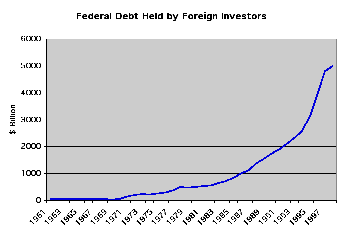 Economists also have widely differing views on the extent to which a rising national debt threatens the stability of the economy. In periods of high interest rates, the amount of revenue required to service the outstanding debt can become a high percentage of total government spending. The Executive and Legislature branches talk about deficit reduction but give virtually no consideration to the possibility of retiring a significant portion of the national debt. After several years of optimal performance during the Clinton years, Federal revenue is declining and President Bush has achieved significant reductions in taxes on dividends, incomes and estates. He is hoping for a supply-side effect that failed to develop during the Reagan years. The graph below does not reflect the huge escalation in total debt incurred since President Bush has taken office. 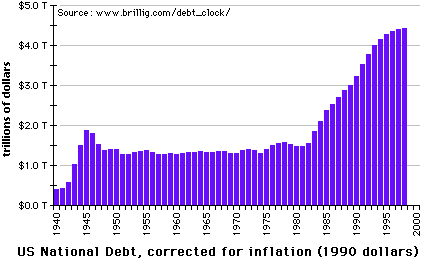 For the moment, the low interest rate environment is allowing the Federal government to take on added debt without driving up interest rates. A much more serious scenario develops if this debt must be refinanced down the road in an environment of rising interest rates. |
Asset Ownership and Incomes For most of the post-Second World War period -- for the majority of U.S. households -- acquiring property and enjoying rising incomes became an expected outcome of living according to certain norms. Millions of people benefited by access to better schools. Obtaining professional credentials or technical training prepared us for a place in the expanding economy. Others achieved significant financial wealth because of their talents in the arts or athletics. In fact, when one looks at the enormous number of professional sports teams and entertainment mediums that exist because of spending by U.S. consumers, it is had to reconcile the fact that asset ownership and income is actually very highly concentrated at the top. Whether by design or simply because of statistical convenience, U.S. government reporting downplays the true extent to which wealth is concentrated: "[B]y designating the top 20 percent of the entire nation as the "richest" quintile, the Census Bureau is including millions of people who make as little as $70,000. If you make over $100,000, you are in the top 4 percent."[4] Among the U.S. population, the top 1% -- fewer than 3 million people -- control assets of greater value than the bottom 95%. The Forbes 400 wealthiest Americans in 1999 included 268 billionaires. In 1998, the top 1% of income-recipients enjoyed greater income than the 100 million people at the bottom. Between 1983 and 1997, only the top 5% of households experienced an increase in net worth. All others experienced a decline. More recent data is not available on the status of household wealth since then; however, one can surmise that a considerable portion of the gains experienced by investors in the stock market have been lost. In Recent Trends in Wealth Ownership, 1983-1998, Edward N. Wolff provides important insights in the process of wealth concentration that has occurred in this country. Among his observations:
|
A remarkable amount of personal wealth has been turned over to the thousands of foundations established over the last century. The Foundation Center estimated the value of assets held by the nation's foundations in 2000 at $486 billion. However, during 2002 foundation assets fell in value by a median of 9 percent because of the downward direction in the value of corporte shares of stock).[5] The five largest foundations (Gates, Lilly, Ford, Robert Wood Johnson, Getty) control assets of nearly $75 billion. Yet, despite this enormous pool of funds available to address many societal problems, the extent of wealth and income concentration in the United States continues to worsen:
|
The organization
United for a Fair Economy has
compiled the data on how corporate executives are now compensated in
relation to the rest of the nation's workforce. The first chart
shows the trend just since 1990. The second chart shows how the
multiple has climbed since 1960: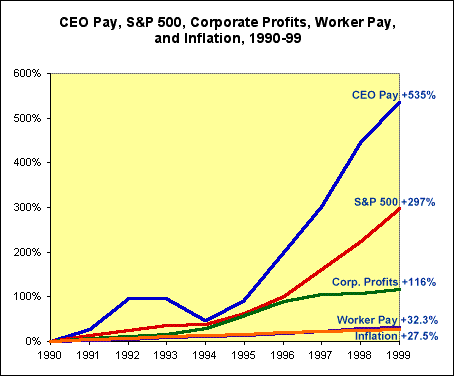 Forbes continues its annual tradition of publishing a list of the wealthiest people in the United States. Just three individuals -- William Gates, Warren Buffett and Paul Allen -- control assets worth $100 billion. The 400 people included in the Forbes list have a combined net worth in excess of $1 trillion. To put their wealth in some perspective, even in the wealthiest suburban communities across the country only 35-40% of households have annual incomes over $100,000.[6] A more detailed picture of how wealth and income are distributed in the United States can be found at The Shared Capitalism Institute website.
|
How do we Tax Wealth and Income? An ongoing debate with enormous potential impact on our society concerns the extent to which wealth and income ought to be subject to taxation. What level of taxation is appropriate to the benefits enjoyed and what level is unjustly confiscatory? Is the size of one's income an appropriate basis for one's tax obligation, or should a distinction be made based on other factors, such as whether income is "earned" or "unearned?" In addition to the Federal government, forty-three states also tax personal income. At what point incomes become subject to taxation differs in each state. Eleven states provide income supplements to families with incomes at or below the poverty line. Alabama exempts the least income from taxation ($4,600); California exempts the most ($36,800). For quite awhile there has been a good deal of debate over the fairness of the Federal income tax, the main alternative proposal being to replace the current system with a flat tax. Yet, there is great reluctance to make any major changes. Legislation raises or lowers effective tax rates, loopholes are closed and new ones opened. The tax rules are extremely complex and subject to conflicting interpretation. Accountants, lawyers and tax preparation services build careers and businesses based on their success in minimizing the tax obligations of clients. In far too many instances, people feel compelled to use tax preparation services because they simply do not understand how to comply with the tax laws. The taxation of inherited wealth is also under intense debate. One side argues that inherited wealth already has been taxed and should be exempted from taxation at the time assets pass on to heirs. Others argue that the accumulation of wealth is possible only because of the benefits society provides, so that a good portion of a person's estate should be returned to society and not passed on through inheritance. In any case, the exemption of inherited wealth from taxation is already considerable. A report prepared by the Center on Budget and Policy Priorities analyzed the data for 1997, concluding:
|
| A coalition of anti-poverty groups and others argue the case to retain the taxation of inherited wealth. A surprising number of people in the top eschelon of the wealthy have joined in this campaign. Pictured at the right is Chuck Collins, Program Director of United for a Fair Economy, whose organization has been described by John Nichols of the Nation as: |
| "... the single most effective group in the country when it comes to publicizing issues of economic injustice, income disparity, the racial underpinnings of the gap between rich and poor, and . . . the yawning chasm between the salaries of corporate CEOs and those of working Americans." |
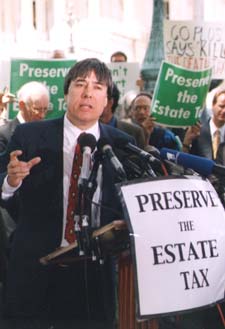 |
| Collins has collaborated with William Gates, Sr. to popularize the idea that the wealthy owe much of their success to societal institutions and good fortune. |
After exhaustive debate in the public media, the U.S. Congress has agreed to reduce taxes over the next ten years by an estimated $350 billion. This represents the third largest tax reduction in U.S. history. Critics point to the fact that the overwhelming percentage of beneficiaries are the very wealthy. Moreover, unless an historically unique supply-side effect occurs, the Federal deficit is forecasted to hit over $500 billion in 2004. At the beginning of 2003, The Heritage Foundation's Center for Data Analysis published Who Really Benefits from Dividend Tax Relief?, a report by Norbert J. Michel challenging the assertions the "average" working Americans would hardly benefit by the President's tax cut proposals. A close look at the data, Michel concluded, reveals a very different picture:
Subsequent discussions at this conference will examine the pros and cons of specific changes in the way government raises revenue and from whom. Hopefully, the long-term result of changes in our tax system will achieve greater fairness and equity, as well as efficiency and simplicity. Whether the current changes meet these tests will become known as individuals and entities make investment decisions, as household incomes rise or fall, and as the economy produces greater or lesser employment at livable wages. These considerations beg the next question. Is the Middle Class in Decline? A real concern for the health of the U.S. economy and our society expressed by many public officials, economists and others, is the perceived declining economic strength of the middle class. Some recent statistics suggest the situation is getting worse every year. As already shown, those at top have experienced an unparalled increase in their net worth and incomes. The picture for everyone else is less clear. People who have owned homes for any period of time have experienced significant increases in their nominal net worth. Some have "cashed out" and relocated to less costly parts of the country, investing the net gain in stocks and bonds. Homeowners have also been able to take advantage of historically low mortgage interest rates to reduce their overall debt payments or upgrade and expand the size and amenities of their home. While widespread, the benefits of low interest ratese and rising housing values are not universal. The Center for Housing Policy, the research affiliate of the National Housing Conference (NHC), produced a study of housing affordability for low- and moderate-income working families across the nation. In a press release dated May 5, 2003, NHC reported:
A Population Addicted to Debt? The Federal Reserve reported that at the end of the first quarter of 2003 consumer debt in the United States was $1.742 trillion, with revolving debt accounting for $711 billion of that amount. Managing debt has become a serious challenge for an increasing number of households, as evidenced by the fact that in 2002 a record 1.5 million people filed for protection under the personal bankruptcy laws. This has prompted calls for bankruptcy reform to make it more difficult for people with higher incomes and huge amounts of accumulated debt to obtain relief of their credit obligations. On the positive side, as Fed Chairman Greenspan has noted, millions of homeowners have been able to refinance the mortgage loans on their primary residences, taking an additional $2 billion of equity to repay home equity loans and credit card debt. In the short run, at least, these homeowners are in a much improved financial situation. Still at risk are those who have experienced a loss of employment or other decline in income and have been forced by circumstances to take on additional debt. Minorities Continue to Lag Behind Minorities continue to make up a disproportionate share of the asset-poor population, although there are clear indications that more and more minorities are taking advantage of opportunitiesnot available to them in previous decades. The U.S. is now home to more than 20 million foreign-born residents. More than 25,000 well-trained workers from India have settled in the U.S. to work in the high-tech industries. They now own and manage hundreds of technology firms. An important side-effect has been philanthropic giving. Beneficiaries are not just communities in which immigrants live and succeed, but also those back home. In 1998, the U.S. recorded $16 billion in remittances from foreign born workers to their home countries, out of a global total of $70 billion. In fact, nearly 23 percent of all international remittances originate in the U.S.[7] African-Americans and Hispanics have made enormous progress in the United States. African-Americans own 3.6% of all businesses, although most have revenue of less than $25,000. Many members of these minority populations remain impoverished. The U.S. Census data shows:
Living Below the Poverty Line
Data gathered during the 2000 U.S. Census reveals that the distance between the "haves" and "have nots" in the United States is becoming greater. Some 33 million people -- nearly 12% of the population -- live in families with incomes below the official poverty line of $18,104. An analysis by the Children's Defense Fund draws our attention to those suffering most:
Poverty in the United States does not, generally, translate into the kind of deprivation seen in much of the developing world. However, the rate of child poverty in the U.S. is two-to-three times higher than that of most other major Western industrialised nations. Poverty is closely linked to serious health problems and learning disabilities among the young, diminished potential to achieve self-sufficiency and a greater probability of involvement in criminal activity as an adolescent or young adult. These are serious, and costly public issues.
Housing and Homeownership The U.S. Census Bureau reports a homeownership rate of roughly 68 percent. Across the nation, some 74.4 million housing units are owner-occupied. Among African-Americans and Hispanics the homeownership rate is between 48-49% but experiencing annual increases. In fact, during the 1990's, the number of minority homeowners increased by 4.4 million, reaching 12.5 million by the end of the decade.[8] Housing prices have been escalating in most parts of the country since the mid-1990s. The $1 million house is no longer a rarity. Over 9,000 residential properties sold from $1 million or more in 1998. Although union wages for construction workers, restrictive building codes and density restrictions are often pointed to as primary reasons for the shortage of new, affordable housing units, the more fundamental reason is the escalating cost of land available for development. A commentary on the housing market published in October of 2002 by theMortgage Bankers Association of America attempted to focus attention on this underlying market dynamics:
The authors' reference to "imputed rent" is unfortunate. The dilemma is that people have to live somewhere, incurring actual expenses related to whatever housing they occupy. Most people choose housing options based on what their household income permits. If they do not have much savings, they will likely lease housing from a private or public owner of real estate. To the extent people own more than one residential property, the tendency is to live in the property that most meets their space and amenity needs. Other real estate is leased out to obtain "rental" income. The reality is that only a small number of property owners are in a position to actually enjoy net imputed rental income. Few homeowners offer their residential property for lease if they suffer a loss in household income and cannot maintain payments on a mortgage loan. If they have sufficient savings, they will sell the property and attempt to find less costly housing or relocate in order to find alternative employment. There are numerous housing markets in every metropolitan area across the United States. Housing prices during the last decade have been increasing -- at different rates -- in almost all of these markets. A few have peaked and experienced reversals (e.g., the San Francisco Bay area). Some markets are driven up by the influx of higher income households competing for a limited supply of existing housing units and by developers competing with one another to acquire developable land parcels. The hoarding of land by speculators in these markets drives up the cost of land faster and further. Sklarz and Miller, in the above article, should have noted that one of the important distinctions between the imputed rent associated with housing units and that of land parcels, is that the ownership of housing requires continuous outflows of financial reserves for maintenance and systems replacement, whereas the only cost of ownership imposed on the landowner is whatever annual tax payment is required by the local community. The result is that as demand for land increases, the supply often actually falls as owners decide to hold land longer in anticipation of greater future gains. The outcome of these market and public policy dynamics by the first quarter of 2002 was to push the national median price of housing to nearly $151,000. Double-digit price increases were experienced in many parts of the country, with housing in some parts of Massachusetts increasing at over 20% annually. As already noted, not every market continues to move upward. A number of metropolitan areas (e.g., the San Francisco Bay Area, Peoria, Illinois and Springfield, Missouri) have experienced declines from their high points but have not fallen back to pre-1995 levels). Another important observation needs to be made about housing in the United States. Although the prices of single-family homes have been increasing for decades, so has the size and amenities of homes being built. Between 1970 and 2000, the average size of new homes has increased from 1,500 square feet to more than 2,200 square feet. In just five years -- from 1992 to 1999 -- the home building industry added 11.5 million single-family homes to the nation's housing stock. Most are constructed with energy-efficient systems and appliances, central air-conditioning, wall-to-wall carpeting, attached garages and two or more bathrooms. Yet, demand continues to outrun supply. Data released by the U.S. Census Bureau indicates the U.S. loses about 0.6% of its housing stock annually, which translates into a forecasted loss of 15 million units by 2025. During this same period the population of the nation will increase by 30 million households. Thus, to meet demand the nation will need to construct 45 million new housing units. In the Northeastern states, the increases have been most dramatic in Boston metropolitan area, impacting young families and other first-time homebuyers most seriously.
In the State of Connecticut, housing prices in some areas had been falling since the late 1980s. On the one hand, this made the cost of single family housing in Connecticut relatively affordable. Until 1996 the ratio between housing cost and per captial personal income had fallen for nine consecutive years.
One of the side-effects of rising real estate prices is the disappearance of rental housing affordable to those at the bottom of the economic ladder. Adult children return, if they can, to live with parents, in more and more cases bringing their own spouse and children with them. The least fortunate become homeless. Economic hardship coexists with mental illness and drug addiction to exacerbate the situation of the homeless. Single men make up 40% of the total. Families with children make up another 40%. Single women another 12% and teenage youth another 2-4%.. Nearly one-third of the homeless suffer from some degree of substance abuse. Nearly one-fourth are considered to be mentally ill. One in ten homeless persons is a veteran of the U.S. military.
For a very large number of U.S. households, "equity" in their home and the land on which the house rests represents a significant portion of their net worth. A 2001 study by the Consumer Federation of America indicated that half of U.S. households headed by someone over age 45 possessed assets of at least $100,000. Nearly 35 percent of the wealth of these households is equity in their primary resident. Parents often tap this equity in order to borrow funds for their childrens' college education. Others sell after reaching retirement from their working life and either move into rental housing or relocate to a part of the country where housing is less costly -- or they downsize from a single-family property to a townhome, condominium or manufactured housing unit. For all of these reasons, housing (and land) equity is a driving force in our society and economy. Existing homeowners generally benefit by the rise in land values, although retirees living on a fixed income often find it difficult to absorb increases in annual real estate taxes. The last six or seven years have seen a return to unprecentedly low mortgage interest rates. Homeowners have refinanced mortgage loans several times during this period, either to tap equity for various expenses or simply to reduce the monthly payments or the length of time over which loans are repaid. Data on mortgage loan originations to owners and purchasers of 1- to 4-family properties indicates that in 2001 a total of $2.03 trillion in financing was provided. Total mortgage debt increased to $2.48 trillion in 2002, and the forecast for 2003 is $2.59 trillion. [10] Lenders made over 16.7 million mortgage loans in 2002. Of this total, the overwhelming majority -- around 75% -- were made in an amount representing less than 80 percent of the appraised value of the real estate. Even so, one estimate is that more than 420,000 mortgage loans were made at a level representing more than 95% of property value.
The causes of homelessness are complex. Although personal failures are involved, an important question is whether homelessness can be materially reduced (if not eliminated) by the adoption of changes in public policy. A report by Hope Harbor Christian Mission provides the following statistics on homelessness:
Who Owns the Land?
An important but often overlooked component in our economic system is that every person requires access to land on which to live, work and play. Our system embraces both private and public control over land, directed in part by market forces and in part by societal needs. We need no reminder that the history of land ownership in the United States is troubled. Colonial governments removed the indigenous tribal peoples in order to establish a system of land ownership on the English model. The territory under colonial control (and later under the control of the states and the Federal government became a public domain that could be sold off to raise revenue to supplement taxation. There are a number of states where most of the land remains under the control of the Federal government. Nearly 96% of Alaska remains in the public domain, for example. Rhode Island sits at the other extreme with less than 2% of its territory held by government. This pattern is inconsistent, even in the Northeastern states, as the following chart shows:
The Federal government controls 28 percent of the nation's land area. State and local governments control another 9 percent, and trust lands for the indigenous tribes who occupied the continent before the arrival of Europeans account for roughly 2 percent. Thus, over 60 percent of the land -- 1.4 billion acres -- is in private hands.
The total land area of the United States consists of 2.3 billion acres. Our cities occupy 72 million acres, expanding at a rate of 1.4 million acres annually. Another 73 million rural acres are developed for non-farm residential use. Less than one percent of our land is dedicated to housing people (and roughly 5 percent is used for residential, commercial and industrial purposes). Not surprisingly, the principal private landowners in the United States are Seniors.
Decade after decade we continue to experience a loss in the number of family-owned farms across the United States. Periodically, thousands of farmers become insolvent and are forced to sell out and attempt to find alternative employment elsewhere. Markets for agricultural commodities have always been competitive, and the development of effective means of transporting agricultural products over long distances has only contributed to the need for farmers to be highly efficient -- unless heavily protected from competition by legislation that imposes quotas and tariffs on imported commodities. Even so, there is a rather consistent repeated pattern of behavior that victimizes farmers. In periods of rising prices (e.g., during the First and Second World Wars), farmers were encouraged to borrow from banks to acquire and cultivate additional -- often marginally-fertile -- acreage. Meeting the debt service on these land acquistion loans depended on the cash flows from artificially inflated commodity prices. When war ended and overseas farmers were able to bring their own farms back into production, demand fell, commodity prices came down, and the more highly leveraged farmers defaulted on their bank loans. The banks foreclosed, the farms were sold to financially-solvent neighbors, or -- in more recent times -- to corporate agribusinesses.
Prices for commodities are determined internationally. U.S. farmers compete with farmers elsewhere as much for subsidies and price supports as for market share. By 1935 there were just 6.8 million family farms left in operation. By 2002 that number had fallen to just 2 million. The children of farmers are leaving their parent's farms in droves. And, many farmers must work second jobs in nearby towns in order to keep farming. Even this strategy becomes less and less possible as rural towns close down as the rural population moves away. As summed up by Mary Hendrickson, professor of rural sociology at the University of Missouri (Columbia):
"When demands for developable land are sufficiently high, the value of land in developed use will exceed its value in agricultural use. This enables developers to outbid farmers for use of the land. ...As more land exits farming, the local agricultural economy may suffer. However, existing farmers may welcome the increase in farmland values, especially if they view their investment in land as a retirement fund and do not have children who plan to continue farming the land." [14] U.S. government subsidies have overwhelmingly benefitted corporate agribusiness. Total subsidies in 2001 amounted to over $71 billion. Not surprisingly, corporate farmers and ranchers reported huge increases in profits at taxpayer expense. All across the nation there is a slowly-growing movement to preserve wilderness. A leading nonprofit steward is the San Francisco-based Trust for Public Land (TPL). In 2002, TPL acquired over 170,000 acres of land in northern New Hampshire from International Paper Corp.
For those who have the financial reserves or the borrowing capacity, purchasing land and holding on to it has proven to be a very profitable investment strategy. Ron Axelrod, principal of a California-based land investment firm, advisers potential investors that "land selected must be in the path of growth in areas that are on the verge of rapid growth -- for it is population growth the creates wealth." Population growth increases demand for housing, for public infrastructure, for retail shopping, for office buildings, for everything residents look for as citizens and consumers. When owners of undeveloped land in the cities or adjacent suburbs ask more than developers believe can be profitably developed, they look for less expensive land further out, driving up the cost of rural land and often encroaching on a region's most productive agricultural land. On the other hand, two researchers at the U.S. Department of Agriculture -- Marlow Vesterby and Kenneth S. Krupa -- concluded in 1997 that:
Research pubished by The Brookings Institution in 2000 [16] indicates that on average, 15% of the land area in our cities is described as vacant ("ranging from undisturbed open space to abandoned, contaminated brownfields"). Although cities in the Northeastern states generally had the lowest percentage of vacant land, they reported the highest number of abandoned structures. The challenge has long been one of how to stimulate investment that recycles or replaces abandoned structures or brings into development locations in the cities rather than the continuous conversion of outlying agricultural land and open space for development.
The historical data confirms that land prices -- and "nominal" prices, particularly -- have not experienced a general or long-lasting decline in the United States. Yet, land markets do exhibit periodic crashes. These occur when price rises occur so rapidly that they outpace increases in personal incomes and business profits. Those individuals who lease land, lease housing, lease office space, lease retail space or any space experience rising demands from property owners for a larger share of their household or business income. In some markets, the problem is now reaching crisis proportions. As recently reported in the Wall Street Journal:
RETURN TO TOP |