| Welcome
Definition
and Properties of Laser Light
How
a Laser Works
Laser
Types and Classifications
Laser Biological Hazards
Eyes
Skin
Non-Beam Laser Hazards
Protective Measures - Laser Safety
Protective Equipment
Path to Laser Operation
Test
Laser Links
|
|
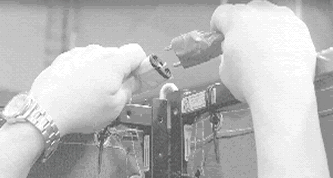

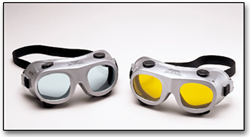
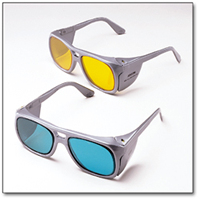
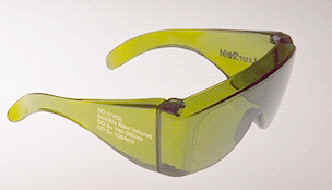
Laser Safety Glasses
 |
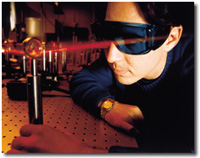
When all other protective measures fail, if you are
wearing proper laser safety glasses for the wavelength and power of the
laser you are using you will protect your eyes. The importance of
wearing these glasses whenever there is a possibility of being exposed
to laser light above the MPE cannot be overemphasized.
 |
As discussed earlier, different wavelengths interact with the
body in different ways. We should understand that the same applies
to the protective lenses we use. For example, we should not use a
pair of safety glasses that are rated to protect against a HeNe
laser @ 632 nm when we are using a Ar-Ion laser @ 488 nm. The
first thing to take into account when choosing safety glasses is WAVELENGTH.
|
|
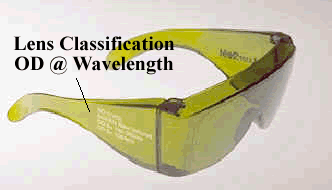
We must also take into account that even
though we may have chosen the proper protection for a certain
wavelength, lenses do not filter out all of the light that may be
incident upon them, and all lenses are not rated the same. This is
where OPTICAL DENSITY (OD) comes into play. The OD is defined
by the ANSI Z136.1 as the logarithm to the base ten of the
reciprocal of the transmittance:
 |
Dl
= - log10
tl
where tl
is the transmittance.
|
|
|
Both the wavelength and the OD must be
labeled on either the temple for glasses, or on the frame, for
goggles. Remember that in certain applications, as in the use of
powerful Class IV lasers, certain protective lenses are not meant as
a permanent protective shield. For example, in the use of Class IV
CO2
lasers @ 10,600 nm, the protective lens only provides sufficient
protection to allow immediate movement away from the beam. If the
operator remains in the path of the beam, the beam will burn through
the lens very quickly.
|
|
Barriers, Shrouds, and Beam Stops
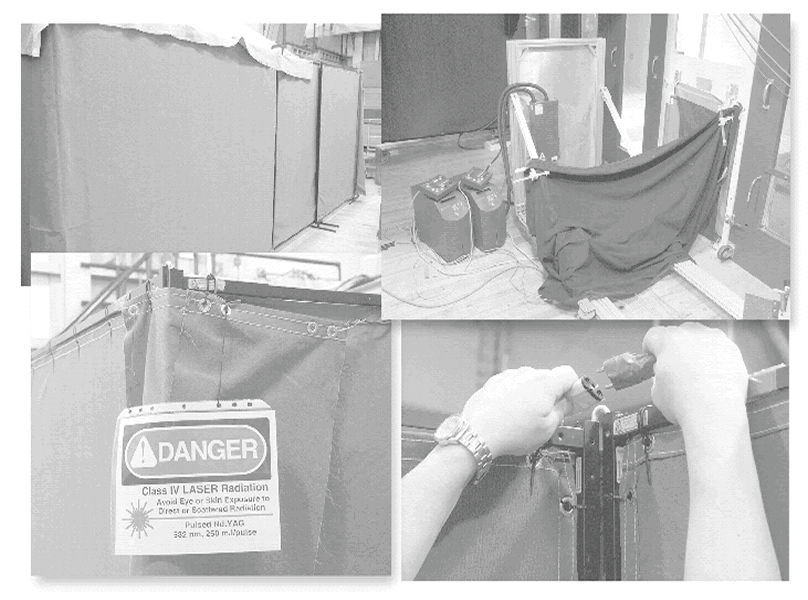
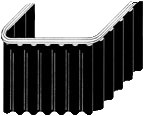
Protective Laser Curtain Set-Up for a Class 4 Laser
System
In a perfect laser safe world, we would never have a need
for protective backstops. The laser beam would either be totally
enclosed or always right where we wanted it to be. But we do not
live in a perfect world and sometimes even our favorite laser beams go
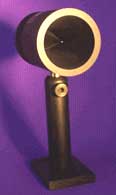
astray. When they do, we need a non-reflective surface that can dissipate
heat well to stop the beam until we can return it to proper
alignment. Welding curtains, darkened bricks, and commercial beam
stops are all used in laser systems to protect personnel and the
environment from stray laser beams.
Commercial Beam Stop
Laser Use Controlled Area
Areas used for laser operations, especially for laser
operations using Class 3b and 4 lasers, need to be controlled.
| For Class 3b and 4 lasers:
|
Access to the area needs to be restricted to only
allow entry to personnel who have been trained and who are
listed on the Laser Safety Permit when the laser is in operation
and exposure to laser radiation above the MPE is possible
|
|
The laser system must be operated by a key and
that key must be under the control of an Authorized Laser User (ALU)
at all times
|
|
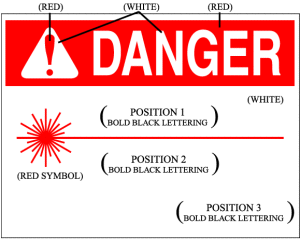
The area needs to be conspicuously posted to
prevent inadvertent entry
|
|
The area should be locked and the entrances
interlocked to stop the laser radiation in the case of inadvertent
entry
|
|
The beam shall be enclosed or surrounded by a
protective housing whenever possible and practicable
|
|


|

