
Definition
and Properties of Laser Light
Laser Types and Classifications
Laser Biological Hazards
Protective Measures - Laser Safety
Types of Lasers
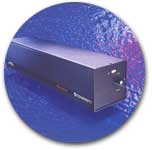
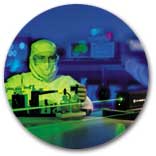
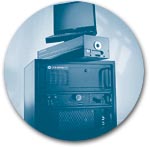
There are many types of lasers available for research, medical, industrial, and commercial uses. Lasers are often described by the kind of lasing medium they use - solid state, gas, excimer, dye, or semiconductor.
 | Solid state lasers have
lasing material distributed in a solid matrix, e.g., the ruby or
Gas lasers (helium and helium-neon, HeNe, are
the most common gas lasers) have a primary output of a visible red
light. CO2 lasers emit energy in the |
Excimer lasers (the name is derived from the
terms excited and dimers) use reactive gases such as
chlorine and fluorine mixed with inert gases such as argon, krypton,
or xenon. When electrically stimulated, a pseudomolecule or dimer is
produced and when lased, produces light in the ultraviolet range.
|
Dye lasers use complex organic dyes like
rhodamine 6G in liquid solution or suspension as lasing media. They
are tunable over a broad range of wavelengths.
|
Semiconductor lasers, sometimes called diode
lasers, are not | |


Lasers are also characterized by the duration of laser emission - continuous wave or pulsed laser. A Q-Switched laser is a pulsed laser which contains a shutter-like device that does not allow emission of laser light until opened. Energy is built-up in a Q-Switched laser and released by opening the device to produce a single, intense laser pulse.
| CONTINUOUS WAVE (CW) lasers operate with a stable average beam power. In most higher power systems, one is able to adjust the power. In low power gas lasers, such as HeNe, the power level is fixed by design and performance usually degrades with long term use. |
| SINGLE PULSED (normal mode) lasers generally have pulse durations of a few hundred microseconds to a few milliseconds. This mode of operation is sometimes referred to as long pulse or normal mode. |
| SINGLE PULSED Q-SWITCHED lasers are the result of an intracavity delay (Q-switch cell) which allows the laser media to store a maximum of potential energy. Then, under optimum gain conditions, emission occurs in single pulses; typically of 10(-8) second time domain. These pulses will have high peak powers often in the range from 10(6) to 10(9) Watts peak. |
| REPETITIVELY PULSED or scanning lasers generally involve the operation of pulsed laser performance operating at a fixed (or variable) pulse rates which may range from a few pulses per second to as high as 20,000 pulses per second. The direction of a CW laser can be scanned rapidly using optical scanning systems to produce the equivalent of a repetitively pulsed output at a given location. |
| MODE LOCKED lasers operate as a result of the resonant modes of the optical cavity which can effect the characteristics of the output beam. When the phases of different frequency modes are synchronized, i.e., "locked together," the different modes will interfere with one another to generate a beat effect. The result is a laser output which is observed as regularly spaced pulsations. Lasers operating in this mode-locked fashion, usually produce a train of regularly spaced pulses, each having a duration of 10(-15) (femto) to 10(-12) (pico) sec. A mode-locked laser can deliver extremely high peak powers than the same laser operating in the Q-switched mode. These pulses will have enormous peak powers often in the range from 10(12) Watts peak. |
Classifications of Lasers
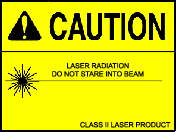
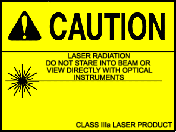
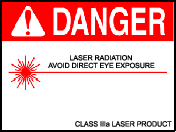
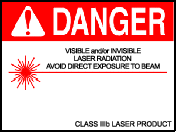
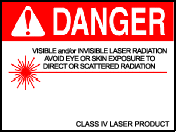
A classification label will be found on the laser housing. This label provides important information on the hazard of the laser.
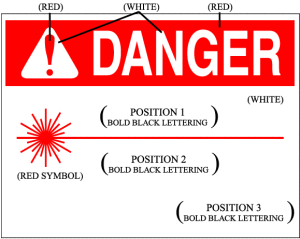
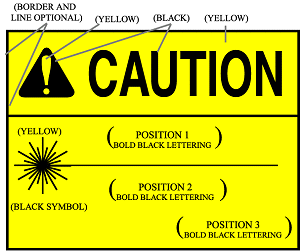
Lasers have been classified with respect to their hazards based on power, wavelength, and pulse duration. These definitions are wordy and cumbersome to read out of context, but when given the specifications of a laser or laser system are not difficult to apply.
Classes of Lasers (adopted from ANSI Z-136.1-2000)
|
Class 1
| Class 2
|
|
Class 3a
|
|
Class 3b
|
|
Class 4
|

Bonus! Click for Huge Image of a Laser Wavelength Chart


