Contents
 |
|
|
|
|
|
|
|
|
|
|
|
|
|
|
|
|
|
|
|
|
|
|
|
|
|
|
|
|
CNN Wednesday, August 27, 2003 Posted:
1716 GMT (1:16 AM HKT)
 European
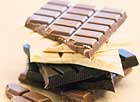
researchers have found out that eating milk chocolate, which is most
commonly used in candy bars, does not raise antioxidant levels in the
bloodstream. They found the same discouraging result among patients who
drank milk while eating dark chocolate.
European
researchers have found out that eating milk chocolate, which is most
commonly used in candy bars, does not raise antioxidant levels in the
bloodstream. They found the same discouraging result among patients who
drank milk while eating dark chocolate.
The results suggest that milk and other dairy products somehow discourage the body's ability to absorb the protective compounds in chocolate. Only subjects who ate dark chocolate showed a temporary increase in their antioxidant levels.
Details of that study appeared in Thursday's issue of the journal Nature.
"This puts in question the possible protective effects of (chocolate) milk shakes or ice cream or other dairy products," said co-author Alan Crozier of the University of Glasgow.
Nor does Crozier endorse the idea that eating dark chocolate is healthier. It still contains plenty of fat and sugar.
"Don't think by eating five or six bars a day you're doing yourself any good," he said.
Effects of chocolate on blood pressure
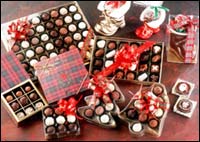 A German study published Wednesday in the Journal of the American Medical
Association suggests that eating dark chocolate can lower blood pressure.
Other experiments show cocoa flavonoids may reduce harmful blood clotting
properties and decrease low-density-lipoprotein (LDL), known as the "bad
cholesterol."
A German study published Wednesday in the Journal of the American Medical
Association suggests that eating dark chocolate can lower blood pressure.
Other experiments show cocoa flavonoids may reduce harmful blood clotting
properties and decrease low-density-lipoprotein (LDL), known as the "bad
cholesterol."
The JAMA study involved adults with untreated mild hypertension who ate 3-ounce chocolate bars daily for two weeks. Half of the patients got white chocolate, half got dark chocolate.
Blood pressure remained pretty much unchanged in the group that ate white chocolate, which does not contain the polyphenols that is present in other types of chocolate. After two weeks of of eating, systolic blood pressure had dropped an average of five points in the dark-chocolate group. The lower, or diastolic, reading fell an average of almost two points.
In 1998, a Harvard study of nearly 8,000 of its male graduates determined that eating the equivalent of few bars of chocolate a month lowered the risk of death by 36 percent as compared to abstainers.
In the latest experiments, which were conducted without industry funding, Crozier and researchers in Italy first determined the antioxidant levels of dark chocolate and milk chocolate in the lab. Dark chocolate had twice as much, Crozier said, as milk chocolate contains only approximately half as much actual chocolate.
The researchers then gave chocolate bars to seven women and five men who were between 25 and 35 years old. All of the participants were nonsmokers, had normal blood lipid levels, took no prescription drugs or vitamins and were not overweight.
After they ate dark chocolate bars, the antioxidant potential measured in their blood increased an average of 18 percent and remained elevated for three hours.
Lead author Mauro Serafini said the subjects' antioxidant potential did not rise noticeably when they consumed a glass of whole milk with the dark chocolate, or when they ate milk chocolate. He said it's possible that antioxidants bind with milk proteins making absorption more difficult.
Scientists who did not contribute to the research said the protective aspects of flavonoids in chocolate have not been proven.
"I guess this means to be healthy you should eat chocolate with red wine," said Andrew L. Waterhouse, a nutrition professor at the University of California at Davis. "That is, if you believe the antioxidant hypothesis.
"No one has taken flavonoids, given them to people in a controlled scenario and shown that people who take them are more healthy than those who don't," he said.
Dr. Robert H. Eckel, a spokesman for the American Heart Association, said there is not enough information to recommend chocolate as a food that reduces the risk of heart disease.
Coughing Thursday, 5 December, 2002, 00:10 GMT CNN
Chocolate could provide the key for a new kind of cough medicine. But experts say patients should not take the news as a licence to eat lots of chocolate bars if they are sick. A chemical in chocolate called theobromine has been shown to be effective in preventing cough in early tests.
The research was presented to the British Thoracic Society's (BTS) winter meeting in London.
A cough was artificially provoked in 10 healthy non-smokers.
Researchers at the National Heart and Lung Institute, Imperial College London gave them theobromine, followed by capsaicin, a cough stimulant based on chilli peppers.
They compared theobromine to a dummy version, which would have no effect, and codeine, which is used in traditional cough remedies.
Theobromine was the most effective in treating cough.
Experts say more research is needed into new cough treatments, particularly for persistent cough.
Around £100m is spent each year on cough medicines in the UK.
The researchers plan to carry out more studies into the effectiveness of theobromine for patients who are suffering from a cough after a cold or flu.
But they say it is too soon to say theobromine can definitely be used to effectively treat cough.
Dr Omar Sharif Usmani, respiratory physician at the National Heart and Lung Institute and member of the BTS, who led the research, told BBC News Online it was not clear if theobromine suppressed the action of coughing or cleared mucus from the lungs.
"We don't know how this drug works, but it gives us an insight into possible applications and treatments."
But he added: "If it does work, it will just be a white tablet that is tasteless, and colourless - it will not be chocolate flavoured."
Dr John Harvey, chairman of the BTS communications committee, said: "The number of people with undiagnosed chronic cough is increasing in this country and more effective treatments are needed.
"The condition can be really distressing and so I hope this research provides a clue for future treatments."
But he added: "It is too early to advise people suffering from coughs to treat themselves with chocolate!"