Contents
 |
|
|
|
|
|
|
|
|
|
|
|
|
|
|
|
|
|
|
|
|
|
|
|
|
|
|
|
|
Composition and effects of chocolates
The following is the contents of some chocolates in some countries and the weight of the chocolates taken for reference is 100g each. Also I would like to add that all chocolates depending on the type, brand or even country that it is produce in would have slight difference in composition. The following is only an average. In the table below The Chocolate Wrappers Museum website, and many other websites that I went to, actually listed vitamins as a component of chocolates. Though, personally, I have never seen any vitamins listed as a component in any of the wrappers that I have seen. I did look for some other brands online and found that some chocolates do indeed contain a small percentage of vitamins.
Component |
DARK Chocolate |
MILK Chocolate |
WHITE Chocolate |
| protein | 3,2g | 7,6g | 7,5g |
| lipids | 33,5g | 32,3g | 37g |
| carbohydrates | 60,3g | 57g | 52g |
| lecithin | 0,3g | 0,3g | 0,3g |
| theobromine | 0,6g | 0,2g | |
| calcium | 20mg | 220mg | 250mg |
| magnesium | 80mg | 50mg | 30mg |
| phosphorus | 130mg | 210mg | 200mg |
| iron | 2mg | 0,8mg | traces |
| copper | 0,7mg | 0,4mg | traces |
| vitamin A | 40IU | 300IU | 220IU |
| Vitamin B1 | 0,06mg | 0,1mg | 0,1mg |
| Vitamin B2 | 0,06mg | 0,3mg | 0,4mg |
| Vitamin C | 1,14mg | 3mg | 3mg |
| Vitamin D | 50IU | 70IU | 15IU |
| Vitamin E | 2,4mg | 1,2mg | traces |
| Energy (kJ) | 2080 | 2160 | 2260 |
Taken from The Chocolate Wrappers Museum
The whole cacao bean is 50-57% cocoa butter, which in turn is composed of 34% stearic acid, 34% oleic acid, 25% palmitic acid, and 2% linolenic acid (Otton, et al., 1998) and the following is the pharmacology active ingredients and their percentage by weight in the cacao seeds.
|
|
||||||||||||||||||||||||||||||||||||||
| Source: Biochemist, Apr/May 1993, p 15. copyright of Royal Society of Chemistry website 2000 | |||||||||||||||||||||||||||||||||||||||
Cacao contains fat, sugars, carbohydrates and protein, so it is known and have been used as an energy food as it's energy content is high; around 2000kJ. It also contains catechin, fiber, carbohydrates, B vitamins and anti-oxidant-like substances in high amounts. Other substances like calcium, phosphates, vitamins A, C and D occur in smaller amounts.
 Cacao have the same anti-oxidants, flavonoids, as red wine, which have
been shown to possibly protect against heart disease. A fourty grams serving
of milk chocolate typically contains around 400 mg of antioxidants, similar
to the amount in red wine. While dark chocolate contains more than twice
that amount, close to the amount in black tea. However, the manufacturers
have to be careful when they are processing the chocolate products so as not
to remove the flavonoids that are present. These
antioxidants can protect the heart and blood vessels. In fact, the
flavonoids are more effective than vitamins, such as vitamin C, in
preventing the oxidation of cholesterol present in the low-density
lipoproteins (LDL) and very-low-density lipoproteins. Atherosclerosis
studies have suggested that oxidation of these lipoproteins is an vital step
in the formation of the artery-clogging plaque. The main family of
flavonoids that gives chocolates their antioxidant properties is the
procyanidins, that have a basic unit of a three ring structure. The mature
cocoa bean have dimers, trimers, tetramers, and other larger compounds that
has more units. Tetramers were the compounds that have the most effect in
preventing the oxidation that produces free radicals, that can wreak in
blood vessel walls, a process that encourages the rupturing of
atherosclerotic plaque. Chocolate's tetramers and larger procyanidins also
help relax the inner surface of blood vessels, according to studies in
isolated tissues headed by C. Tissa Kappagoda of the University of
California, Davis School of Medicine.
Cacao have the same anti-oxidants, flavonoids, as red wine, which have
been shown to possibly protect against heart disease. A fourty grams serving
of milk chocolate typically contains around 400 mg of antioxidants, similar
to the amount in red wine. While dark chocolate contains more than twice
that amount, close to the amount in black tea. However, the manufacturers
have to be careful when they are processing the chocolate products so as not
to remove the flavonoids that are present. These
antioxidants can protect the heart and blood vessels. In fact, the
flavonoids are more effective than vitamins, such as vitamin C, in
preventing the oxidation of cholesterol present in the low-density
lipoproteins (LDL) and very-low-density lipoproteins. Atherosclerosis
studies have suggested that oxidation of these lipoproteins is an vital step
in the formation of the artery-clogging plaque. The main family of
flavonoids that gives chocolates their antioxidant properties is the
procyanidins, that have a basic unit of a three ring structure. The mature
cocoa bean have dimers, trimers, tetramers, and other larger compounds that
has more units. Tetramers were the compounds that have the most effect in
preventing the oxidation that produces free radicals, that can wreak in
blood vessel walls, a process that encourages the rupturing of
atherosclerotic plaque. Chocolate's tetramers and larger procyanidins also
help relax the inner surface of blood vessels, according to studies in
isolated tissues headed by C. Tissa Kappagoda of the University of
California, Davis School of Medicine.
 Penny Kris-Etherton and her colleagues at Pennsylvania
State University in State College, plan to report yet another benefit that
dark
chocolate have to the heart. In the 24 volunteers whom they studied, diets
enriched with dark chocolate or cocoa powder, which is essentially
unsweetened chocolate, raised the individuals'
high-density lipoprotein (HDL) cholesterol, the so-called good cholesterol.
"This is important," Kris-Etherton says, "because a higher ratio of HDLs to
LDLs is associated with a decreased risk of heart disease." The high
levels of HDLs would help in preventing the fats from clogging of the
arteries.
Penny Kris-Etherton and her colleagues at Pennsylvania
State University in State College, plan to report yet another benefit that
dark
chocolate have to the heart. In the 24 volunteers whom they studied, diets
enriched with dark chocolate or cocoa powder, which is essentially
unsweetened chocolate, raised the individuals'
high-density lipoprotein (HDL) cholesterol, the so-called good cholesterol.
"This is important," Kris-Etherton says, "because a higher ratio of HDLs to
LDLs is associated with a decreased risk of heart disease." The high
levels of HDLs would help in preventing the fats from clogging of the
arteries.
However, the Harvard research also suggested that people who eat too much chocolate have a lower life expectancy. Chocolate's high fat content means that the indulgence can lead to obesity, and thus lead to an increased risk of heart disease. As people often say too much of anything is indeed no good for anyone.
However, Alan Crozier from the University of Glasgow is doing research on the different type of chocolate and they have found that flavonoids in certain chocolates may be present but is not taken up by the body. More information is given in the latest news on chocolate.
Chocolate contains more than 300 known chemicals. Scientists have been working on isolating specific chemicals and chemical combinations which may explain some of the pleasurable effects of consuming chocolate. Due to the large amount of chemical substances that can be found in chocolate, it is actually quite common for people to be allergic to chocolates. Allergies normally appears in the form of Hives. Hives, also known as urticaria scientifically, is an allergic reaction that causes the skin to develop large white or pink bumps that are surrounded by redness, especially in the case of chronic hives. Chocolate is among the foods that is most often able to cause hives to develop. Numerous clinical studies have shown that diets that are free of foods or food additives that commonly trigger allergic reactions typically produce significant reductions in symptoms in 50 to 75 percent of people with chronic hives.
Caffeine is the most well known of these chemical ingredients, but it is present in a amount so small that about 40 pieces of bite-size chocolate would make up the amount of caffeine that is present in one cup of coffee. So unless a large amount of chocolate is eaten at one time, it is not possible to experience the effects of caffeine. With that said however, some manufacturers do added extra caffeine to their chocolate product to produce their own unique product, so those people allergic to caffeine still have to look out for the amount of caffeine present in the chocolate products before consuming them.
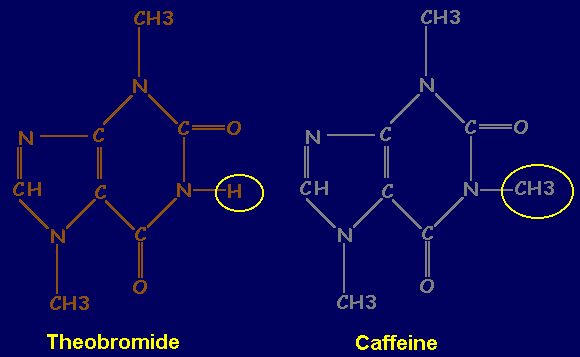 Theobromine,
which is a weak stimulant, is present in relatively high amount in
chocolate. Theobromine has the following properties:
Theobromine,
which is a weak stimulant, is present in relatively high amount in
chocolate. Theobromine has the following properties:
~50% in bloodstream after 6 to 10 hrs
~increases
feeling of well being
~mild antidepressant
~gentle, smooth, sensual stimulation
~stimulates
cardiovascular system
~stimulates muscular system
~mild effect on central nervous system
~almost no one is allergic
~not addictive
~mild diuretic and can stimulates the kidneys
~help relax the smooth muscles in the lining of the lungs