 QuikPac
OneStep SARS-CoV Rapid Test
QuikPac
OneStep SARS-CoV Rapid TestLIFE & DREAM
Research Project : SARS-CoV diagnosis within 15 mins
QuikPac
OneStep SARS-CoV Rapid Test
1. Infection Disease Diagnosis : SARS-CoV diagnosis
 |

自從2002年底
廣東省爆發大規模的「非典型肺炎」以來,今年二,三月初相同的病例報告陸陸續續在香港,
越南,加拿大等地發生。世界衛生組織(WHO)於三月十五日緊急發出全球的警訊,稱之為「嚴重急性呼吸道症候群」(Severe
Acute Respiratory Syndrome) 簡稱
SARS。其病徵特點為發生瀰漫性肺炎及呼吸衰竭,且較過去所知病毒、細菌引起的非典型肺炎嚴重。目前已知引起這次非典型肺炎的元兇是新型的變種冠狀病毒,此病毒稱之為
SARS-Associated
Coronavirus (SARS-CoV)。 在臨床上,經常引起普通感冒或傷風的人類冠狀病毒是
HCoV-OC43 以及
HCoV-229E 兩個不同的病毒株。但這次出現的新型冠狀病毒--SARS-CoV
冠狀病毒,其不僅會衍生上呼吸道感染,也會導致嚴重的下呼吸道感染引起非典型肺炎的併發症。在醫學界最新掌握的資料發現,SARS-CoV,亦會令體內的免疫系統失調,出現非常強烈的免疫反應,過多的細胞激素
(Cytokine) 引發大量巨噬細胞(macrophage)的繁殖增生,巨噬細胞會吞噬其他各種血球細胞,造成血球的過度破壞,導致所謂的噬血症候群(hemophagocytic
syndrome)。 |
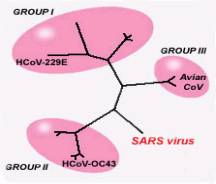
SARS 已引起全球性嚴重的感染問題,因此當務之急是如何及早偵測預防與治療。所以檢測試劑、疫苗與抗病毒藥物的設計與開發就益形的重要與刻不容緩。 最近在全球科學家的共同努力下,SARS-Associated Coronavirus (SARS-CoV) 的基因體已完成定序, SARS-CoV共有29,751 bp,此病毒與目前已知的冠狀病毒, 包括人類冠狀病毒 HCoV-OC43 以及 HCoV-229E 只有少部分的相關性,而病毒蛋白體 (包括replicase 1A, membrane glycoprotein, Nucleocapsid及spike glycoprotein) 的序列分析,也顯示出SARS-CoV 和目前已知的三個冠狀病毒族群的相似性不高,故暫時將 SARS-CoV 劃分在第四個族群(Fig. 1)。
Fig.
1 SARS-CoV is distant related to other three groups in Coronaviridae and can be
divided as a new group IV coronavirus.
冠狀病毒的
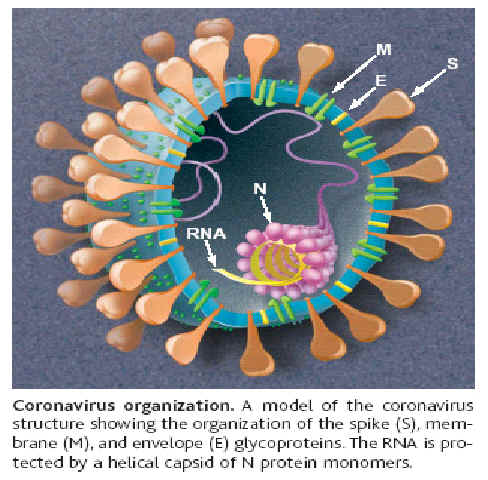
envelope
主要包括三個
glycoprotein:
S
– Spike Protein: receptor binding, cell fusion, major antigen
E
– Envelope protein: small, envelope-associated protein
M–
Membrane protein: transmembrane – budding and envelope formation
另外在第二族群的冠狀病毒還有
HE
– Hemagglutinin Esterase 其和
Influenza C virus 的
HE
相似。但 SARS-CoV
基因體中的病毒蛋白卻沒有 Hemagglutinin Esterase 。此外,病毒之單股RNA會被 nucleocapsid protein (N protein)
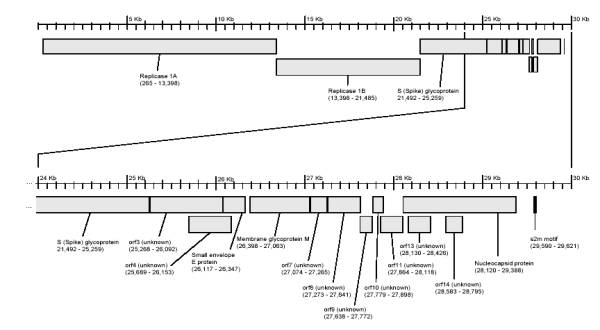
所包覆。Fig. 2是 SARS-CoV, Tor2
病毒株基因體中病毒蛋白之相關圖譜。以下就針對各個病毒蛋白質做簡略的介紹其功能與特性:
Fig.
2 Map of predicted Orfs and s2m motif in the Tor2 SARS virus genome sequence
1. The replicase1a (265-13,398 bp) and 1b Orfs (13,398-21,485 bp) occupy 21.2 kb of the SARS virus genome. Conserved in both length and amino acid sequence to other coronavirus replicase proteins
2. The
S (Spike glycoprotein) (21,492-25,259 bp) encodes a surface projection
glycoprotein precursor predicted to be 1,255 amino acids in length. Mutations in
this gene have previously been correlated with altered pathogenesis and
virulence in other coronaviruses. In some coronaviruses, the mature spike
protein is inserted in the viral envelope with the majority of the protein
exposed on the surface of the viral particles. It is believed that three
molecules of the Spike protein form the characteristic peplomers or corona-like
structures of this virus family. TMHMM reveals a strong transmembrane domain
near the C-terminal end. Together these data predict a type I membrane protein
with the N-terminus and the majority of the protein (residues 14-1195) on the
outside of the cell-surface or virus particle, in agreement with other
coronavirus spike protein data. Supporting this conclusion, it has recently been
shown that for HCoV-229E virions, residues 417-546 are required for binding to
the cellular receptor, aminopeptidase N. However it is known that various
coronaviruses use different receptors, hence it is likely that different
receptor binding sites are also used.
3.
Orf 3 (25,268 - 26,092) encodes a predicted protein of
274 amino acids that C-terminus and a large 149 amino - terminal domain would be
located inside the viral or cellular membrane. The C-terminal (interior) region
of the protein may encode a protein domain with ATP-binding properties.
4.
The small envelope protein E (26,117 - 26,347) encodes a
predicted protein of 76 amino acids. BLAST and FASTA comparisons indicate that
the predicted protein exhibits significant matches to multiple envelope
(alternatively known as small membrane) proteins from several coronaviruses.
PFAM analysis of the protein reveals the predicted protein is a member of the
well-characterized NS3_EnvE protein family. This protein is a component of the
viral envelope, and conserved sequences are also found in other viruses,
including gastroenteritis virus and murine hepatitis virus. We note that in some
coronaviruses such as transmissible gastroenteritis coronavirus (TGEV) the E
protein is essential for virus replication.
5.
Membrane
Glycoprotein M (26398-27063) encodes 221 amino acids. BLAST
and FASTA analysis of the protein revealed significant matches to a large number
of coronaviral matrix glycoproteins. The association of the spike glycoprotein
(S) with the matrix localization glycoprotein (M) is an essential step in the
formation of the viral envelope and in the accumulation of both proteins at the
the function site of virus assembly. TMHMM and TMpred analysis both indicate the
presence of three trans-membrane helices, located at approximately residues
15-37, 50-72 and 77-99, with the 121 amino acid hydrophilic domain on the
predicted inside of the virus particle, where it is believed to interact with
the nucleocapsid.
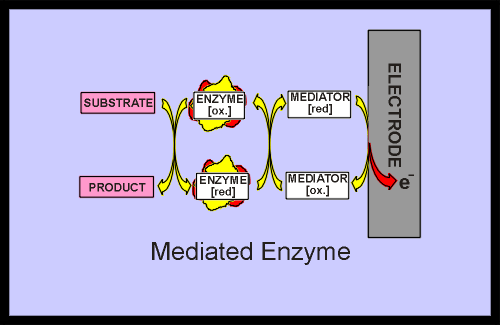
2. Biosensor are analytical devices which use biological interactions to provide either qualitative or
quantitative results

Biosensor =
Bioreceptor + Transducer 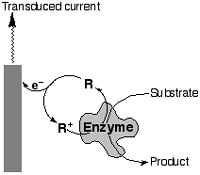
3. DNA-PK (DNA-dependent Protein Kinase) associated protein
The DNA-dependent protein kinase (DNA-PK) is composed of a large catalytic subunit of approximately 470 kDa, DNA-PKcs, and the Ku autoantigen with DNA binding activity (heterodimers of Ku70 and Ku80). DNA-PK is crucial for double-strand break repair and V(D)J recombination with strongly genetic evidence. However, the precise regulatory mechanism of DNA-PK in these process remains to be elucidated. In this report, we present results of identification, molecular cloning and characterization of a novel PHD-finger protein DPKAP (DNA-PK activating protein). DPKAP, its cDNA encodes a polypeptide of 1189 amino acid, is a DNA-binding protein without apparent sequence specificity. Immunoprecipitation experiments demonstrate that DPKAP and DNA-PK coexist in a multiprotein complex. We also show that DPKAP is a efficient in vitro substrate for DNA-PK . In addition, recombinant DPKAP stimulates the kinase activity of DNA-PK and facilitates Ku binding to DNA, promoting assembly of DNA-PK and complexing with DNA-PK bound to DNA. These results demonstrate that DPKAP may be important for stability of DNA-PK complex.
Stem cells are not only units of biological organization, responsible for development and regeneration of tissue and organ system, but also are units in evolution by natural selection. Certain aspects of the stem cell microenvironment, or niche, are conserved between tissues, and this can be exploited in the application of stem cells to tissue replacement therapy.
Classically, stem cells are generally defined as clonogenic cells capable of both self-renewal and multilineage differentiation. Mammalian stem cells have been studied in tissues such as blood and epidermis, where the differentiated cells do not divide and have a short life span. However, stem cells are also present in tissues that normally undergo very limited regeneration or turnover, such as the brain and liver. In early embryos, stem cell self-renewal is less important than the ability to found specific lineages and, paradoxically, it is as a result of differentiation that embryonic stem (ES) cells give rise to the stem cells of adult tissues.
Recently, therapeutic techniques for reconstruction of the ocular surface have been greatly advanced by the introduction of limbal epithelial-cell transplantation and amniotic-membrane transplantation. The therapeutic effectiveness of these two procedures lies in their ability, respectively, to replenish the limbal epithelial-cell population and to restore the limbal stroma that supports the epithelial cells.
The limbal zone is the exclusive site of corneal epithelial stem cells. We have established an innovative method for bioengineered corneas tissue by exo vivo expansion of limbal stem cells on amniotic membrane. Ex vivo expansion of autologous limbal epithelial cells on amniotic membrane provides sufficient limbal epithelial cells for transplantation. The use of autologous limbal epithelial cells grown on amniotic membrane for transplantation has all the benefits of amniotic-membrane transplantation. Moreover, because only autologous cells are transplanted, immunosuppression is not required. On the other hand, transplantation of limbal-tissue allografts is required the prolonged immunosuppression.
The
objectives of this research program are :
1.
To identify and isolate the limbal
stem cell population and to investigate its differentiation signals. Eventually,
the established limbal stem cell strains will be applied for corneal repair.
2.
To assess the feasibility of using specific genetically engineered stem
cells to confer the engineered tissues with desirable phenotype and / or
functions.
visitor

