Biosensor

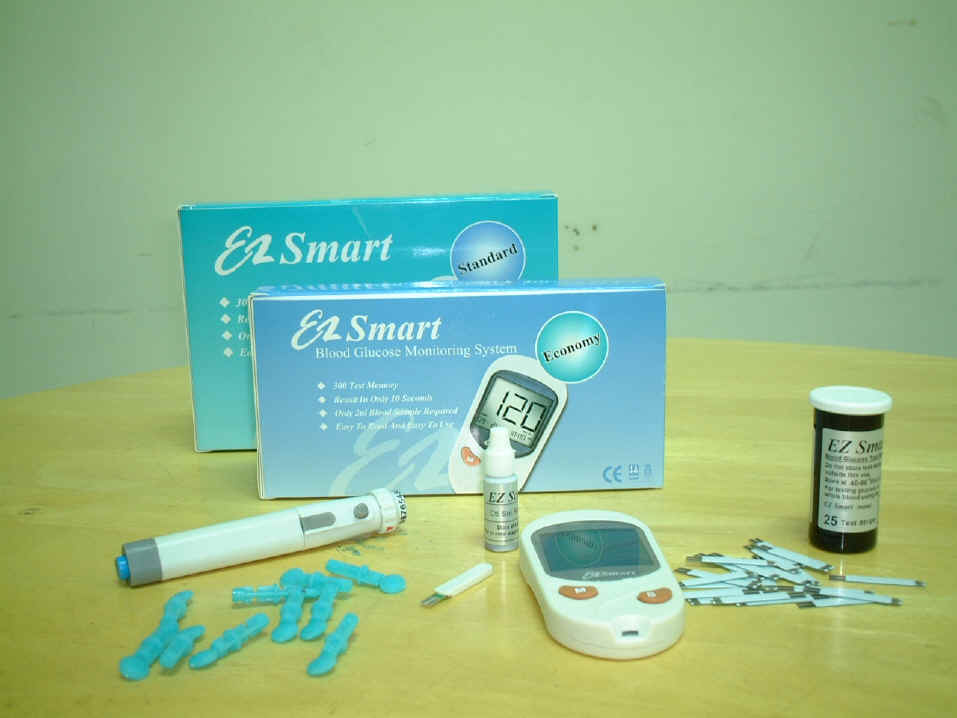
 EZ
Smart - Blood Glucose Monitoring System
EZ
Smart - Blood Glucose Monitoring System
Biosensors
are analytical devices which use biological interactions
to
provide either qualitative or quantitative results
Biosensor =
Bioreceptor + Transducer

Bioreceptor
: a biomolecule that recognizes the
target analyte
(1) Enzyme is capable of recognizing a specific target molecule.
This biorecognition capability of the enzyme is used in biosensors.
(2) Other biorecognizing molecules (= bioreceptors) include antibodies, nucleic
acids,
and receptors.
Transducer
: converts the recognition event into a measurable signal.
(1) A transducer should be capable of converting the biorecognition event into a
measurable signal
(2) Typically, this is done by measuring the change that occur in
the bioreceptor reaction.
(3) For example, the enzyme glucose oxidase (used as a bioreceptor in a
glucose biosensor)
catalyzes the following reaction:
Glucose + O2 --------> Glucosnic acid + H2O2
Considerations
in Biosensor Development
The
major tasks in developing a biosensor for a target analyte and the necessary
skills
involved are:
1.
Selection of a suitable bioreceptor molecule -
Requires knowledge in biochemistry
and biology
2.
Selection of a suitable immobilization method –
Requires
knowledge in chemistry
3.
Selection of a suitable transducer –
Requires
knowledge in electrochemistry and physics
4.
Designing of biosensor considering measurement range, linearity,
and minimization of
interference –
Requires
knowledge in kinetics and mass transfer
5.
Packaging of biosensor
- Once a biosensor has been designed, it has to be put into a
package for convenience
manufacturing and use. The current trend is
miniaturization and mass
production. Modern IC (integrated circuit)
fabrication technology and
micromachining technology are
used increasingly in fabricating
biosensors.
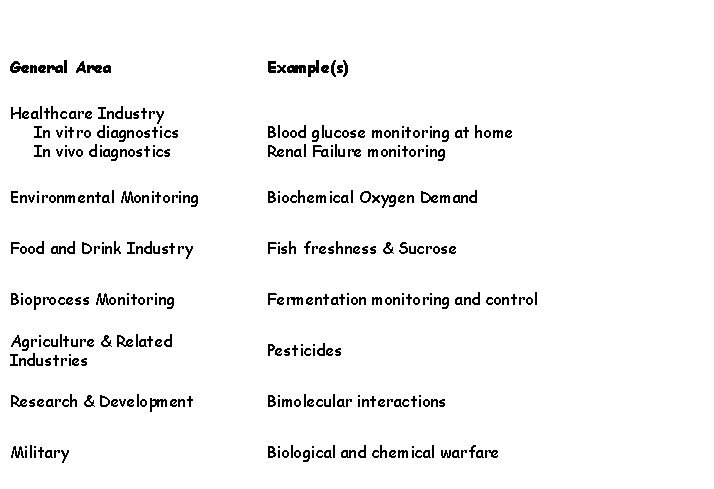
Potential
Applications of Biosensor
Commercial
Requirements for Sensors
To
be commercially successful, a biosensor has to meet the general
requirements
of commercial sensors. These are:
1. Relevance of output
signal to measurement environment
2. Accuracy and repeatability
3. Sensitivity and resolution
4. Dynamic range
5. Speed of response
6. Insensitivity to temperature (or temperature compensation)
7. Insensitive to electrical and other environmental interference
8. Amenable to testing and calibration
9. Reliability and Self-Checking Capability
10. Physical robustness
11. Service requirements
12. Capital cost
13. Running costs and life
14. Acceptability by user
15. Product safety-sample host system must not be
contaminated by sensor
Amperometric
Biosensors
1.
High sensitivity, selectivity, and ability to operate in turbid solutions
are
advantages of electrochemical biosensors.
2.
Amperometric detection is based on measuring the oxidation or reduction
of
an electroactive compound at a working electrode (sensor).
3.
A
potentiostat is used to apply a constant potential to the working
electrode with respect to a second electrode (reference electrode).
First
Generation Amperometric Biosensor
Proposed
by Clark and Lyons and implemented by Updike and Hicks, who coined the term
enzyme electrode
In
the 1970s, Yellow Springs Instruments (Yellow Springs, OH) was the first
company to successfully market an amperometric biosensor

Second
Generation Amperometric Biosensor
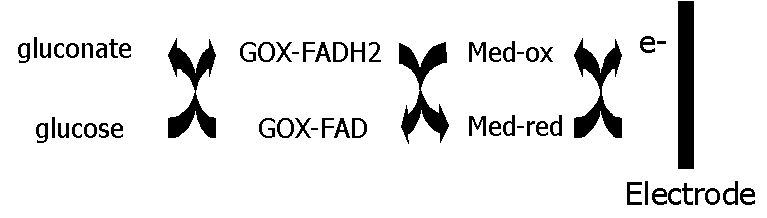
Second-generation
biosensors use an artificial electron mediator,
which
replaces O2 as
the electron shuttle.
Ferrocene,
quinones, quinoidlike dyes, organic conducting salts,
and
viologens have been used as mediators.
Second-generation
biosensors have been commercialized,
mostly
in single-use testing format.
Third
Generation Amperometric Biosensor
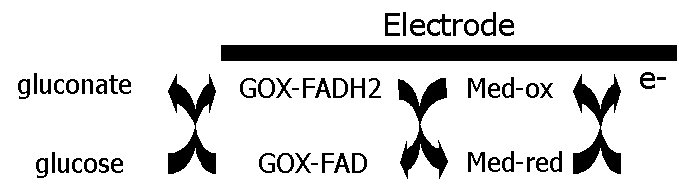
Third-generation
sensors are marked by the progression from
use
of a freely diffusing mediator (O2 or
artificial) to a system
where
enzyme and mediator are coimmobilized at an electrode
surface,
making the biorecognition component an integral part
of
the electrode transducer.
Redox
mediator labeling of the enzyme followed by enzyme
immobilization,
enzyme immobilization in a redox polymer,
or
enzyme and mediator immobilization in a conducting polymer.
BLOOD
GLUCOSE MONITOR COMPARISON CHART
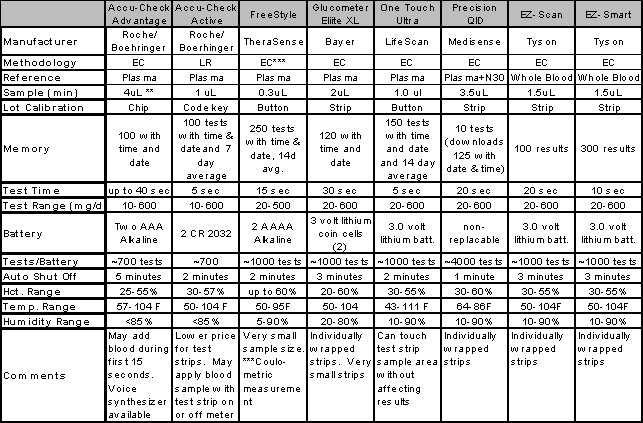
LR=Light Reflectance
EC=Electrochemical (Biosensor)
* Dedicated Health Care
Professional Phone Number
** 4uL With "Comfort
Curve" strip. Standard
strip requires 9uL sample
***Alt. Site Testing = May draw blood from arm or thigh
visitor