Stem
Cells : Stem
cells can be stem cells are able to reproduce themselves (Self-renewal)
throughout the life-span of the animal, and they are able to give rise to
differentiated cells (Multilineage Diffrentiation).
Embryonic Stem Cells
Adult
Stem Cells
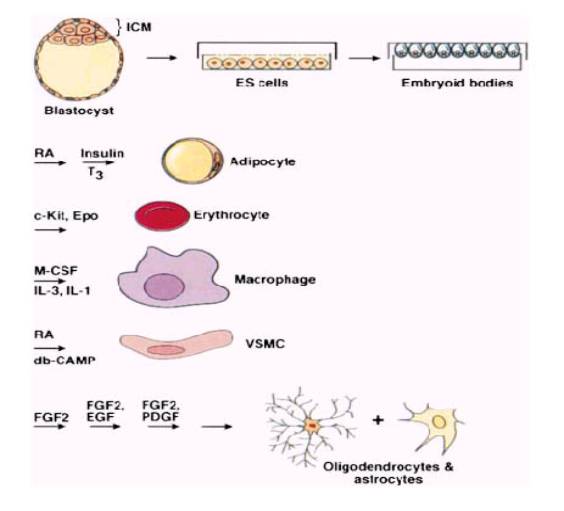
ICM
: Inner Cell Mass of mammalian blastocysts.
ES
: pluripotent Embryonic Stem cells.
It needs the Oct4 and LIF for their pluripotent state
Embryoid
bodies :
When ES withdraw LIF, they differntiate and spawn many cell lineages.
Adult
Stem Cells :
relatively
slow-cycling cells able to respond to specific environmental signals and either
generate new stem cells or select a particular differentiation program
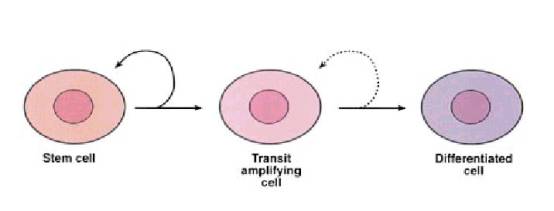
When a stem cell undergoes a commitment to differentiate, it often first enters a transient state of rapid proliferation. Upon exhaustion of its proliferative potential, the transiently amplifying cell withdraws from its cycle and executes its terminal differentiation program
Stem Cells Self-Renew and Differentiate to Give Rise to Transit Amplifying and Fully Differentiated Cells
Stem
Cells Develop and Maintain Their Ability to Self-Renew within a Specific Niche.
Adult
stem cells are often localized to specific niches, where they utilize many but
not necessarily all, of the external and intrinsic cues used by their embryonic
counterparts in selecting a specific fate.
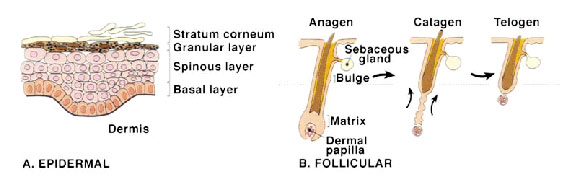
Epidermis
and Hair Follicles.
The
hair follicle represents a major repository of keratinocyte stem cells in mouse
skin, and that follicular bulge stem cells are potentially bipotent as they can
give rise to not only the hair follicle, but also the epidermis.
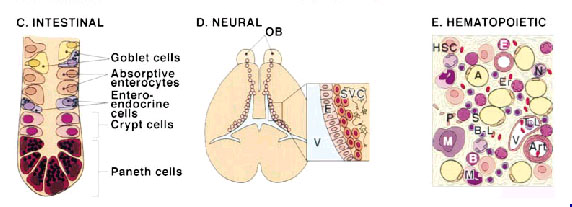
Intestinal
Epithelium.
Multipotent
Neural Stem Cells in the Brain.
Hematopoietic
Stem Cells.
The
Unexplored Area :
1.
To characterize the epithelial stem cells in terms of molecular markers.
2. To establish more in vitro culture systems, like those used for epidermis
, in which the control of stem cell behavior can be investigated in detail.
3. To identify the mysterious environmental factors that control stem cell
behavior, both with regard to self-renewal potential and to the ability to form
particular types of differentiated cells.
Putative molecule, such as alpha-enolase, cytokeratin 15
Prepare
the specific Monoclonal antibody that recognize the limbus cells (cornea stem
cells)
(1) Use the limbus cells lysate for immunization and screening the specific monoclonal antibody (mAb).
(2) The specific mAb is further characterized by immunostaining.
(3) Screening the expression cDNA library with this specific mAb or identify the protein which is
immunoprecipitated with this specific mAb by LC/MS/MS .
Which cytokines are involved between the epithelial cells and the amniotic membrane? PDGF-B, b-FGF, EGF, IL-1, LIF, KGF, EGFR, TGF-b, TGFR…… Up or down regulate
1. Different cell culture microenvironment:
Corneal epithelial cells/ amniotic membrane
Conjunctival epithelial cells / amniotic membrane
Limbal epithelial cells / NIH 3T3 cells
Corneal epithelial cells / NIH 3T3 cells
Conjunctival epithelial cells / NIH 3T3 cells
2. Compare the expression level of cytokines under different cell culture microenvironment
RT-PCR
Northern blot analysis
ELISA
visitor 
