|
|
|
| |
The Pool Lifeguard |
|
| |
|
|
| |
Swimming pools vary enormously both in their size and
layout and in the facilities and activities they provide.But
whether visiting the smallest hotel pool or the largest
multi-featured leisure centre,one thing pool users do expect
is adequate lifeguard provision.
They want swimming pools that are safely managed by smartly
turned-out,well-trained,
qualified lifeguards who will assist and protect them.
What sort of people choose to train as lifeguards?Well,some
will have a background in swimming at various levels.Others
will have taken higher education courses in sports and leisure
subjects.The candidates will be good communicators who ENJOY
HELPING OTHER PEOPLE.They will need to be alert,have good
powers of concentration and have a sense of humour.
The key functions of a pool lifeguard are:
to keep a close watch over the pool and the users
to anticipate problems
to identify emergencies quickly and take appropriate action
to supervise diving or other pool activity when required
to carry out rescues and other emergency action when necessary
to give immediate first aid to any casualty and
to communicate with pool users and colleagues when performing
these tasks. |
|
| |
|
|
| |
 |
|
| |
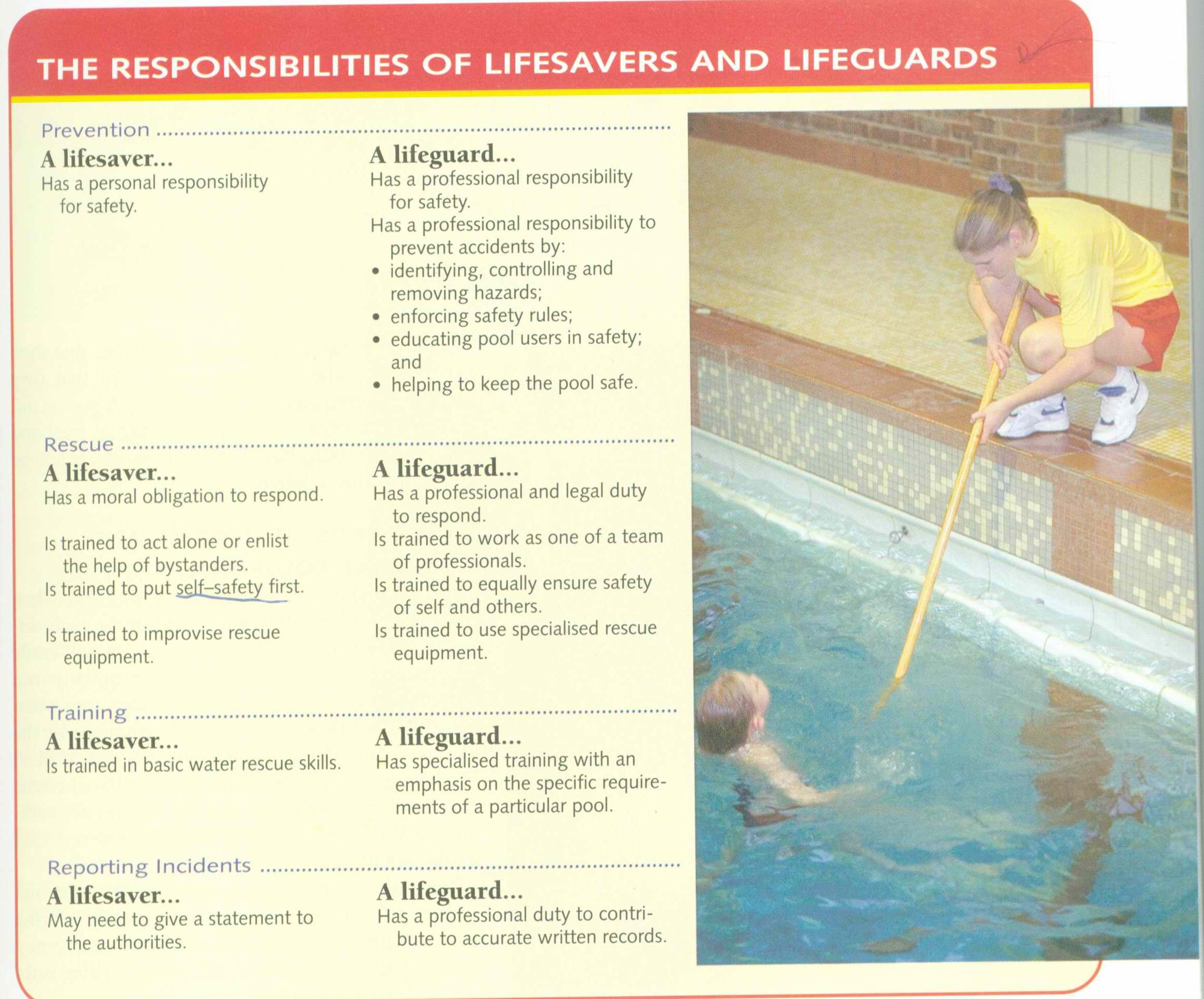
LIFESAVERS AND LIFEGUARDS
Members of the public are often assume the terms(lifesaver)
and (lifeguard) amount to the same thing.But there are important
differences.
Lifesavers are trained bystanders who respond to an emergency
after it has occurred.They usually act alone or enlist the
help of other bystanders,rather than act as part of a team.
Lifeguards,by contrast,are team members trained in accident
prevention,rescue and first aid.They will be on the lookout
for potential dangers or accidents and will take action
to prevent them developing.Lifeguards are responsible for
supervising swimming pools and ensuring the users safety.This
brings them into constant contact with the public and they
have to deal with a wide range of ages,backgrounds and abilities.So,they
are trained to be tolerant,supportive and courteous.And
because they must ensure that pool users follow safety rules.Lifeguards
are also trained to be authoritative when the need arises.This
means Lifeguards are specially trained to deal with incidents
at the pool or seaside where they are working.
Some lifeguards are full-time employees, others work part-time
and some give their time voluntarily.Whether they are full
time,part timers, temporary staff,members or volunteers,.their
role and responsibilities as lifeguards is the same. |
|
| |
|
|
| |
  |
|
| |
|
|
| |
LIFEGUARDS AND TEAMWORK
Teamwork is an essential feature of lifeguarding.As we
have seen,it is one of the things that distinguishes lifeguards
from lifesavers.Obviously,the larger the pool,the larger
the team but however small the venue,lifeguards should always
work with the close support of their colleages.A well-trained
team is more effective than its members would be if they
were working as individuals.In an emergency,secure in the
support of other team members,lifeguards can concentrate
on their allotted tasks.This principle applies to all aspects
of lifeguards work and not just to dealing with emergencies.It
is always possible that lifeguards may themselves get into
difficulties or be injured during a rescue.Then the support
of the team will be essential.That is why team working is
an integral part of lifeguard traning.Sometimes,lifeguards
may have to be on duty alone. I, personally,does not believe
this to be best practice.However,a Risk Assessment may establish
that it is reasonable in certain specific circumstances.
In emergencies,team members can offer support in many ways.These
include:
summoning additional assistance from the emergency services(an
ambulance,for instance) clearing the public from the pool
when recovering a casualty and assisting with CPR cardio
pulmonary resuscitation of a casualty( resuscitation is
more effective when carried out by two qualified persons. |
|
| |
  |
|
| |
Teamwork depends on certain qualities.These include:
good communication skills
willingness to support colleagues
readiness to work for others
being flexible and adaptable
keeping other people informed which is very important.
Good team members always remember that their performance
affects others and accept that they can’t do everything
by themselves.A SUCCESSFUL TEAM is built on a RELATIONSHIP
of MUTUAL TRUST and RESPECT.The importance of teamwork cannot
be emphasized too strongly.Lifeguards should not wear wrist
watches or jewellery (such as ear rings,bracelets or chains)while
they are on duty.Watches or jewellery could injure a casualty(or,for
that matter,the lifeguard)when dealing with an emergency
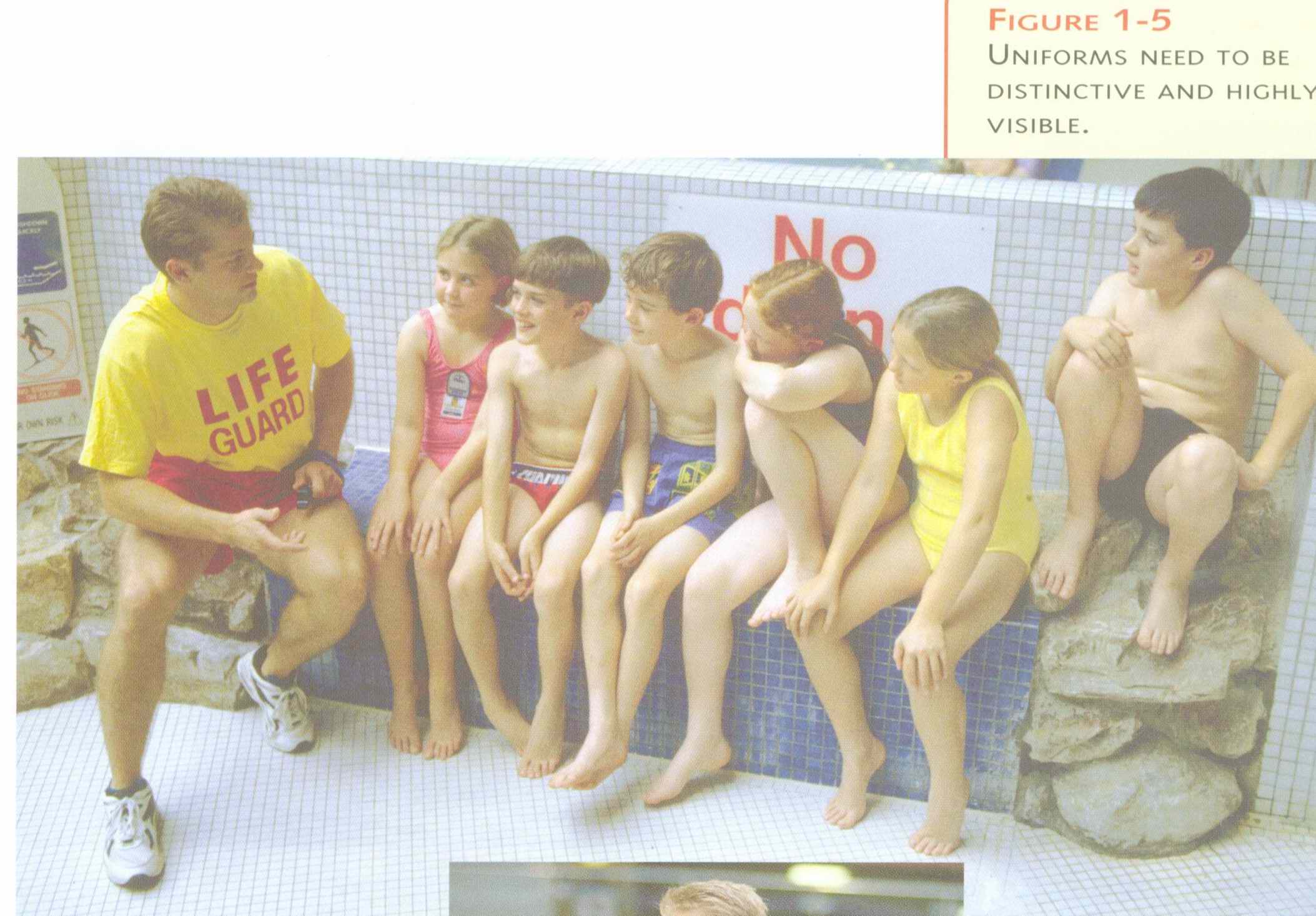
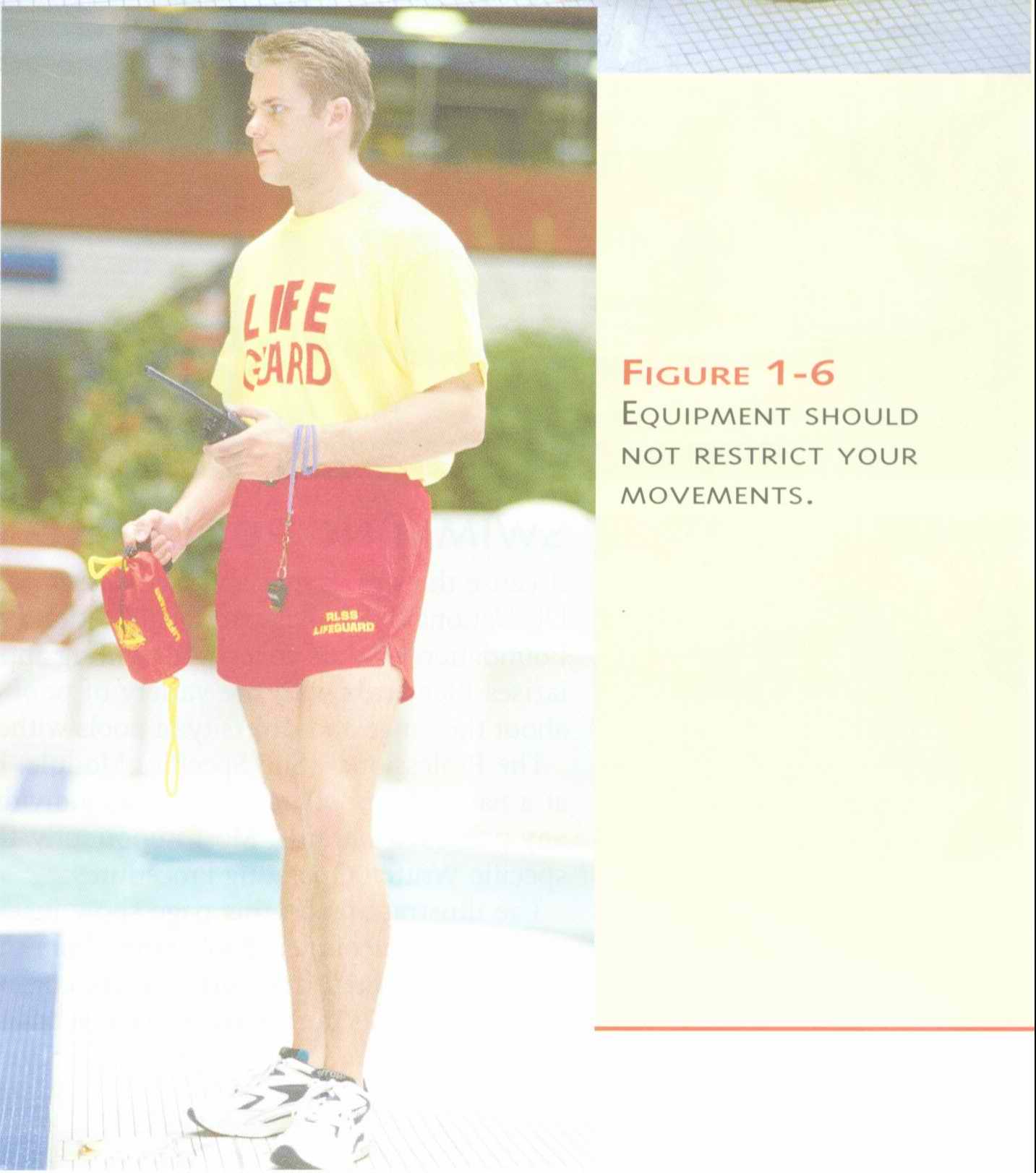
or performing a rescue.Lifeguards on duty usually carry
a few items of personal equipment.The most common is a whistle
to attract pool users or beach swimmers attention and give
signals.Most lifeguards will carry,or keep close at hand,a
throwbag and a torpedo buoy.Sometimes lifeguards also carry
items such as sterile dressings in a waterproof pack and
a resuscitation mask.Whatever personal equipment lifeguards
carry,it must not hinder them or restrict their movements. |
|
| |
 |
|
| |
|
|
|
|