Action below is for relief under 42 U.S.C. §1983 and 42 U.S.C. §1994. District court had jurisdiction provided by 42 U.S.C. §1983, 28 U.S.C. §1343(a), and 28 U.S.C. §1331. District court had jurisdiction to enforce the declaration, 42 U.S.C. §1994, that any attempt by virtue of state law, including orders, to enforce peonage in liquidation of any debt or obligation is null and void.
Order of
Dismissal, Document 16, ER 9-11, was filed on
II. STATEMENT
OF THE ISSUES PRESENTED FOR REVIEW
Was
district court in error in dismissing Roger W. Knight’s claim under
42 U.S.C.
§1983 that the impoundment of his automobile was an unreasonable seizure that
violated the
Fourth and
Fourteenth Amendments?
Was
district court in error in finding that the claims were barred by
Younger abstention[1],
Rooker-Feldman doctrine[2],
and res judicata?
Is
the WorkFirst Act,
RCW 74.20A.320, as applied to
unmodified child support orders entered and to support arrearages accumulated
prior to its passage in 1997, a bill of attainder or an ex post facto law
against parties unable to comply with such support orders prohibited by
Article
I Section 10 clause 1 of the Constitution?
Is freedom from bills of attainder and ex post facto laws a civil right
enforceable under 42 U.S.C. §1983?
Did
Knight state a claim under
42 U.S.C. §1983 that by suspending his driver’s
license solely for noncompliance with a child support order without meeting the
notice requirements of
RCW 74.20A.320(1), the appellees offended his
Fourteenth Amendment due process
right to rely upon the state statute?
Does
the Antipeonage Act,
42 U.S.C. §1994, by including
the word “orders” and declaring such that establish, maintain, or enforce
peonage to be null and void, create a statutory exception to
Rooker-Feldman doctrine,
28 U.S.C. §1738, res judicata, collateral estoppel, and 28 U.S.C. 2283? Does
42 U.S.C. §1994 provide federal courts with jurisdiction independent of any other
statute? Is
42 U.S.C. §1994 authorized
by
Thirteenth Amendment Section 2?
Is
attempting to coerce, by license suspension, Knight’s consent to a “repayment
agreement” when he possesses wealth insufficient to comply with the support
order without employment, declared null and void by
42 U.S.C. §1994?
Was
the district court in error in finding claims and the questions of law upon
which they are based frivolous?
III. REVIEWABILITY AND STANDARD FOR REVIEW
An
order of dismissal is reviewed de novo.
IV. STATEMENT
OF THE CASE
On
V. ARGUMENT
A. Impound Was an Unreasonable Seizure in
Violation of the
Fourth and
Fourteenth
Amendments. Relief is
Available Under 42 U.S.C. §1983.
The
Fourth
Amendment protection against unreasonable seizures of a person’s property is
incorporated upon the States by the Due Process Clause of the
Fourteenth
Amendment.
Mapp v.
The right to search and the validity of the seizure
are not dependent on the right to arrest.
They are dependent on the reasonable cause the seizing officer has for
belief that the contents of the automobile offend against the law.
Knowles v.
(1) the need to disarm the
suspect in order to take him into custody, and (2) the need to preserve
evidence for later use at trial.
As Knight was
not physically impaired when appellee Trooper
Mitchell stopped him on
Nor has
. . .
Here we are asked to extend that “bright line rule” to
a situation where the concern for officer safety is not present to the same
extent and the concern for destruction or loss of evidence is not present at
all. We decline to do so.
A Driving
While License Suspended (DWLS) charge does not require a search of the
automobile, and it was not searched. The
seizure of the automobile was thus not reasonable under
Carroll and
Knowles.
Any interest
that the defendants had in preventing Knight from driving his automobile while
license is still suspended was defeated by the State Officers allowing appellee
Impounding an
automobile that is nonfunctioning or parked where it blocks traffic or
otherwise parked illegally, and where the driver is either unavailable or
incapable of safely operating it, is part of the “community caretaking
functions” of the police.
B
Fourth
Amendment Issue of Impound Not Barred in the Action Below
Exhibit
A to Knight Declaration I, Document 10, ER 50, is a letter informing Knight
that as of
C. Other Claims Not Barred in Action Below
by
Younger Abstention,
Rooker-
Feldman
Doctrine, 28 U.S.C. §1738, Res Judicata,
or Collateral Estoppel
i. State Court Actions and Other Federal
Court Actions
Exhibit B to
Knight Declaration I, Document 10, ER 51-67 is the Decree entered in In re Marriage of Knight,
King County
Superior Court No. 90-3-04471-1 on July 11, 1991. Nothing in this Decree authorizes, threatens,
or provides for the suspension of licenses for nonpayment of child
support.
RCW 74.20A.320 was not added
until
No criminal
charge for DWLS was filed for the incident of
Court: Well the
issue before me was whether or not the case should be dismissed based upon lack
of notice.
This court does not have jurisdiction
to hear collateral issues of whether or not the Legislature is empowered to
adopt the WorkFirst law. That’s a collateral attack on the licensing
scheme that I don’t have jurisdiction to hear that issue. So I’m not going to hear it.
Subsequent to this ruling, Knight filed
Knight v. City of Mercer Island et al, W.D. Wash. No. C02-879L
claiming
Younger abstention
exception. No judgment had been entered in
No. C02-879L when the
Complaint, Document 1, was filed on
Exhibit F to
the Knight Declaration I, Document 10, ER 77-84, is documentation Knight
received for the first time on
Court: Mr. Knight,
let me interrupt you because we need to get started here, and I’m not going to
modify my ruling or Judge Jacke’s ruling from
yesterday, and sounds like you’re very well versed in the statute and, also if
you want to obtain legal assistance as to what other remedies you may have, for
a collateral attack on the scheme, you can certainly do that, but I’m, we’re not
going to hear that here at this Court.
Okay?
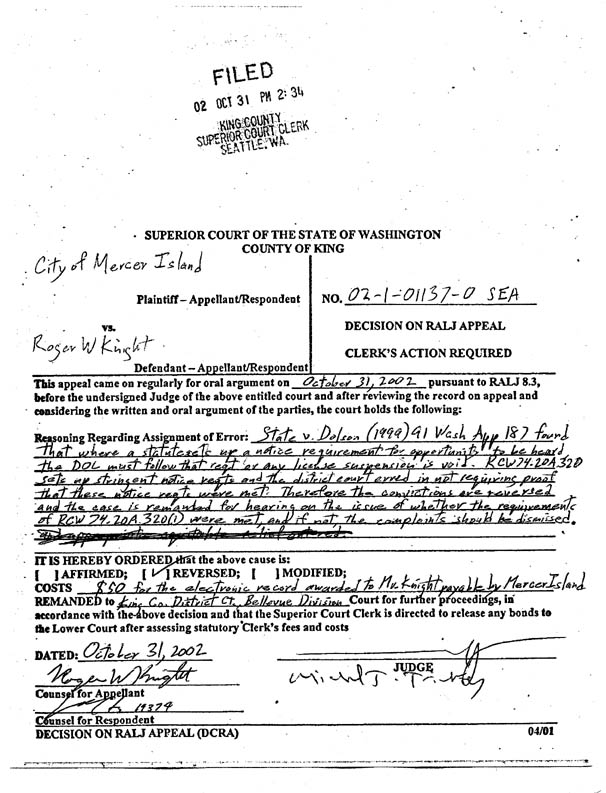
Judge Jacke’s ruling was that her
court in a criminal DWLS trial lacked the jurisdiction to consider whether the
Washington
Department of Social and Health Services (DSHS) met the notice requirements of
RCW 74.20A.320(1) to obtain jurisdiction over Knight to suspend his license for
nonpayment of child support. The
convictions for DWLS were
reversed on
Knight was
charged with DWLS by the City of
Knight v. Maleng
et al, W.D. Wash. No. C00-151Z,
challenged then on-going state court contempt proceedings in In re Marriage of Knight,
King County
Superior Court No. 90-3-04471-1 KNT as declared null and void by the
Antipeonage Act. The
district court found, and
this Court affirmed in
unpublished decision,
No. 00-35625, see attached
memorandum decision, that the federal courts must abstain under
Younger doctrine. Therefore
no decision on the merits of the claim was made in this proceeding. In September 2001, the
state court ceased
attempting to enforce the support order through contempt without entering any
finding on the validity of the enforcement through contempt.
Knight v. Schmitz, et al,
W.D. Wash. No. C00-1874R, challenged the
support order entered in 1991 and the support schedule statute,
chapter 26.19 RCW, as exceeding the state’s interest in the welfare of the child and
offending Knight’s
Fourteenth Amendment right as a parent to make decisions as
to the custody, care, and support of the child, including how much money to
spend, based on
Troxel v.
Granville, (2000) 530
Knight v.
State of Washington, King County Superior Court No. 97-2-21231-6 KNT (Knight
v DSHS I), and Knight v. State of Washington,
King County Superior
Court No. 99-2-22195-8 KNT appealed Washington Court of Appeals Div. 1 No. 46753-1-I
(Knight v. DSHS II) resulting in unpublished decision, challenged the
Washington WorkFirst Act as a multi-subject bill
prohibited by
Article II Section 19 of the
Washington Constitution. No federal issues were raised in these
proceedings.
ii.
Younger
Abstention.
Canatella v.
This court reviews de novo whether abstention is
required.
Green v. City of
Of
course the
Green interference inquiry
presumes the existence of an ongoing state proceeding to be interfered with,
which is precisely what the first prong of the
Middlesex test requires the district court to consider. We consider whether the state court
proceedings were ongoing as of the time the federal action was filed. See
Beltran v. State of
Beltran v.
The third prong of the
Middlesex test requires adequate
opportunity to litigate federal claims in the state proceedings. Without notice sufficient to acquire in personam jurisdiction as required by
RCW 74.20A.320(1),
the plaintiff was deprived by appellee Dennis
Braddock through his agency DSHS of adequate opportunity by means of a petition
for redetermination of administrative decision in a superior
court,
chapter 34.05 RCW subsequent to the hearing provided by
RCW 74.20A.320,
wherein he may challenge the validity of the WorkFirst
Act. In the
Mercer Island DWLS case, the
state court found it lacked jurisdiction to consider these issues on
Ordinarily,
Younger abstention applies where a losing litigant has not
exhausted his state appellate remedies, Dubinka v. Judges of
Superior Court, (9th Cir. 1994)
A similar issue was raised in
Gibson v. Berryhill, 411 U.S. 564, 93 S.Ct. 1689, 36 L.Ed.2d 488 (1973), but we were not required
to decide it because there the enjoined state proceedings were before a biased
administrative body which could not provide a necessary predicate for a
Younger dismissal, that is, 'the
opportunity to raise and have timely decided by a competent state tribunal the
federal issues involved.'
To timely
decide the federal issues involved can only mean before trial in a criminal
case, not on appeal after trial. The
opportunity required for
Younger
abstention as found by
Gibson for
timely decision is not met.
Green v. City of
The Supreme Court has stressed, on the one hand, that
federal courts are obliged to exercise the jurisdiction given to them,
Colorado River, 424 U.S. at 817,[5] .
. . and on the other, that when a case meets the narrow
Younger exception to that general principle “there is no discretion
to grant injunctive relief.”
Having thus
established that there is no discretion to abuse on the question of whether
Younger applies,
Green went on to find, at
Younger doctrine only applies when there is an additional
element absent here: that the federal relief sought would interfere in some
manner in the state court litigation.
That requirement is ordinarily . . . restricts application of the
Younger doctrine to circumstances in
which the state court proceeding is an enforcement action against the federal
court plaintiff, and is not met simply by the prospect that the federal court
decision may, through claim or issue preclusion, influence the result in state
court.
After reviewing
Younger v. Harris
and
Middlesex County Ethics Comm. v.
Garden State Bar Ass’n, (1982) 457
Green
cited and analyzed
New Orleans Public
Service, Inc. v. Council of the City of New Orleans, (NOPSI) (1989) 491 U.S. 350, 105 L. Ed. 2d. 298,
109
Because the necessary elements for
Younger abstention are not present, the district
court is required to exercise its jurisdiction.
Canatella,
supra, at
The district court
determined that Canatella’s
§ 1983 suit was, in
effect, an action to review the California Supreme Court’s final disciplinary
order approving the settlement between Canatella and
the State Bar. The court reasoned that
because Canatella was still on probation, a grant of
his requested injunctive and declaratory relief would effectively nullify the
California Supreme Court’s approval of Canatella’s
probationary status. The court was
rightly concerned that asserting jurisdiction might require review of a final
state court decision, particularly one potentially subject to revision in the
state court system, . . . but this situation no longer
obtains. On
And at the word “moot” is
Footnote 6 on
We note
that even if Canatella were still under the
probationary period,
Rooker-Feldman
would likely not bar Canatella’s claims. His complaint does not request review of the
stayed suspension to which he stipulated with the State Bar, and seeks only
prospective relief. Nor does the
complaint request review of the probationary sentence. . . .
Prospective injunction and declaratory relief in the current action thus
does not appear to require review by the district court of the final California
Supreme Court order approving Canatella’s
discipline. We do not read Canatella’s complaint to be a “skillful attempt to mask the
true purpose of the action, which essentially is to reverse the decision of the
Supreme Court of [
Likewise, prospective injunctive relief requiring the State
Officers to restore the driver’s license would not have invalidated the
convictions for DWLS as it would not affect the previous status of the license. As these convictions were reversed on appeal,
Knight Declaration II and its
Exhibit J, Document 14, ER 42-45, and dismissed
with prejudice on remand, review of Knight’s “claims no longer raises the
specter of review of a final state court decision, and the question of whether
Rooker-Feldman applies is moot.”
As state court
found that it lacked jurisdiction to consider the issues of whether
RCW
74.20A.320 as applied to the plaintiff is invalid in the DWLS case, finding partially
affirmed on appeal,
Knight Declaration II page 2, ER 43, lines 1-4, there is no
appellate review of a decision not made by the state court. Olson Farms, Inc. v. Barbosa, (9th Cir. 1998) 134 F. 3d. 933, 937 paraphrasing Robinson v. Ariyoshi,
(9th Cir. 1985) 753 F. 2d. 1468, 1472:
(Where state court refused to decide federal issue,
our decision of that issue will not be review of state court decision and will
not be barred on jurisdiction or res judicata grounds.)
Neither would
prospective injunction require appellate review of Knight v. DSHS I and Knight
v. DSHS II wherein Knight challenged the WorkFirst
Act as a multi-subject bill prohibited by
Article II Section 19 of the
Washington Constitution. He did not
present any federal questions. There is thus
no jurisdictional bar to a federal court action under
28 U.S.C. §§ 1331 and
1343, and under
42 U.S.C. §1983. Dubinka
v. Judges of Superior Court, (9th Cir. 1994)
However, the district court did have jurisdiction to
determine the general constitutionality of the district’s bar rule, because
such review would not require reviewing “a final state-court judgment in a
particular case.”
Feldman, 460
In the
present case, appellants’ complaint does not require the district court to
review a state court decision. In broad
language it challenges the general constitutionality of
Proposition 115. For example, it alleges that the discovery
statutes are not fully reciprocal and that compelled disclosure of information
regarding defense witnesses violates the
Fifth and Sixth Amendments. A district court could easily analyze these
claims without resorting to the state trial courts’ discovery orders in the
pending cases. . . . Therefore, the district court did have
subject matter jurisdiction to hear appellants’ facial challenges to the
constitutionality of
Proposition 115.
Likewise, a consideration of whether the WorkFirst
Act is a bill of attainder or an ex post facto law does not require any review
of any of the state court proceedings cited herein. No state court has ruled on this issue.
iv.
28 U.S.C. §1738.
Migra
v.
It is now settled that a federal court must give to a
state-court judgment the same preclusive effect as would be given that judgment
under the law of the State in which the judgment was rendered. In
Allen v. McCurry, 449
"Indeed, though the federal courts may look to
the common law or to the policies supporting res judicata and collateral estoppel
in assessing the preclusive effect of decisions of other federal courts,
Congress has specifically required all federal courts to give preclusive effect
to state-court judgments whenever the courts of the State from which the
judgments emerged would do so. . . ."
Migra
went on to find, at 465
Hisle v. Todd Pacific Shipyards Corp., (2002)
113
Res judicata bars all grounds for
recovery that could have been asserted, whether they were or not, in a prior
action between the same parties if there is a concurrence of identity in (1)
the subject matter; (2) the cause of action; (3) persons and parties; and (4)
the quality of the persons for or against whom the claim is made. . . .
Rains v. State, 100 Wn. 2d 660, 665, 674 P. 2d 165 (1983). If any single requirement is lacking, the
doctrine does not apply,
International Bhd. of Pulp, Sulphite &
Paper Mill Workers v. Delaney, 73 Wn. 2d 956,
960, 442 P. 2d 250 (1968), and the party invoking the defense has the burden of
proving its applicability.
McDaniels v. Carlson, 108 Wn. 2d 299, 304, 738 P. 2d 254 (1987).
. . .
In considering whether causes of action are the same
for purposes of res judicata,
courts consider (1) whether rights or interests established in the prior
judgment would be destroyed or impaired by prosecution of the second action;
(2) whether substantially the same evidence is presented in the two actions;
(3) whether the two suits involve infringement of the same right; and (4)
whether the two suits arise out of the same transactional nucleus of
facts.
Hayes v. City of
There is no identity of
parties between the appellees and the State of
Hisle at 113
By the same token, the
right to not be targeted by a bill of attainder or held in a condition of
peonage is independent of the right to not be governed by a multi-subject
bill. A bill of attainder or a
requirement to work based upon a debt or obligation is void whether it is
passed as a single subject bill or included as part of a multi-subject bill. Therefore, the claims in this case are not
barred by res judicata
under
Because the original
divorce case was litigated long before the WorkFirst
Act was passed, Knight Declaration I, Document 10, Exhibit B, ER 51-67, it does not preclude any challenge to subsequently
passed legislation.
Shuman v. Dept. of Licensing, (2001) 108
A party seeking to invoke the doctrine of collateral estoppel must prove: (1) the issue decided in the prior
adjudication is identical with the one presented in the second action; . . .
Thompson v. Dep't of Licensing, 138 Wn. 2d 783, 790, 982 P.2d 601 (1999).
The issue raised by Knight in Knight v.
DSHS I and Knight v. DSHS II, his claim that the WorkFirst
Act is void as a multi-subject bill, he did not raise in the Complaint, Document
1. None of the issues raised in this
case are precluded by collateral estoppel under
As to Knight’s
claim, Complaint, Document 1 paragraph 23, that failure to comply with the
notice requirements of
RCW 74.20A.320(1) offended his
Fourteenth Amendment
right to rely upon a state notice statute,
State v. Dolson, (1999) 138
The
State also asserts that Dolson was not prejudiced
because Dolson had actual knowledge of his license
revocation at the time of his 1996 arrest for driving with
a revoked license. The State points out that Dolson
had been convicted of driving without a
license on three separate occasions since the 1990 revocation.
Emphasis
added. Dolson
could have raised the issue of the validity of notice required by statute
during one of the three previous criminal trials for DWLS. Nevertheless,
Dolson at 138
Therefore, 28 U.S.C. §1738 does not bar federal court consideration of
any of the claims.
v. Res Judicata and
Collateral Estoppel With Respect to Other Federal
Proceedings.
Knight v. Maleng
et al, W.D. Wash. No. C00-151Z
affirmed
9th Cir.
No. 00-35625
considered contempt proceedings in a state court and found that the federal
courts must abstain from hearing such a claim under the
Younger abstention doctrine.
Knight v.
Schmitz, et al, W.D. Wash. No. C00-1874R
affirmed
9th Cir.
No. 01-35459
considered whether a new Supreme Court decision could establish a basis that an
old child support order offended the
Fourteenth Amendment and found that the
federal courts lacked jurisdiction to consider such a claim under the
Rooker-Feldman doctrine. Thus no determinations made of the
underlying issues that would have a res judicata or collateral estoppel effect. As they were litigated before the license suspension in September
2001 and did not consider any challenge to a license suspension, they do not
preclude this case.
All
other federal cases which involved Knight were litigated before the passage of
the WorkFirst Act in 1997,
they did not consider license suspension for child support. As all federal cases involving Knight have so
far resulted in unpublished decisions by this Court, they cannot be cited as
precedent in the determination of this case.
Ninth Cir. Rule 36-3 and
Hart v. Massanari,
(9th Cir. 2001)
D.
Ex Post Facto Law Prohibited by
Article I Section 10 Clause 1. Freedom
From Bills of Attainder and Ex Post
Facto Laws is a Civil Right that Can Be
Enforced Under
42 U.S.C. §1983.
The WorkFirst
Act was passed as Laws of Washington 1997 Chapter 58. The child support order was imposed in its
current form upon Mr. Knight in 1991 and has not been modified since. Knight Declaration I, Document 10, Exhibit B,
ER 51-67. On
Where
RCW 74.20A.320(3)
prohibits consideration of inability to comply with a support order. If the parent has not complied with the
support order, the licenses must be suspended, permanently if the parent is
never able to comply. For a pre-existing
support order where the debt was accrued prior to the passage of the statute,
the imposition of such a sanction by irrebuttable
legislative presumption is a bill of attainder.
The subsequent legislation is a legislative, not a judicial,
modification of the pre-existing support order.
A bill of attainder or an ex post
facto law imposes punishment upon a group of persons by legislative action and
without judicial trial. While bills of
attainder are not restricted to criminal punishments, ex post facto laws add a
quantum of punishment to previously committed crimes or define as criminal
previous acts that were not criminal at the time committed.[8]
Cummings v.
Justice Black’s
concurring opinion in
Aptheker v. Secretary
of State, (1964) 378
the ‘marginal effect of adding long guns to the otherwise
exhaustive list of restricted weapons does not amount to punishment for ex post
facto purposes.’
However,
RCW 74.20A.320 does not have
any such “marginal effect” upon parents who previously did not comply with
support orders.
RCW 74.20A.320 applies
to all licenses by directing the state’s agencies to suspend licenses upon a
certification by DSHS that the parent is out of compliance with a support
order. Previously no such threat existed
in any support order or was contemplated in any statute. There is no list of license restrictions to
which the
RCW 74.20A.320 makes a “marginal” addition. It is thus an ex post facto law to the extent
noncompliance with a support order may be considered a crime. It is a bill of attainder whether nonpayment
of child support is considered a crime or not.
Bills of attainder, ex
post facto laws, and laws impairing the obligations of contracts, are
contrary to the first principles of the social compact and to every principle
of sound legislation.
In
Federalist Paper 78, Alexander
Hamilton wrote:
By a limited Constitution, I understood one which contains
certain specified exceptions to legislative authority; such for instance, as
that it shall pass no bills of attainder, no ex post facto laws and the like.
Limitations of this kind can be preserved in practice no other way than
through the medium of courts of justice, whose duty it must be to declare all
acts contrary to the manifest tenor of the Constitution void. Without this, all the reservations of rights
or privileges would amount to nothing.
In
Federalist Paper 84,
The creation of crimes after
the commission of the fact, or, in other words, the subjecting of men to
punishment for things which, when they were done, were breaches of no law, and
the practice of arbitrary imprisonments, have been, in all ages, the favorite
and formidable instruments of tyranny.
While
Freedom
from bills of attainder and ex post facto laws are thus rights that can be
enforced with 42 U.S.C. §1983.
E. Suspending License for Child Support Without Meeting Notice
Requirement of
RCW 74.20A.320(1) Violates
Fourteenth Amendment
Due Process Right to Rely Upon
State Statute and Therefore States a Claim
Enforceable Under
42 U.S.C. §1983.
RCW 74.20A.320(1) reads:
(1) The
department may serve upon a responsible parent a notice informing the
responsible parent of the department's intent to submit the parent's name to
the department of licensing and any appropriate licensing entity as a licensee
who is not in compliance with a child support order. The department shall
attach a copy of the responsible parent's child support order to the notice.
Service of the notice must be by certified mail, return receipt requested. If
service by certified mail is not successful, service shall be by personal
service.
Appellee Dennis Braddock, through his agency
DSHS, failed to successfully complete notice by certified mail and he failed to
accomplish personal service.
United Pacific Insurance v. Discount Co.,
(1976) 15
is in conflict with and therefore has
been overruled by
Weiss v. Glemp, (1995) 127
The priest informed them
that Glemp was having breakfast and asked them to
return later. The messenger responded
that he had “important legal documents . . . and it would only take a second to
make the delivery.” . . . The priest asked them to wait and returned
with a second priest who identified himself in English as Glemp’s
secretary. The messenger told him they
had legal documents for Glemp and would like to see
him. The secretary said Glemp was not available, was not a citizen, and was not
subject to this country’s laws. The
messenger responded that was irrelevant and that he just wanted to deliver the
documents to Glemp.
The secretary asked the messenger and interpreter to leave, and they
left.
The priests’ refusal to take the
papers and demand that the messengers leave, is as much a refusal of “delivery”
as Mrs. Norelius’.
Nevertheless,
Weiss found at
127
or a person of suitable age and discretion, such as Glemp’s secretary who came to the door. That is noncompliance with the statute, an
essential objective of the statute is the requirement that process be actually
delivered to a responsible person.
That
RCW 74.20A.320(1) requires personal service within
meaning of
RCW 4.28.080 absent a successful service by certified mail is
evident from the statute’s language, which does not qualify the definition of
the phrase “personal service”.
State ex rel
Coughlin v. Jenkins, (2000) 102
The
declaration of service by C. Legge on the first page
of Exhibit F to Knight Declaration I, Document 10, ER 77, reads in significant
part:
Then presenting to and leaving the
same with JANE DOE, RESIDENT WHO REFUSED TO GIVE HER NAME 67 125 5’6C/F GRAY
HAIR.
C. Legge goes into somewhat more
detail on the second page, ER 78:
SERVED JANE DOE RESIDENT, WHO REFUSED TO ACCEPT THE
DOCUMENTS, SIGN OR GIVE HER NAME. SHE
SAID SHE WOULD NOT ANSWER ANY QUESTIONS.
No more information is available from C. Legge. Based upon the standards for personal service
set forth in
Weiss, there is no
personal service accomplished by appellee Dennis
Braddock and the DSHS never had in personam
jurisdiction to certify noncompliance with the support order to the
DOL.
Dusenbury v.
However,
where a state statute meets and goes beyond the minimum due process notice
requirements of the
Fourteenth Amendment, the
Fourteenth Amendment requires
that such statutory requirements be met.
Lehr v.
Robertson, (1983) 463
Such
doctrine is a reasonable extension of the void for vagueness doctrine
reaffirmed by
City of Chicago v. Morales,
(1999) 527
F. Claim of Violation of
Antipeonage Act,
42 U.S.C. §1994, While
Enforceable Under
28 U.S.C. §1331,
28 U.S.C. §1343, and
42 U.S.C. §1983
States a Claim for Which
42 U.S.C.
§1994 Provides Federal Court With
Jurisdiction
Independent of Any Other Statute.
It is Authorized by
Thirteenth
Amendment Section 2.
Neither
42 U.S.C. §§1981 nor
1982 have specific language providing jurisdiction to the
federal courts. Yet these statutes were
found enforceable in
Jones v. Alfred H.
Mayer, Co., (1968) 392
The federal
courts thus have jurisdiction granted independently by the
Antipeonage
Act. One construction of the phrase:
“debt or obligation, or otherwise” in
42 U.S.C. §1994 includes child support,
which grants a parent ordered to pay child support an enforceable right. Another construction, that it does not
include child support, would deny such a parent an enforceable right.
The
Antipeonage Act has always been found to be authorized by
Section 2 of the
Thirteenth Amendment,
Civil Rights Cases, (1883) 109
U.S. 3, 20-23, 27 L. Ed. 835, 3 S. Ct. 18.
G.
Antipeonage
Act, 42 U.S.C. §1994, Creates Statutory Exception to
Rooker-Feldman Doctrine,
28 U.S.C. §1738, and
28 U.S.C. §2283.
42 U.S.C.
§1994 reads:
The
holding of any person to service or labor under the system known as peonage is
abolished and forever prohibited in any Territory or State of the United
States; and all acts, laws, resolutions, orders, regulations, or usages of any
Territory or State, which have heretofore established, maintained, or enforced,
or by virtue of which any attempt shall hereafter be made to establish,
maintain, or enforce, directly or indirectly, the voluntary or involuntary
service or labor of any persons as peons, in liquidation of any debt or
obligation, or otherwise, are declared null and void.
This language is adapted from the
original statute at 14 Stat 546, which refers specifically to the system then
existing in
“Our task is to give effect to the
will of Congress, and where its will has been expressed in reasonably plain
terms, that language must ordinarily be regarded as conclusive.”
quoting
Griffin
v. Oceanic Contractors, Inc., (1982) 458
The
Antipeonage Act targets state court orders with the
language “acts, laws, resolutions, ORDERS,
regulations, or usages”. State court
orders are declared null and void, if such orders establish, maintain, or
enforce the service or labor of any person as a peon in liquidation of a debt
or obligation. “To
suggest otherwise . . . ‘is to reject the plain meaning of language’”,
Jones at 392 U.S. 419 quoting
Hurd v. Hodge, (1948) 334
Under the
system known as peonage in
42 U.S.C.
§1994 provides the federal courts with jurisdiction to declare state court
orders null and void to the extent that such orders establish, maintain, or
enforce peonage, because that is the precise right it declares. It thus grants a statutory exception by its independent
grant of jurisdiction to the
Rooker-Feldman
doctrine, 28 U.S.C. §1738, and
28 U.S.C. §2283.
Any finding that it does not is an absurd result, given the inclusion of
the word “orders” in 42 U.S.C. §1994 and that it refers to both pre-existing and
future orders.
42 U.S.C. §1983, which creates an exception to
28 U.S.C. §2283,
Mitchum v. Foster, (1972), 407
Rooker-Feldman is a statutory jurisdictional
doctrine,
Olson Farms,
supra at
Precisely
because
Rooker-Feldman acknowledges that Congress can
provide federal courts appellate jurisdiction to review decisions of state
courts in 28 U.S.C. §1257, it does not preclude Congress from providing through
other statutes such federal court appellate jurisdiction. By including the word “orders” in
42 U.S.C.
§1994, and declaring such that enforce peonage to be null and void, Congress
created an exception to
Rooker-Feldman.
H. Claim that License Suspension for Child
Support is a Sanction for
Previously Insufficient Employment
and is an Attempt to Coerce
Employment in Liquidation of Debt
or Obligation States a Claim for
Which Relief Can be Granted Under
the Independent Jurisdiction of the
Antipeonage Act, 42 U.S.C. §1994. Such Attempt is Declared Null and
Void by
42 U.S.C. §1994.
42
U.S.C. §1994 and the Antipeonage Act as originally
passed, 14 Stat 546, include the phrase: “debt or obligation, or
otherwise”. If Congress had intended an
exception for child support or alimony, or to limit the application to debts
arising from contract, it could have easily written in such language. Limitations to contractual debts are written
explicitly in the imprisonment for debt provisions of some state
constitutions. State v. Lenz, (Ct. App. 1999) 230
If
the language of 42 U.S.C. §1994 does not express the will of Congress in
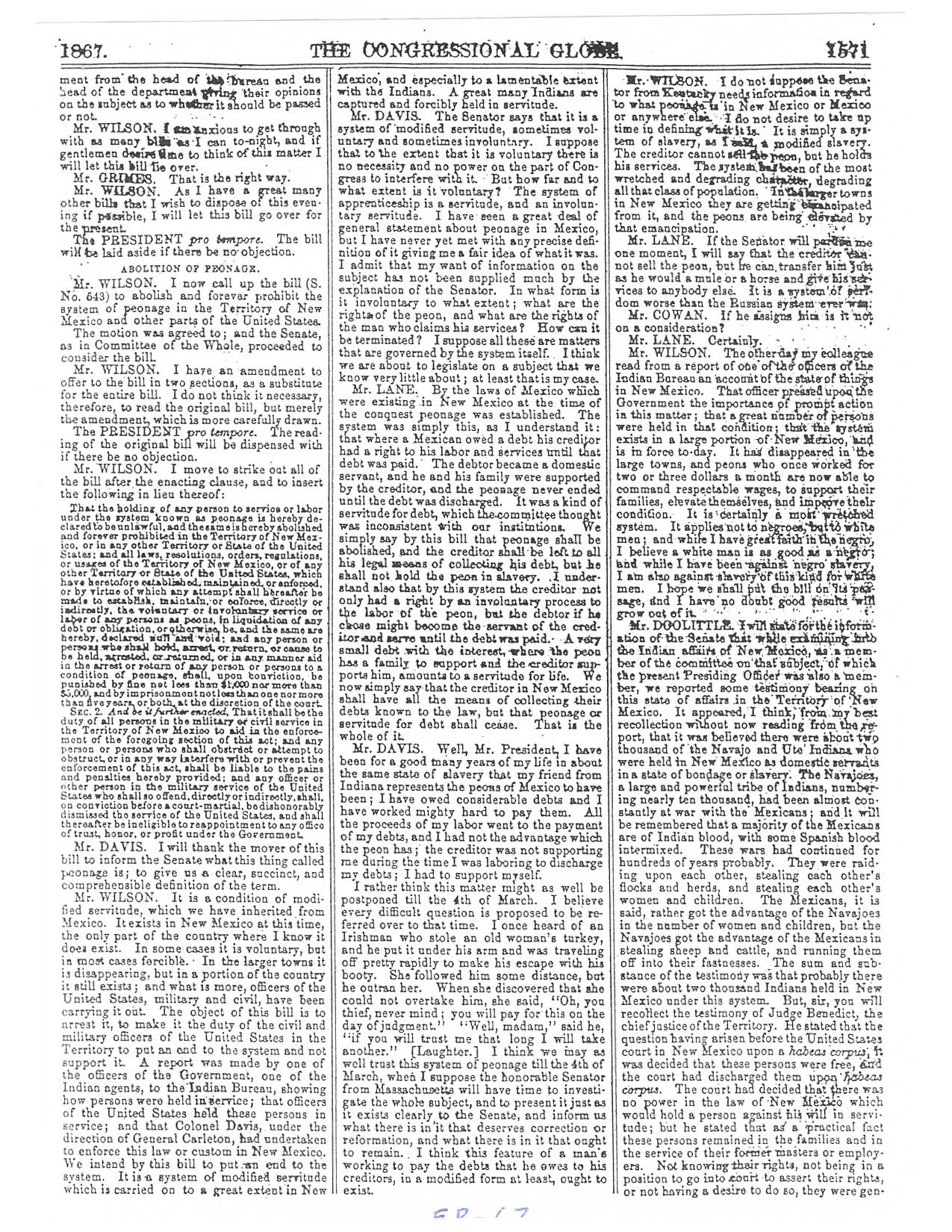
reasonably plain terms, then Senator Lane’s comments recorded in the
Congressional Globe, 39th Cong. 2d. Sess. at p. 1571 about the effects of
The deliberate decision by Congress to not exclude alimony and child support from the Antipeonage Act, as originally passed in 1867, 14 Stat 546, and since as codified as 42 U.S.C. §1994, should be respected by the Courts.
RCW 74.20A.320(5) provides that the DSHS may stay suspension of the license if the parent agrees to a repayment schedule acceptable to the DSHS. This is a clear statutory authorization for the agency to coerce, through a legal sanction not justified by any other consideration, and not related in any way to the activities licensed, including operating motor vehicles, to coerce the employment necessary to comply with a support order. RCW 74.20A.320(9) provides that the DSHS may send a release of the license suspension when the parent is in compliance with the support order. If the parent is unable to comply with the support order, even with employment, RCW 74.20A.320(3) prohibits consideration of ability to comply, then the license suspension is permanent.
This is precisely the type of statutory scheme declared null and void by 42 U.S.C. §1994.
I. Claims
Are Not Frivolous
A complaint is frivolous if “it lacks
an arguable basis either in law or fact.”
Neitzke v. Williams, (1989) 490
Knight’s
construction of the
Antipeonage Act is not only
reasonable, Moss v. Superior Court,
(1996) 56
Knight has
since acted in the good faith belief that a California court decision
construing 42 U.S.C. §1994 does not bind the federal courts, and that the
California Supreme Court’s construction of
42 U.S.C. §1994 conflicts with the
rules of statutory construction for Acts of Congress set forth by numerous
Supreme Court decisions including the decisions summarized in
United States
v. Romo-Romo, (9th Cir. 2001)
Therefore,
the claims presented by Knight are not frivolous.
For
the reasons stated herein, the Order of Dismissal, Document 16, ER 9-11, the
Judgment, Document 17, ER 8, and the
Order, Document 21, ER 6-7 should be
reversed or vacated and this case be remanded for further proceedings
consistent with such reversal.
Respectfully submitted this 3d day
of February, 2003,
_________________________________
Roger
W. Knight, appellant pro se
[2]
Rooker v. Fidelity Trust Co., (1923) 263
[3] Example:
1935 Nuremberg Laws deprived Jews of their
German citizenship, and the rights and privileges thereof, including licenses
to operate automobiles.
[4] Example:
[5]
[6] Entire bill or initiative void as a
multi-subject bill prohibited by
Article II Section 19 of the
Washington
Constitution.
Power, Inc. v. Huntley, (1951) 39
[7] P.O.P.S.
v. Gardner, (9th Cir. 1993)
[8] 18 U.S.C. §228 defines failure to pay child support for a child residing in a different state to be a crime. If applied to an unmodified child support order that predates its passage in 1993, it too is a bill of attainder and an ex post facto law, where the parent is unable to pay the pre-existing debt.