WESTERN DISTRICT OF
WASHINGTON AT SEATTLE
ROGER W. KNIGHT, )
)
plaintiff, ) No. C02-1641C
v. )
) PLAINTIFF’S SUPPLEMENT TO
RONAL W. SERPAS, Chief of the ) RESPONSE TO ORDER TO SHOW
Washington State Patrol, NESSAN ) CAUSE
MITCHELL, Trooper of the Washington )
State Patrol, FRED STEPHENS, Director )
of Department of Licensing, DENNIS )
BRADDOCK, Secretary of Department )
of Social and Health Services, )
GARY LOCKE, Governor of Washington, )
and BETHEL G. & LOUISE CLARK, d.b.a. )
CLARK’S TOWING, a sole proprietor )
doing business in the State of Washington, )
)
defendants. )
____________________________________)
SUPPLEMENT
TO RESPONSE TO ORDER TO SHOW CAUSE
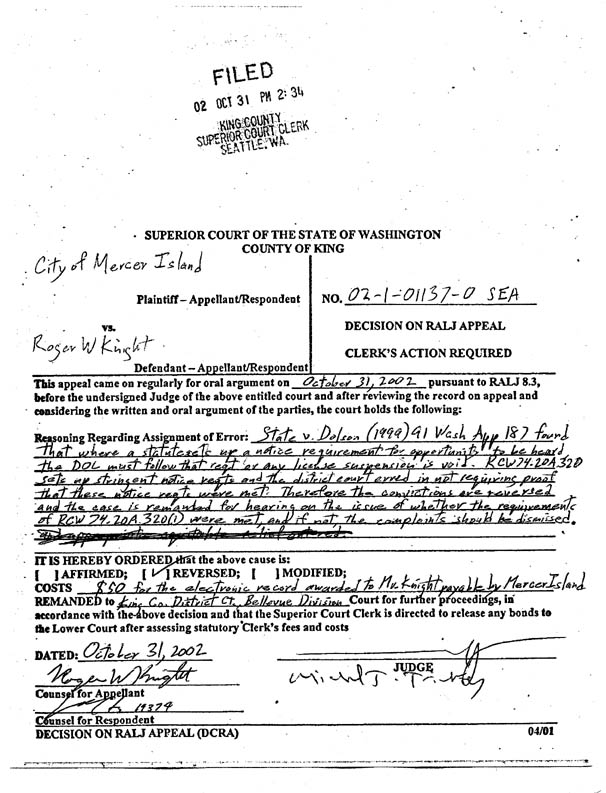
On October
31, 2002, Judge Michael Trickey of the King County Superior Court reversed the
convictions of Mr. Knight of Driving While License Suspended,
City of Mercer Island v. Knight, King
County Superior Court No. 02-1-01137-0 SEA reversing
King County District
Court, Bellevue Division
Nos. 84199 and 84268.
Please see
Declaration by Roger W. Knight in Support of Plaintiff’s
Supplement to Response to Order to Show Cause (Knight Declaration II) and its
Exhibit J,
Decision on RALJ Appeal.
During the hearing, Judge Trickey found that he did not believe that a
court in a criminal DWLS case could hear a challenge to the validity of the WorkFirst Act, either on its face, or as applied to Mr. Knight. Having said that, the court does have
jurisdiction to determine if there was notice sufficient to meet the statutory
requirements of
RCW 74.20A.320(1). After
the Decision was presented to the judge, he crossed out language mandating the
King County District Court to enter appropriate equitable relief in addition to
dismissing the complaints if it is found that the requirements of
RCW
74.20A.320(1) were not met. He explained
that he did not believe that a court in a criminal DWLS case could order the
state agencies to restore the license.
This
does not alter the
Younger abstention
posture of this case. As previously
argued in the
Plaintiff’s Response to Order to Show Cause,
Younger abstention is based on the availability of adequate remedy
at law in an ongoing state court proceeding at the time the Complaint is filed. However, this does have some interesting
Rooker-Feldman and Full Faith and Credit
considerations.
Rooker-Feldman doctrine and
28 U.S.C. §1738 work to preserve state
court decisions in favor of Mr. Knight as well as those decisions against Mr.
Knight. However, any finding that the
state court finds itself unable to make or relief unable to grant is not
covered by
Rooker-Feldman and Full
Faith and Credit. If on remand, the
Bellevue District Court finds that the requirements of
RCW 74.20A.320(1) were
not met, it would dismiss the DWLS complaints as mandated by
King County
Superior Court.
This Court is prohibited
from making any determination different then any such determination by the
state court. However, if the state court
finds it cannot order equitable relief to restore the license or award damages
for depriving Mr. Knight of his driver’s license, a well recognized property
and liberty interest covered by the
Fourteenth Amendment,
42 U.S.C. §1983
provides a court with the authority to grant equitable relief and to award
damages for violating a civil right guaranteed by federal law. The void for vagueness doctrine is that
constitutional due process requires that criminal statutes clearly define what
is illegal, and that a person has the right to rely upon the language of the
statute. In non-criminal statutes, such
as statutes that regulate licensing, a person with a property and liberty
interest in a license has as much due process right to rely upon the language
of the statute, such as
RCW 74.20A.320(1).
Should
the state court system decide that defendants FRED STEPHENS and DENNIS
BRADDOCK, through their agencies, failed to meet the requirements of
RCW
74.20A.320(1) before suspending the plaintiff’s license,
this Court will have
the jurisdiction to order the appropriate equitable relief and to award any
damages found to result from the unlawful suspension of license.
RESPECTFULLY SUBMITTED, November 4,
2002.
____________________________________
Roger W. Knight, plaintiff
If the back button does not take you there, click Home to go to the Index page of this Antipeonage Act Website, click Enemies for the main Enemies page, click Letters for the Letters page, and click Allies for the Allies page. Click C02-1641C to get to the main page for this case. Or you can use the Antipeonage Act Site Map.