| Archaeology
Motorcycling
Travels
Alien
Words
Window
Links
Contact
Home
no self respecting
hooligan,
film
star wannabe, Youth
Congress
activist or milkman was
seen
without one of the
thumping
exhaust singles.
Flash of the
Thumper
Boozo Boz, Johnny the
wild one, Harley Davison
& the Marlboro Man
Screen
Wheels
Diesel Enfields, Mz
and
Nato experiments
Selling
a
Horse in
Donkey's
country
Unqualified and self
taught
mechanics on one hand,
and unscrupulous dealers
on the other
...and
the art of
motorcycleMaintenance.
“Do you have gas
shockers ??
For Enfield Bullet ??
No demand,
doesn't
Sell
A stallion on Viagra?
No just
a Lemon from Bimota
Return of
2-stroke?
|
|
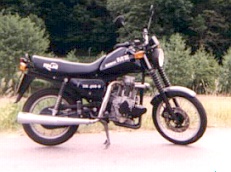
Selling a Horse
in Donkey's country
I
just couldn’t sell my bike.
Broke and
compelled by circumstances to remain stuck in Auroville in Pondichery,
I decided to sell Marmalade, my trusty Enfield 350. So the next few
days
Xeroxed sheets of paper heralding a god sent opportunity to own a
unique
orange motorcycle found themselves pasted all over the commune. Soon a
steady stream of visitors started trickling to my quarters, enduring my
sales talk and subjecting the bike to every possible molestation
imaginable.
Yet, in spite of everything, I was not getting even a fraction of the
price
I would have commanded in Delhi. The only outcome of the entire
exercise
was that a French “girl on a motorcycle” who accompanied one of her
potential
buyer friends and my own ridding companion almost scratched each others
eyes out, after I slipped of with her with the excuse of checking out
her
own bike. The lady left of in a huff and my companion a few
days later, leaving me alone with faithful Marmalade, still standing
unsold.
If there is a moral in this story it will be “don’t try selling a horse
in a donkey country.” In my case it was an Petrol Enfield in a Lombardini
country.
Immaculately
maintained Marmalade (okay,
okay,
I know that the crank seized after two weeks, but it is beside the
point)
was of no value in a place dense with diesel two wheelers. Enfields,
Soorajs
and a motley collection of converted machines each powered by the same
pump/generator - Greeves Lombardini 325, distinctive in its clatter and
providing not less a mileage than 60 kilometres per litre of diesel.
Not
since Gujarat where every milkman is mounted on one, did I see such a
concentration
of oil-burning motorbikes. Hence, it was also here that I took my first
ever diesel bike ride. A neighbour wanted to buy a used machine and
asked
me to check out one example of the Enfield kind, which I did and
frankly
confessed that I couldn’t really make out anything from the experience.
Strapping an oil burner on
a rolling
bike chassis
for economy, as prevalent it may be here, but it really not a swadeshi
innovation. In the late forties, a chap named F.E.Sidney of
Rottingdean,
somewhere in England, took a prewar Norton model 18 and designed a
direct
injection diesel single to power it. The age wilted grapevine has it
that
the motorcycle manufacturer itself had active interest in the project,
though obviously it amounted to nothing but a single bike that ran on
diesel,
and apparently quite well.
More recently, another promising dieseling
phenomena
which also came to nothing was the French Boccardo, powered by the
engine
of the Citroën Visa AX, the successor of the famed 2CV, mated to a
Guzzi Gearbox. The brain child of designer Louis Boccardo, the last
anyone
heard about the undertaking was that he had been arrested for fraud.
With a history as shaky and
slow as the
bikes
themselves and sans mass production, diesel bikes have nonetheless
continued
to plod along in significant numbers on the roads worldwide. England
probably
having the largest figures after India.
Taking the part of the Lombardini out there
is
the 412 cc Subaru Fuji Robin direct injection single, pumping out 10
bhp
at 3,600 rpm, in place of the peak power of 6.6 bhp of the Indo-Italian
unit. Though fitted on the frames and chassis of countless different
bikes
by enthusiasts, the man responsible for popularising this method of
propulsion
is Paul Holdsworth of Redbreast Industrial Equipment, Northhampton.
Primarily
a seller of small industrial machinery, which includes the Fuji Robin
in
its cement mixer guise, Paul started R.B.Developments for retrofitting
the engine on bikes. Mainly using imported Indian Enfields, he thus
created
a new variation of the British classic. With a small but steady market
for their diesel bikes, R.B.Development also carried out a similar
transplant
on a MZ, not the usurper with the MuZ title, but into a real
pedigreed
Kanden MZ two-stroke. However, unlike their Robin Enfield which retains
the four speed Albion gearbox of the Bullet, for the MZ they opted for
a variomatic transmission, a la Kinetic Honda, which proved more
adaptable
to the stationary and single speed nature of the motor. Attaining
considerable
popularity in Europe, the development of the MZ Robin diesels was then
taken over by Gred Engmann, the German importer of these machines and
the
man responsible for the VanVeen rotary engine motorcycle.
Besides their poor speeds,
another area
that can
be squinted upon in diesel bikes, is the area of engine
development.
Sparing possibly F. E. Sidney, almost all the subsequent moves in this
direction revolved around shoehorning engines manufactured for various
lowly applications into motorcycle frames. The only saving grace being
the work of Dr.Stuart Mcguian and his team from the Royal Military
college
of Silverham of the Cranfied University, who in association of with the
Defense Research Agency of England, developed a diesel two-wheeler for
possible Army applications, in view of the new NATO single fuel
regulation.
Dr. Stuart’s team took the bottom end and the gearbox of our Chenai
Enfield
Bullet, strengthened the casing, fitted a new crank, piston, con road
and
a four valve head with indirect injection and cramed it into an Eric
Cheny
made trail frame. The end result is a 542 cc bike producing 16 horses
at
the back wheel, expandable to 18, with off road capabilities, a top
speed
of 75 mph and acceleration comparable to many conventionally fueled
machines.
Surprisingly the bike has still not made it into production. Wonder why
doesn’t Enfield pick up the tab and start touting Dr. McGuian’s name
with
promises of manufacturing the bike as they had been doing with Fritz
Egli
all these years.
© Ravi J. Deka 2000
|