| Archaeology
Motorcycling
Travels
Alien
Words
Window
Links
Contact
Home
no self respecting
hooligan,
film
star wannabe, Youth
Congress
activist or milkman was
seen
without one of the
thumping
exhaust singles.
Flash of the
Thumper
Boozo Boz, Johnny the
wild one, Harley Davison
& the Marlboro Man
Screen
Wheels
Diesel Enfields, Mz
and
Nato experiments
Selling
a
Horse in
Donkey's
country
Unqualified and self
taught
mechanics on one hand,
and unscrupulous dealers
on the other
...and
the art of
motorcycleMaintenance.
“Do you have gas
shockers ??
For Enfield Bullet ??
No demand,
doesn't
Sell
A stallion on Viagra?
No just
a Lemon from Bimota
Return of
2-stroke?
|
|
Screen Wheels
It
was while sitting idle in Delhi
waiting
for a job call that never came, a friend came over and enthusiastically
stated that he held tickets to a great film. Hearing the name I
recollected
having seen it earlier on video, but still went ahead as it was one
well
worth seeing again, especially in full-size.
Once it
started I sat through the opening
sequence
with a sense of utter Deja Vu and not one effected by memories of
watching
it earlier, but from a recent episode, during which I too had this
strange
feeling of familiarity.
On the screen Mickey Rourke
was riding
across
the Mojave desert, alone on a silver Harley “Low Rider” and stretching
out on both sides of the road was a forest of whirling fans. The
beginning
of “Harley Davidson and the Marlboro Man” had an uncanny similarity of
my own experience of riding from Nagercoil to Tirunevelli at the
southern
tip of the country a few months earlier. Though mounted on an iron
steed
made in Madras (as it was then called) and not Milwaukee, the
surrounding
landscape was equally arid, greyish Cardamom hills lined the western
horizon
separating Kerala from Tamil Nadu, scrubs grew in tuffs on the sandy
red
soil. Occasionally the roads were flanged by the same propeller tipped
white colums of India’s biggest Wind Power farm as in the film. At
times
they stood at a distance, some whirling at top speed others barely
moving.
Like Mickey I too, rode alone as my two
companions
were left far behind and the only other person I discerned on that
stretch
was the pilot of a fighter flying high above, marking his passage on
the
deep blue sky with a thick bushy white tail.
“Harley Davidson and the
Marlboro Man,”
was not
a great film after all; my friend contended, writing it off as an
action
thriller and not a serious biking picture. A person with a newly found
penchant for gaping at movie motorcycles, I didn’t want to disappoint
him
further disclosing that most famous motorcycling films usually have
with
little or no relation to their most dominant attribute. And that the
scores
of films involving screen variants of Hell’s Angles, biker lifestyle
and
motorcycle racing are either “B” grade flicks or made for too select an
audience.
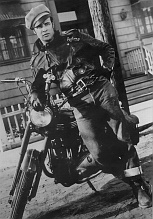
When Marlon Brando as Johnny rode a Triumph
in
the 1954 classic, the Wild One, it was not a picture about
motorcyclists
but about young people rebelling against the society. Thus, Johnny rode
a bike not because he loved them, but because he was portraying an
antisocial
and such was the public opinion at that time about as these machines.
If
a van or a tractor would have been considered uncouth instead, he would
have probably been seen riding one of those.
Concurently, both with tragic endings, the
Silver
Dream Racer, staring one time pop star David Essex and the Knight
Rider,
based on the lives of motorcycle showmen, could prove boring for all
but
the most die hard of motorheads and knights.
The two protagonists of
“Harley....Man”
occurred
to me as a modern-day carry-over of the Billy and Captain America, the
heroes of “Easy Rider,” but in a more action oriented settings.
Detailing
the metaphysical quest for life’s meaning of two friends, played by
Peter
Fonda and Dennis Hopper, ridding Panhead hardtail Harley choppers,
which
ultimately led to a Brothel in New Orleans, the Easy Rider has so
far netted over $50 millions.
I still remember how with an ardour
comparable
to teenagers clandestinely viewing porn, fifteen of us cramped into our
drawing room to watch it for the first time. Our whistles and
Stepphenwolf
starting it off with “Born to be wild” as the duo negotiated their drug
deal to finance their motorcycling quest for truth.
The truth as I discovered, was that the
thirty
years old icon of bikers worldwide has no more to do with motorcycles
than
an average film has with cars even if its leading characters spend half
its duration inside one. Yet, it was the Easy Rider which introduced
Harley
Davidsons in a big way into the celluloid world, resulting in them
becoming
the most photographed two wheelers in the industry.
The theme of Terminator 2,
in spite of
the strong
symbolism of a shotgun wielding and “Fat Boy” riding Arnold
Schwarzenegger,
again had little to do with bikers except that they are the
rowdies
who got bullied by an android from the future who later confiscated one
of their Harleys and rode it through an orgy of violence.
That way Stone Cold featuring American
footballer
Brian “Boz” Bosworth is probably the only film of any consequence which
could effectively combine the two-wheeler element strongly within the
plot.
Highlighting an apocalyptic, Harley riding and drug dealing cult, a
biker
cop (Boz), lots of nudity, raw-edged violence and gut wrenching stunts,
the movie had enough punch to knock me out of a post broken hearted
stupor
and in no time I was back repairing my BSA and drying the leathers in
the
sun.
Interestingly, though the
heroes in both
the pictures
are mounted on Harleys themselves, the bad guys are also the bikers.
Even
when Richard Gere rode a Triumph Bonneville in the Officer and a
Gentleman,
stating that decent people too use motorcycles, the
motorcyclist's
creed still hardly warrants any respectability on the screen. An
organized
sadistic gang taking over a town Mad Max or clumsy buffoons messing up
a cafe during a comic interlude before they get thrown out, Hollywood
had
remained faithful to the trend set by the Wild One.
No denying, whether
presented in the
most unfavourable
light or just as simple transportation, the two wheeled metal horses
invariably
become the show stealers. From lifestyle indicators to sexual and
spiritual
metaphors, motorcycles invoke a rare sense of flamboyance, unmatchable
by any other kind of transport, while the thudding exhausts of a
V twin often manages to do more to a film’s nature then its
entire
sound and music department combined. And Film directors woke up to this
beat long time ago.
© Ravi J. Deka 2000
|