| HOME
| CONTENTS
|
| ABSTRACT
| BACKGROUND
| METHODOLOGY
| CHECKLIST
| DISCUSSION
| APPENDIX
| BIBLIOGRAPHY
|
| Statistical
Analysis | Vegetation Communities |
CHECKLIST OF VASCULAR FLORA
EQUISETACEAE
Field Horsetail
Common Scouring-rush
PINACEAE
White Spruce*
CUPRESSACEAE
Eastern White Cedar
TYPHACEAE
Common Cattail
POTAMOGETONACEAE
Richardson's Pondweed
ALISMATACEAE
Common Arrowhead, Wapato, Duck-potato
HYDROCHARITACEAE
Waterweed, Elodea
GRAMINEAE
Redtop*
Orchard Grass*
Quack Grass*
Meadow Fescue*
Rice Cut Grass
Perennial Rye Grass*
Wire-stemmed Muhly Grass
Witch Grass
Fall Panic Grass*
Reed Canary Grass
Timothy*
Kentuckey Blue Grass
Green Foxtail*
CYPERACEAE
Hop Sedge
Yellow Nut Sedge
Blunt Spike Rush
Black or Dark green Bulrush
Soft-stem Bulrush
LEMNACEAE
Common Duckweed
JUNCACEAE
Path Rush
LILIACEAE
Field Garlic*
Garden Asparagus*
Orange Day Lily*
IRIDACEAE
Little Blue-eyed-grass
SAURURACEAE
Lizard's-tail
SALICACEAE
Trembling Aspen
White Willow*
Sandbar Willow
Crack Willow*
Black Willow
Basket Willow*
JUGLANACEAE
Black Walnut
BETULACEAE
Yellow Birch
ULMACEAE
American or White Elm
Siberian Elm*
URTICACEAE
American Stinging Nettle
POLYGONACEAE
Water Smartweed
Japanese Knotweed or "Mexican Bamboo"*
AMARANTHACEAE
Common Pigweed
CARYOPHLLACEAE
Bouncing Bet, Soapwort*
Common Chickweed*
CERATOPHYLLACEAE
Common Coontail
NYMPHAEACEAE
Fragrant Water-lily
RANUNCULACEAE
Virgin's-bower
MENISPERMACEAE
Moonseed
CRUCFERAE
Garlic Mustard*
Wormseed Mustard*
Dame's Rocket*
Field Pepper-grass*
GROSSULARIACEAE
Wild Black Current
ROSACEA
English Hawthorn*
Wild Strawberry
Rough or Cut-leaved Avens
White Avens
Wild Crab
Apple*
Ninebark .
Rough-fruited Cinquefoil*
Common Cinquefoil
Black Cherry
Pin or Fire Cherry
Choke Cherry
Pasture or Carolina Rose
Wild Red Raspberry
Black Raspberry
Garden or Salad Burnet*
LEGUMINOSAE
Birdfoot trefoil*
White Sweet-clover*
Yellow Sweet-clover*
Black Locust*
Red Clover*
White Clover*
Tufted or Cow Vetch*
GERANIACEAE
Herb Robert*
ANACARDIACEA
Staghorn Sumac
ACERACEAE
Manitoba Maple
Black Maple
Red Maple
Silver Maple
Hard or Sugar Maple
HIPPOCASTANACEAE
Horse-chestnut*
BALSAMINACEAE
Jewelweed, Spotted Touch-me-not
Purple Touch-me-not*
Pale Touch-me-not
RHAMNACEAE
Common or Glossy Buckthorn*
VITACEA
Virginia Creeper
Riverbank Grape
TILIACEAE
Basswood
MALVACEAE
Musk Mallow*
GUTTIFERAE
Common St. John's-wort*
VIOLACEAE
Common blue Violet
LYTHRACEAE
Purple Loosestrife*
ONAGRACEAE
Narrow-leaved Willow-herb
Hairy Yellow Evening-Primrose
HALORAGACEAE
Water-milfoil
UMBELLLIFERAE
Angelica
Wild Carrot, Queen- Anne's-lace*
CORNACEAE
Alternate-leaved Dogwood
Grey dogwood
Red-osier Dogwood
PRIMULACEAE
Whorled Loosestrife
OLEACEAE
White Ash
Red/Green Ash
Common Lilac*
ASCLEPIADACEAE
Common Milkweed
Dog-strangling Vine or Black Swallow Wort*
CONVOLVULACEAE
Hedge Bindweed, Wild Morning-glory
Field Bindweed*
BORAGINACEAE
Viper's-bugloss*
VERBENACEAE
Blue Vervain
White Vervain
LABIATAE
Wild Basil
Motherwort*
Field or Wild Mint
Catnip*
Wild Marjoram*
Heal-all, Self-heal
Heal-all, self-heal*
SOLANACEAE NIGHTSHADE FAMILY
Bittersweet, Climbing Nightshade*
SCROPHULARIACEAE
Butter-and-eggs, Toadflax*
Square-stemmed Monkeyflower
Common Mullein*
Thyme-leaved Speedwell*
PLANTAGINACEAE
English Plantain*
Common or Broad-leaved Plantain*
RUBIACEAE
Wild Madder
CAPRIFOLIACEAE
Tartarian Honeysuckle*
Common Elder, Black Elderberry
Highbush-cranberry
DIPSACACEAE
Teasel*
CUCURBITACEAE
Wild Cucumber
CAMPANULCEAE
Creeping Bellflower*
COMPOSITAE
Wooly Yarrow
Common Yarrow*
Common Ragweed
Giant or Great Ragweed
Common Burdock*
Heath Aster
Heart-leaved Aster
Panicled, Tall White, or Lance-leaved Aster
New England Aster
Nodding Bur Marigold or Nodding Beggarticks
Devil's Beggarticks
Brown Knapweed*
Black Knapweed*
Chicory, Blue-sailors*
Field Thistle
Horseweed
Daisy or Annual Fleabane
Spotted Joe-pye-weed
Grass or Narrow- leaved Goldenrod
Orange Hawkweed, Devils Paintbrush*
Canada Hawkweed
Nipplewort*
Ox-eye Daisy*
Pineapple Weed*
Black-eyed Susan
Tall or Green-headed Coneflower
Canada Goldenrod
Tall or Late Goldenrod
Perennial or Field Sow Thistle*
Tansy, Golden-buttons*
Dandelion*
Goat's-beard*
Oyster-plant, Common Salsify*
Coltsfoot* |
HORSETAIL FAMILY
Equisetum arvense L.
Equisetum hyemale L
PINE FAMILY
Picea glauca Voss
CYPRESS FAMILY
Thuja occidentalis L.
CATTAIL FAMILY
Typha latifolia L.
PONDWEED FAMILY
Potamogeton richardsonii (A.Bennett) Rydb.
WATER-PLANTAIN FAMILY
Sagittaria latifolia Willd.
FROG'S-BIT FAMILY
Elodea canadensis Rich. ex Michaux
GRASS FAMILY
Agrostis giagantea Roth
Dactylis glomerata L.
Elymus repens (L.) Gould
Festuca partensis Hudson
Leersia oryzoides (L.) Swartz
Lolium perenne L.
Muhlenbergia frondosa (Poiret) Fern.
Panicum capillare L.
Panicum dichotomiflorum Michaux
Phalaris arundinacea L.
Phleum pratense L.
Poa pratensis L.
Setaria viridis L.
SEDGE FAMILY
Carex lupulina Muhlenb. ex. Willd.
Cyperus esculentus L.
Eleocharis obtusa (Willd.)
Scirpus atrovirens Willd.
Scirpus validus Vahl.
DUCKWEED FAMILY
Lemna minor L.
RUSH FAMILY
Juncus tenuis Willd.
LILY FAMILY
Allium Vineale L.
Asparagus officinalis L.
Hemerocallis fluva L.
IRIS FAMILY
Sisyrinchium montanum E. Greene
LIZARD'S-TAIL FAMILY
Saururus cernuus L.
WILLOW FAMILY
Populus tremulodies Michaux
Salix alba L.
Salix exuga Nutt.
Salix fragilis L.
Salix nigra Marshall
Salix purpurea L.
WALNUT FAMILY
Juglans nigra L.
BIRCH FAMILY
Betula alleghaniensis Brittton
ELM FAMILY
Ulmus americana L.
Ulmus pumila L.
NETTLE FAMILY
Urtica dioica L spp. Gracilis (Aiton) Selander
SMARTWEED FAMILY
Polygonum amphibium L.
Polygonum cuspidatum Siebold & Zucc.
AMARANTH FAMILY
Amaranthus retroflexus L.
PINK FAMILY
Saponaria officinalis L.
Stellaria media (L.) Villars
HORNWORT FAMILY
Ceratophyllum demersum L.
WATER-LILY FAMILY
Nymphaea ordrata Dryander ex Ation
BUTTERCUP FAMILY
Clematis virginiana L.
MOONSEED FAMILY
Menispemum canadense L.
MUSTARD FAMILY
Alliaria petiolata (M. Bieb.) Cavara & Grande
Erysimum cheiranthoides L. ssp cheiranthoides
Hesperis matronalis L.
Lepidium camperstre (L.) R. Br.
GOOSEBERRY FAMILY
Ribes americanum Miller
ROSE FAMILY
Crataegus monogyna Jacq.
Fragaria virginiana Miller
Geum laciniatum Murray
Geum canadense Jacq.
Malus coronaria (L.) Miller
Malus pumila Miller
Physocarpus opulifolius (L.) Maxim.
Potentilla recta L.
Potentilla simplex Michaux
Prunus serotina Ehrh.
Prunus pensylvanica L.
Prunus virginiana L. spp. Virginiana
Rosa carolina L.
Rubus idaeus L. ssp strigosus (Michx.) Maxim
Rubus occidentalis L.
Sanguisorba minora Scop. Ssp. muricata Briq.
BEAN OR PEA FAMILY
Lotus corniculatus L
Melilotus alba Medicus
Melilotus officinalis (L.) Pallas
Robinia pseudo-acacia L.
Trifolium pratense L.
Trifolium repens L.
Vicia cracca L.
GERANIUM FAMILY
Geranium robertianum L.
CASHEW FAMILY
Rhus typhina L.
MAPLE FAMILY
Acer negundo L
Acer nigrum Michaux f.
Acer rubrum L.
Acer saccharinum L.
Acer saccharum Marshall
BUCKEYE FAMILY
Aesculus hippocastanum L.
TOUCH-ME-NOT FAMILY
Impatiens capensis
Impatiens glandulifera Royal
Impatiens pallida Nutt.
BUCKTHORN FAMILY
Rhamnus cathartica L.
GRAPE OR VINE FAMILY
Parthenocissus inserta (A. Kerner) Fritsch
Vitis riparia Michaux
LINDEN FAMILY
Tilia americana L.
MALLOW FAMILY
Malva moschata L.
ST. JOHN'S- WORT FAMILY
Hypericulum perforatum L.
VIOLET FAMILY
Viola sororia Willd.
LOOSESTRIFE FAMILY
Lythrum salicaria L.
EVENING-PRIMROSE FAMILY
Epilobilum leptophyllum Raf.
Oenothera biennis L.
WATER-MILFOIL FAMILY
Myriophyllum heterophyllum Michaux.
CARROT OR PARSLEY FAMILY
Angelica atropurpurea L.
Daucus carota L.
DOGWOOD FAMILY
Cornus alternifolia L.f.
Cornus foemina Miller ssp. racemosa (lam.) J.S.Wilson
Cornus stolonifera Michaux
PRIMROSE FAMILY
Lysimachia quadrifolia L.
OLIVE FAMILY
Fraxinus americana L.
Fraxinus pennsylvanica Marshall
Syringa vulgaris L.
MILKWEED FAMILY
Asclepias syriaca L.
Cynanchum rossicum (keplov) Borh.
MORNING-GLORY FAMILY
Calystegia sepium (L.) R. Br.
Convolvulus arvensis L.
BORAGE FAMILY
Echium vulgare L.
VERVAIN FAMILY
Verbena hastata L.
Verbena urticifolia L.
MINT FAMILY
Clinopodium vulgare L.
Leonurus cardiaca L. ssp. Cardiaca
Mentha arvensis L. ssp. Borealis (Michaux) R.L.Taylor
Nepeta cataria L.
Origanum vulgare L.
Prunella vulgaris L. spp. lanceolata (Barton) Hulten
Prunella vulgaris L. ssp. vulgaris (Barton) Hulten
NIGHTSHADE FAMILY
Solanum dulcamara L.
FIGWORT FAMILY
Linaria vulgaris Miller
Mimulus ringens L.
Verbascum thapsus L.
Veronica serpyllifolia L. ssp serpyllifolia
PLANTAIN FAMILY
Plantago lanceolata L.
Plantago majora L.
MADDER FAMILY
Galium mollugo L.
HONEYSUCKLE FAMILY
Lonicera tatarica L.
Sambucus canadensis L.
Viburnum trilobum Marshall
TEASEL FAMILY
Dipsacus fullonum L. spp. Sylvestris (Hudson) Clapham
GOURD FAMILY
Echinocystis lobata (Michaux) Torrey & A. Gray
BLUEBELL FAMILY
Campanula rapunculoides L.
ASTER FAMILY
Achillea millefolium L. lanulosa
Achillea millefolium L. spp. millefolium
Ambrosia artemisiifolia L.
Ambrosia trifida L.
Arctium minus (Hill) Bernh. Spp. Minus
Aster ericoides L.
Aster cordifolius L.
Aster lanceolatus Willd. ssp lanceolatus
Aster novae-angliae L
Bidens cernua L.
Bidens frondosa L.
Centaurea jacea L.
Centaurea nigra L.
Cicorium intubis L.
Cirsium discolor (Muhlenb. ex Willd.) Sprengel
Conyza canadensis (L.) Cronq.
Erigeron annus (L.) Pers.
Eupatorium maculatum L.
Euthamia graminifolia (L.) Nutt.
Hieracium aurantiacum L.
Hieracium canadense Michaux
Lapsana communis L
Leucanthemum vulgare Lam.
Matricaria matricarioides (Less.) Porter
Rudbeckia hirta
Rudbeckia laciniata L.
Solidago canadensis L.
Solidago gigantea Aiton
Sonchus arvensis L.
Tanacetum vulgare L.
Taraxacum palustre (lyons) DC. sensu lato
Tragopogon dubius Scop.
Tragopogon porrifolius L.
Tussilago farfara L. |
Statistical Analysis
| Total Families |
62 |
|
| Total Species |
177 |
|
| Total Taxa |
239 |
Percentage of Total Species |
| Native Species |
103 |
58% |
| Non-Native Species |
74 |
42% |
| Provincially Rare Species |
0 |
0 |
Vegetation Communities
Figure
6 describes the location of digital images (Figures 7,8, 9, 10, 11,
and 12) used within this report
to aid in the description of the various vegetation communities observed
within the study area.
From just east of James Street North to the Junction Station an "old
field" type vegetation community is 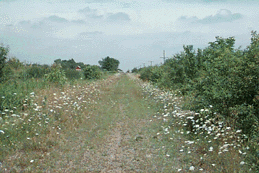
present (Figure 7). Species such as Orchard Grass (Dactylis glomerata),
Timothy (Phleum pratense), Perennial Rye Grass (Lolium perenne), Garlic
Mustard (Alliaria petiolata), Carolina Rose (Rosa carolina), Rough-fruited
Cinquefoil (Potentilla recta), Queen Anne's-lace (Daucus carota), Common
Milkweed (Asclepias syriaca) New England Aster (Aster novae-angliae)Brown
Knapweed (Centaurea jacea), Black Knapweed (Centaurea nigra), Daisy Fleabane
(Erigeron annus), Narrow- leaved Goldenrod (Euthamia graminifolia),
Canada Goldenrod (Solidago canadensis), and Tall Goldenrod
(Solidago gigantea) dominate the area. Shrub and tree species
such American Elm (Ulmus americana), Grey dogwood (Cornus foemina), and
Red-osier Dogwood (Cornus stolonifera) are beginning to invade this
"old field" vegetation community.
Along most of the length of the abandoned rail line and on both
sides of the rail bed is a drainage ditch. This drainage ditch
provides habitat for a variety of wetland vegetation species such as
Field Horsetail (Equisetum arvense), Common Scouring-
rush (Equisetum hyemale), Common Cattail (Typha latifolia), and Reed
Canary Grass (Phalaris arundinacea). This wetland area being quite
small in size is not considered to be a major vegetation community for
the Purpose of this study.
Deciduous forest edge community is the dominant vegetation community
from James Street North to The Sarnia Bridge over 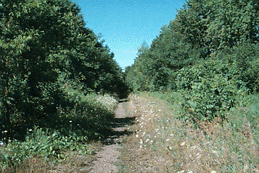 the
North Thames River (Figure 8). A small section of old field community occurs
north of Peel Street North. The deciduous forest edge vegetation
community consists of tree species such as Black Walnut (Juglans nigra),
American Elm (Ulmus americana), White Ash (Fraxinus americana) and Red/Green
Ash (Fraxinus pennsylvanica). Shrub species such as Common Buckthorn
(Rhamnus carartica), Grey dogwood (Cornus foemina), Red-osier Dogwood (Cornus
stolonifera) and smaller young tree species as mentioned above dominate
the lower canopy. Ground Covers as mentioned in the "old field" vegetation
community dominate along the railway bed itself. An invasion of the
nonnative species Dog- strangling Vine (Cynanchum rossicum) has reached
epidemic proportions in this area and threatens to take over much of the
surrounding vegetation.
the
North Thames River (Figure 8). A small section of old field community occurs
north of Peel Street North. The deciduous forest edge vegetation
community consists of tree species such as Black Walnut (Juglans nigra),
American Elm (Ulmus americana), White Ash (Fraxinus americana) and Red/Green
Ash (Fraxinus pennsylvanica). Shrub species such as Common Buckthorn
(Rhamnus carartica), Grey dogwood (Cornus foemina), Red-osier Dogwood (Cornus
stolonifera) and smaller young tree species as mentioned above dominate
the lower canopy. Ground Covers as mentioned in the "old field" vegetation
community dominate along the railway bed itself. An invasion of the
nonnative species Dog- strangling Vine (Cynanchum rossicum) has reached
epidemic proportions in this area and threatens to take over much of the
surrounding vegetation.
Two distinct shoreline vegetation communities were observed along the
Thames River. The first shoreline community is present 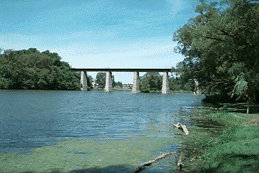 within
the study area under both sides of the Sarnia Bridge and along the eastern
shoreline of the North Thames River to the dam north of the Queen Street
bridge (Figure 9). This riverine swamp type shoreline vegetation
community is dominated by White Willow (Salix alba) and Manitoba Maple
(Acer negundo) trees and shrubs. Ground covers such as American Stinging
Nettle (Urtica dioica), Jewelweed (Impatiens capensis), Purple Touch-me-not
(Impatiens glandulifera), Pale Touch-me-not (Impatiens pallida), and Reed
Canary Grass (Phalaris arundinacea) and semi-aquatic and aquatic species
such as Common Cattail (Typha latifolia), Common Arrowhead (Sagittaria
latifolia), Lizard's-tail (Saururus cernuus), Fragrant Water-lily
(Nymphaea ordrata), Common Duckweed (Lemna minor), Common Coontail (Ceratophyllum
demersum), Richardson's Pondweed (Potamogeton richardsonii), and Elodea
(Elodea canadensis) predominate this vegetation community. The Shoreline
vegetation along the Kinsman Park has been heavily manipulated by man and
thus the only natural vegetation occurs along a narrow band at the water's
edge.
within
the study area under both sides of the Sarnia Bridge and along the eastern
shoreline of the North Thames River to the dam north of the Queen Street
bridge (Figure 9). This riverine swamp type shoreline vegetation
community is dominated by White Willow (Salix alba) and Manitoba Maple
(Acer negundo) trees and shrubs. Ground covers such as American Stinging
Nettle (Urtica dioica), Jewelweed (Impatiens capensis), Purple Touch-me-not
(Impatiens glandulifera), Pale Touch-me-not (Impatiens pallida), and Reed
Canary Grass (Phalaris arundinacea) and semi-aquatic and aquatic species
such as Common Cattail (Typha latifolia), Common Arrowhead (Sagittaria
latifolia), Lizard's-tail (Saururus cernuus), Fragrant Water-lily
(Nymphaea ordrata), Common Duckweed (Lemna minor), Common Coontail (Ceratophyllum
demersum), Richardson's Pondweed (Potamogeton richardsonii), and Elodea
(Elodea canadensis) predominate this vegetation community. The Shoreline
vegetation along the Kinsman Park has been heavily manipulated by man and
thus the only natural vegetation occurs along a narrow band at the water's
edge.
The second shoreline vegetation community could be described as a riverine
limestone pavement flood plain. This vegetation 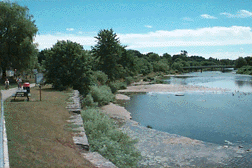 community
is present along the North Thames River from the downstream side of the
dam near Queen Street, to the end of the study area at the tennis court
parking lot (Figure 10). Exposed Dolomite Limestone within the flood plain
provides little habitat for the growth of vegetation. However, where
cracks in the limestone pavement are present, species such as White
Willow (Salix alba), Sandbar Willow (Salix exuga), Crack Willow (Salix
fragilis), Black Willow (Salix nigra) Basket Willow (Salix purpurea), Blunt
Spike Rush (Eleocharis obtusa), and Soft-stem Bulrush (Scirpus validus)
cling to existence. Further up the banks of the North Thames River where
the effects of flooding are less sever and soils are more stable the vegetation
community is much the same as the riverine swamp type vegetation community
described previously. As with the deciduous forest edge vegetation
community an infestation of Dog-strangling Vine (Cynanchum rossicum) is
present along the banks of the limestone flats.
community
is present along the North Thames River from the downstream side of the
dam near Queen Street, to the end of the study area at the tennis court
parking lot (Figure 10). Exposed Dolomite Limestone within the flood plain
provides little habitat for the growth of vegetation. However, where
cracks in the limestone pavement are present, species such as White
Willow (Salix alba), Sandbar Willow (Salix exuga), Crack Willow (Salix
fragilis), Black Willow (Salix nigra) Basket Willow (Salix purpurea), Blunt
Spike Rush (Eleocharis obtusa), and Soft-stem Bulrush (Scirpus validus)
cling to existence. Further up the banks of the North Thames River where
the effects of flooding are less sever and soils are more stable the vegetation
community is much the same as the riverine swamp type vegetation community
described previously. As with the deciduous forest edge vegetation
community an infestation of Dog-strangling Vine (Cynanchum rossicum) is
present along the banks of the limestone flats.
| HOME
| CONTENTS
|
| ABSTRACT
| BACKGROUND
| METHODOLOGY
| CHECKLIST
| DISCUSSION
| APPENDIX
| BIBLIOGRAPHY
|
| Statistical
Analysis | Vegetation Communities |